Vestigial Structures: A Whale’s Hip Bones Anchor Muscles
Short answer
Vestigial structures are body parts that have lost a major ancestral job and are usually much reduced in size. Vestigial does not mean useless. A whale’s pelvis is a frequently cited example: extremely reduced and no longer touching the backbone, it still anchors muscles of the reproductive system, a 2015 survey by Phil Senter and John Moch reports.
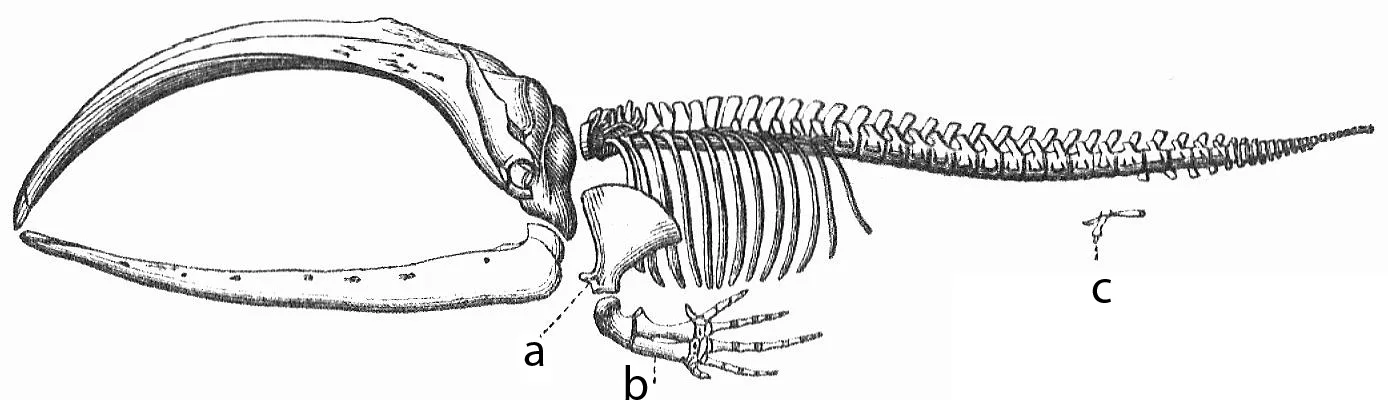
A baleen whale skeleton from an 1888 German encyclopedia. The letter c marks the small remnant of the hind leg, drawn below the backbone and apart from the rest of the skeleton; a marks the shoulder blade and b the flipper.
"Skeleton of a baleen whale, from Meyers Konversations-Lexikon, 4th edition" by Unknown author, Meyers Konversations-Lexikon (1888) — https://commons.wikimedia.org/wiki/File:Whale_skeleton.png — Public domain (US: published 1888, before 1931; EU: anonymous work published 1888, more than 70 years ago)
Whale hip bones are sometimes called useless leftovers, yet muscles still pull on them. A 2014 study of whale and dolphin pelvic bones by J. P. Dines and colleagues noted that the bones are sometimes regarded as useless vestiges of life on land. Then it tested whether mating competition shapes them. Look at the letter c in the drawing above: that small remnant of the hind leg, cut off from the rest of the skeleton, is where this page starts.
What does vestigial mean?
Senter and Moch (2015) give the modern definition in a single sentence: “A vestigial structure is a biological structure that has lost a major ancestral function and is usually drastically reduced in size.” The key word is major, because the same paper states that the term “does not imply a complete lack of any function”: a vestigial structure may keep some other job, a view the authors trace back to Darwin.
Charles Darwin used the term rudimentary organs in On the Origin of Species (1859); the word vestigial came into wide use later, with Wiedersheim in 1895, according to Senter and Moch. In chapter XIII, Darwin described three outcomes. A part can shrink and keep a second job: “An organ serving for two purposes, may become rudimentary or utterly aborted for one, even the more important purpose; and remain perfectly efficient for the other.”
A part can also take on a new task. Darwin’s example was the swim bladder of certain fish, which “seems to be rudimentary for its proper function of giving buoyancy, but has become converted into a nascent breathing organ or lung.” And a part can vanish: “Rudimentary organs may be utterly aborted”, so that no trace is left where a related animal would have one.
Senter and Moch use three tests for a bone, each made against the same bone in related groups. The bone must be extremely reduced (they used one third of its relative size as a cut-off, and call that figure arbitrary), it must have lost its specialised shape, and it must have lost a salient ancestral function.
Every one of those tests first needs the matching bone in a related animal, which is also the first step of the remodel rule, the habit of asking what any odd bone was remodelled from. That matching is how homologous structures are identified in the first place.
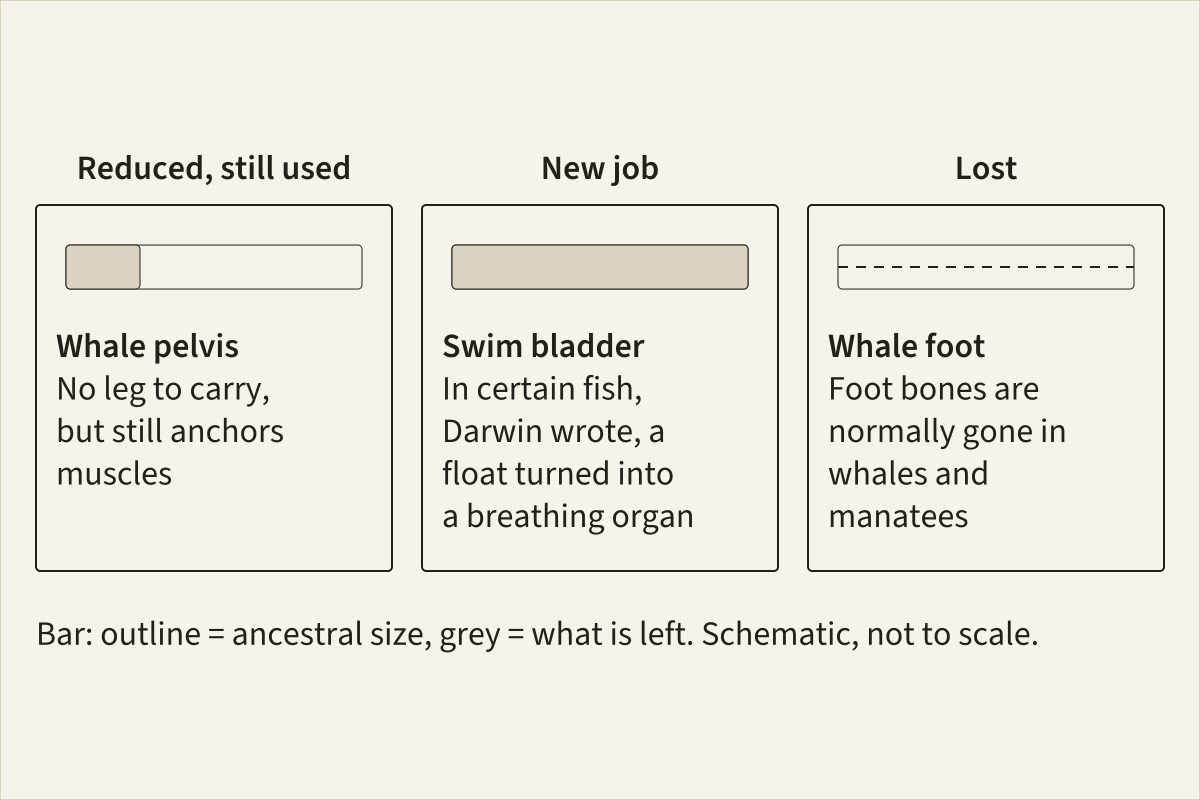
Three outcomes for a part an animal inherits. In each card the outlined bar is the ancestral size and the grey block is what is left. The second card is about a change of job, not of size; in the third card nothing is normally left.
Basis Categories and examples from Darwin 1859 and Senter & Moch 2015; schematic, not to scale.
"Reduced, repurposed or lost: three outcomes for an inherited part" by Feathers, Skeletons & Nests, https://feathersskeletonsandnests.com/skeletons/vestigial-structures/ , licensed under CC BY 4.0, https://creativecommons.org/licenses/by/4.0/
Data: Senter P. and Moch J. G. (2015) A critical survey of vestigial structures in the postcranial skeletons of extant mammals. PeerJ 3: e1439, https://doi.org/10.7717/peerj.1439, CC BY 4.0
Do whale hip bones do anything?
Start with an ordinary land mammal, whose pelvis is made of three bones, the ilium, ischium and pubis, which meet at the hip socket, the acetabulum. The ilium is attached to the backbone, so each push of a hind leg moves the whole spine forward, as Senter and Moch describe the ancestral plan.
In whales that arrangement is gone. The whale pelvis “is extremely reduced in size, has lost contact with the vertebral column, and has lost a distinct acetabulum”, according to Senter and Moch (2015). In baleen whales it is usually a very shallow V. In toothed whales it is typically a straight or slightly curved rod, probably the ischium alone, though earlier anatomists disagreed about which bones it contains.
What the bone still does is anchor muscles. Senter and Moch state that whale pelves “have lost their ancestral locomotor function but still anchor muscles associated with the reproductive system”, citing anatomical work going back to 1881.
Dines and colleagues give the detail. The paired pelvic bones anchor the ischiocavernosus muscles, which control the penis, and in females the same muscles run from the pelvis to the clitoris. In the words of their abstract, the pelvis “seems to serve no other function except to anchor muscles that maneuver the penis” (Dines et al. 2014, p. 3296).
The bones are small for the animal. The scanned pelvic bones shown in the first figure of Dines et al. (2014) are about 11 cm long, roughly 1.3 credit cards laid end to end. The bottlenose dolphin drawn in the same figure, an adult male, is about 3 metres long.
Do whales have leg bones?
Some whales do. Whale embryos grow hind-limb buds, and in toothed whales the buds fade without forming a leg, apart from rare exceptions, Senter and Moch report. In baleen whales a small hind limb is often present. Its shape varies a great deal from one individual to the next.
Typically the bowhead whale keeps a femur (the thigh bone) and a tibia (the shin bone), while humpback and fin whales keep only the femur. The minke whale has a femur in about one third of individuals. The sei whale has none. How whales came to lose their walking legs is the story of whale evolution.
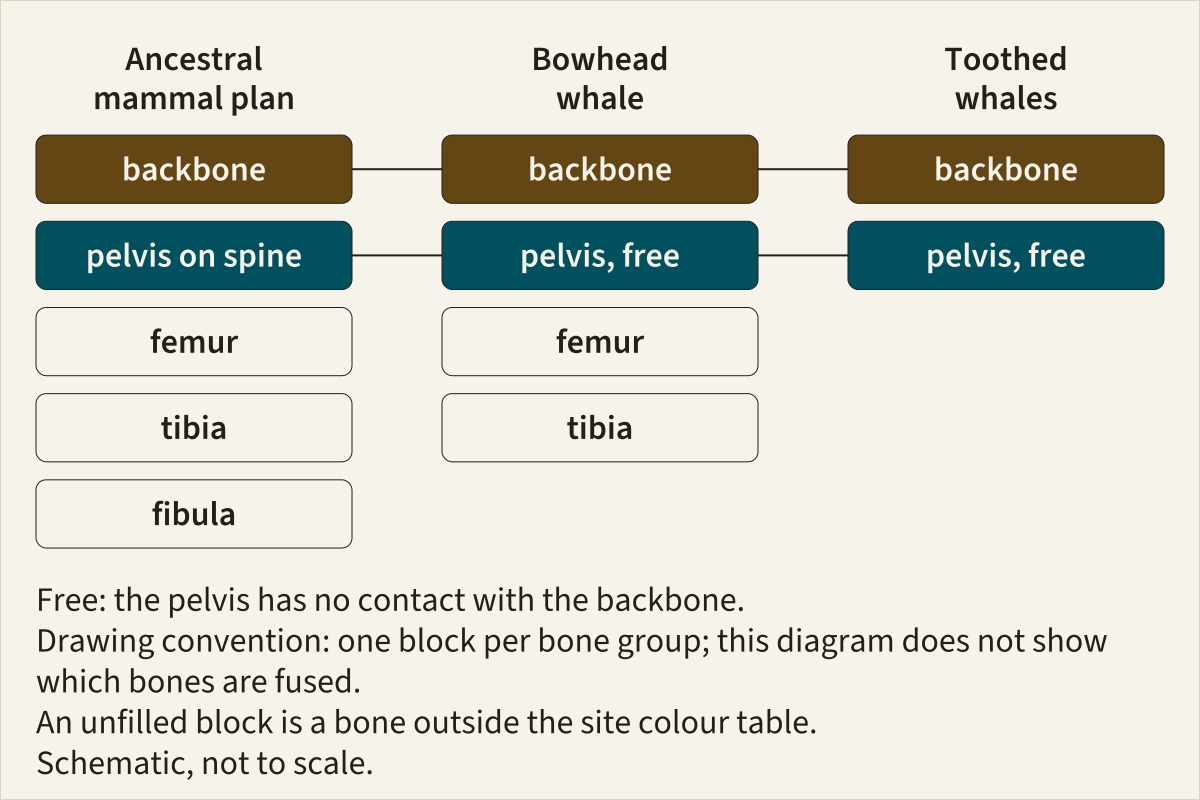
Hip and leg bones, one block per bone group, for the ancestral mammal plan, a bowhead whale and toothed whales. Read across the pelvis row: it sits on the spine in the first column and is free in both whales. A bowhead typically keeps a femur and tibia; toothed whales keep no leg bones, apart from rare exceptions.
Basis Bones kept and lost from Senter & Moch 2015; colours fixed site-wide.
"Hip and leg bones in the ancestral mammal plan, a bowhead whale and toothed whales" by Feathers, Skeletons & Nests, https://feathersskeletonsandnests.com/skeletons/vestigial-structures/ , licensed under CC BY 4.0, https://creativecommons.org/licenses/by/4.0/
Data: Senter P. and Moch J. G. (2015) A critical survey of vestigial structures in the postcranial skeletons of extant mammals. PeerJ 3: e1439, https://doi.org/10.7717/peerj.1439, CC BY 4.0
Why do some whales have bigger pelvic bones?
The 2014 study by Dines and colleagues measured pelvic bones from 130 whales and dolphins of 29 species, held in museum collections, using 3D laser scans. Direct records of mating systems are lacking for most whales and dolphins, so the team used a standard stand-in. Species in which females mate with several males tend to have males with large testes for their body size, and the study used relative testes size as its measure of sexual selection.
The result was clear for the pelvis and absent for the control. Species with relatively large testes had relatively large pelvic bones for their body length, while the first pair of ribs, measured the same way, showed no such pattern. Pelvic shape also differed more between pairs of species that differed in their likely mating system, and female pelvic bones followed the same size pattern as males of their species.
The authors suggest a chain of causes: stronger sexual selection favours a longer penis, which needs larger muscles, which need larger bones to anchor them. They conclude that whale pelvic bones are targets of sexual selection, and that this job may explain why the bones have not been lost.
Not every whale kept the bones, though. Of 92 living whale and dolphin species counted in the 2014 paper, all except two, Kogia breviceps and Kogia sima, keep pelvic bones; those two appear to have sheets of cartilage instead, a point Dines and colleagues take from an anatomical study published in 1901.
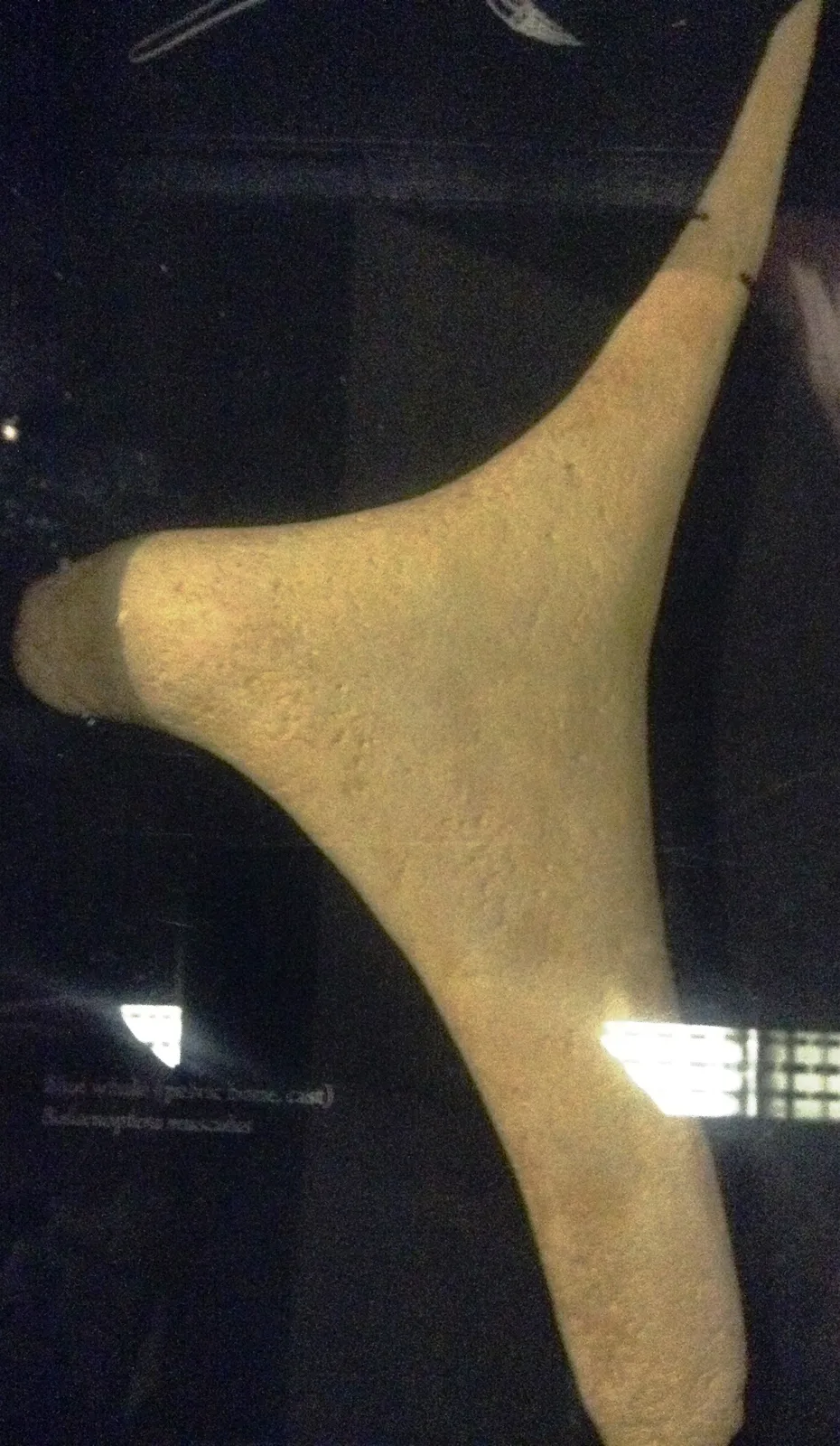
A cast of a blue whale’s pelvic bone in a museum case, with the species name Balaenoptera musculus on the label beside it. Two long arms meet at an angle, with a short third point where they join: the shallow V shape described for baleen whales.
"Blue whale pelvic bone (cast), Beaty Biodiversity Museum" by Nikkimaria — https://commons.wikimedia.org/wiki/File:Blue_whale_pelvic_bone.jpg — CC BY-SA 3.0 (https://creativecommons.org/licenses/by-sa/3.0/)
Which other animals keep reduced bones?
Whales are one case among many. Senter and Moch looked at 578 skeletons and skins from 293 mammal species, and their survey found that the pelvis became vestigial twice, independently: once in whales and once in manatees and dugongs.
A vestigial bone can still work in a smaller role. The horse’s splint bones, its second and fourth metacarpals, no longer act as struts between a toe and the wrist, but they still guide ligaments and give muscles a place to attach.
Darwin listed examples from outside the mammals. Some snakes have “rudiments of the pelvis and hind limbs”, he wrote, and he presumed that the bird’s bastard-wing is “a digit in a rudimentary state”. Which fingers a bird’s wing really holds is its own question, taken up in bird wing bones. The table below gives each example with the source it comes from.
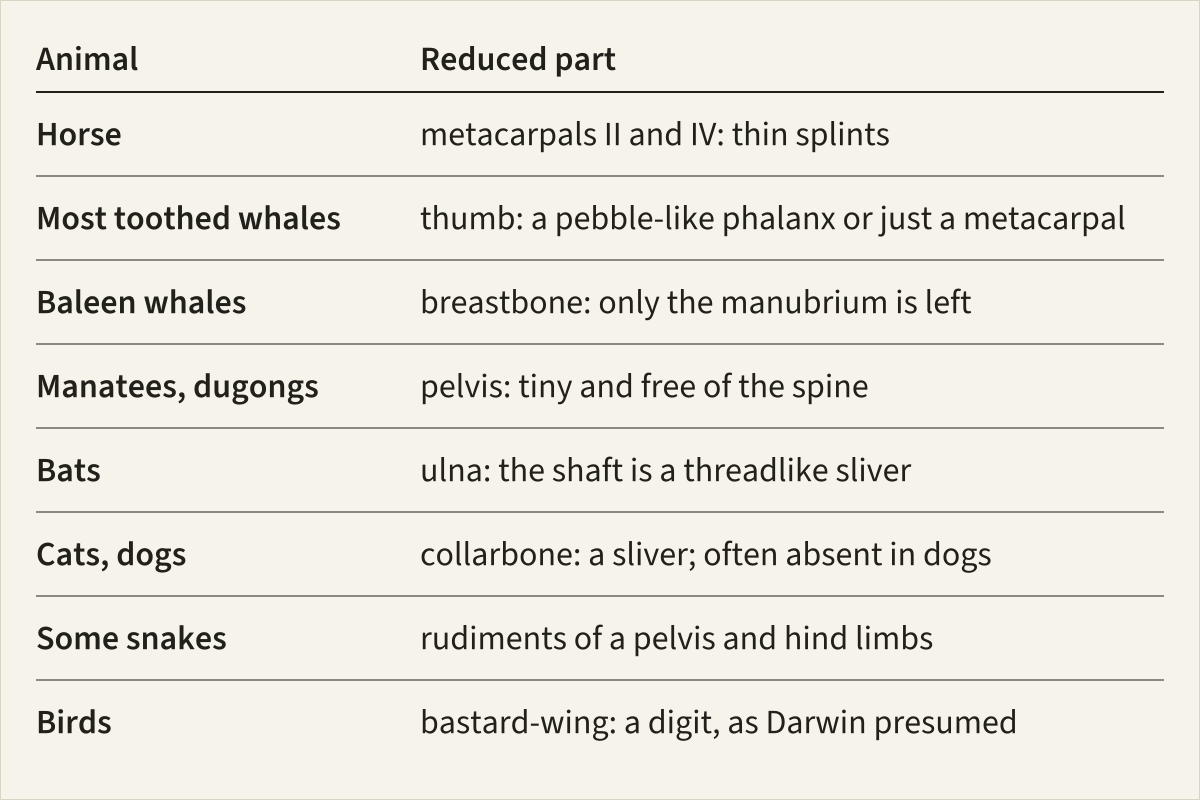
Eight groups of animals and the reduced part each keeps. The table below gives the same rows with what is left and the source for each.
Basis Rows from Senter & Moch 2015 and Darwin 1859; schematic list, sizes not shown.
"Reduced bones in eight groups of animals" by Feathers, Skeletons & Nests, https://feathersskeletonsandnests.com/skeletons/vestigial-structures/ , licensed under CC BY 4.0, https://creativecommons.org/licenses/by/4.0/
Data: Senter P. and Moch J. G. (2015) A critical survey of vestigial structures in the postcranial skeletons of extant mammals. PeerJ 3: e1439, https://doi.org/10.7717/peerj.1439, CC BY 4.0
| Animal | Reduced part | What is left | Source |
|---|---|---|---|
| Horse (Equus) | Second and fourth metacarpals | Thin splints that taper to a point | Senter & Moch 2015 |
| Most toothed whales (not sperm whales and kin) | Thumb | One pebble-like phalanx, or a metacarpal only | Senter & Moch 2015 |
| Baleen whales | Breastbone (sternum) | Only the manubrium, its first segment | Senter & Moch 2015 |
| Manatees and dugongs | Pelvis | Extremely reduced, out of contact with the backbone | Senter & Moch 2015 |
| Bats | Shaft of the ulna | A threadlike sliver | Senter & Moch 2015 |
| Cats and dogs | Collarbone (clavicle) | A short sliver inside a ligament; often absent in dogs | Senter & Moch 2015 |
| Some snakes | Pelvis and hind limbs | Rudiments | Darwin 1859, ch. XIII |
| Birds | Bastard-wing | A digit in a rudimentary state, as Darwin presumed | Darwin 1859, ch. XIII |
Same bones, elsewhere:
- Whale evolution: the fossil ankle bones that tie whales to hoofed mammals on land.
- How many bones in a giraffe neck?: seven neck bones that kept their number while their length changed.
Sources
- Phil Senter and John G. Moch, "A critical survey of vestigial structures in the postcranial skeletons of extant mammals", PeerJ 3 (2015): e1439. doi.org/10.7717/peerj.1439Read: full textText licence: CC BY 4.0 (terms)
- J. P. Dines, E. Otárola-Castillo, P. Ralph, J. Alas, T. Daley, A. D. Smith and M. D. Dean, "Sexual selection targets cetacean pelvic bones", Evolution 68, no. 11 (2014): 3296–3306. doi.org/10.1111/evo.12516Read: full text (author manuscript)
- Charles Darwin, On the Origin of Species by Means of Natural Selection, 1st edition (London: John Murray, 1859), chapter XIII. gutenberg.pglaf.org/cache/epub/1228/pg1228.txtRead: full text of chapter XIII (sections Morphology and Rudimentary, atrophied, or aborted organs)
Cite this page
Feathers, Skeletons & Nests. “Vestigial Structures: A Whale’s Hip Bones Anchor Muscles.” first published 17 November 2026. https://feathersskeletonsandnests.com/skeletons/vestigial-structures/ (accessed on the date you read it).
How facts are sourcedAll correctionsReport an error on this page (contact@feathersskeletonsandnests.com)
More from the Skeletons drawer
Homologous Structures: Same Bones, Different Counts
- Kind
- In-depth explainer
- Added
Picture credit
"Plate VI, Man and the elephant, from A Comparative View of the Human and Animal Frame" by Benjamin Waterhouse Hawkins — https://commons.wikimedia.org/wiki/File:Comparative_view_of_the_human_and_elephant_frame,_Benjamin_Waterhouse_Hawkins,_1860.jpg — Public domain (US: published 1860; EU: artist Benjamin Waterhouse Hawkins d. 1894, who drew the plate on stone himself (printer Vincent Brooks, dates not checked))
Middle Ear Evolution: Two Jaw Bones Became Ear Bones
- Kind
- In-depth explainer
- Added
Picture credit
"Thrinaxodon fossil, Iziko South African Museum" by Nkansahrexford — https://commons.wikimedia.org/wiki/File:Iziko_Thrinaxodon_fossil.JPG — CC BY 3.0 (https://creativecommons.org/licenses/by/3.0/); modified: cropped: top 120 px removed (museum display panel with printed text above the fossil block)
How Many Bones in a Giraffe Neck? Seven, Like Most Mammals
- Kind
- Specimen entry
- Added
Picture credit
"Giraffa camelopardalis (Giraf), skelet, from the Robert Jacob Gordon drawings" by Robert Jacob Gordon / Rijksmuseum — https://commons.wikimedia.org/wiki/File:Giraffa_camelopardalis_(Giraf),_skelet,_RP-T-1914-17-152.jpg — CC0 1.0 (https://creativecommons.org/publicdomain/zero/1.0/)