Bird Wing Bones: Usually Three Digits, but Which Three?
Short answer
A bird’s wing holds the same bone groups as a human arm: a humerus, radius and ulna, wrist bones, a fused palm and usually three digits. Which three is disputed. Judged by anatomy, as in fossils, they are digits 1, 2 and 3, but in the embryo they develop at positions 2, 3 and 4, a 2008 study by Alexander Vargas and colleagues reports.
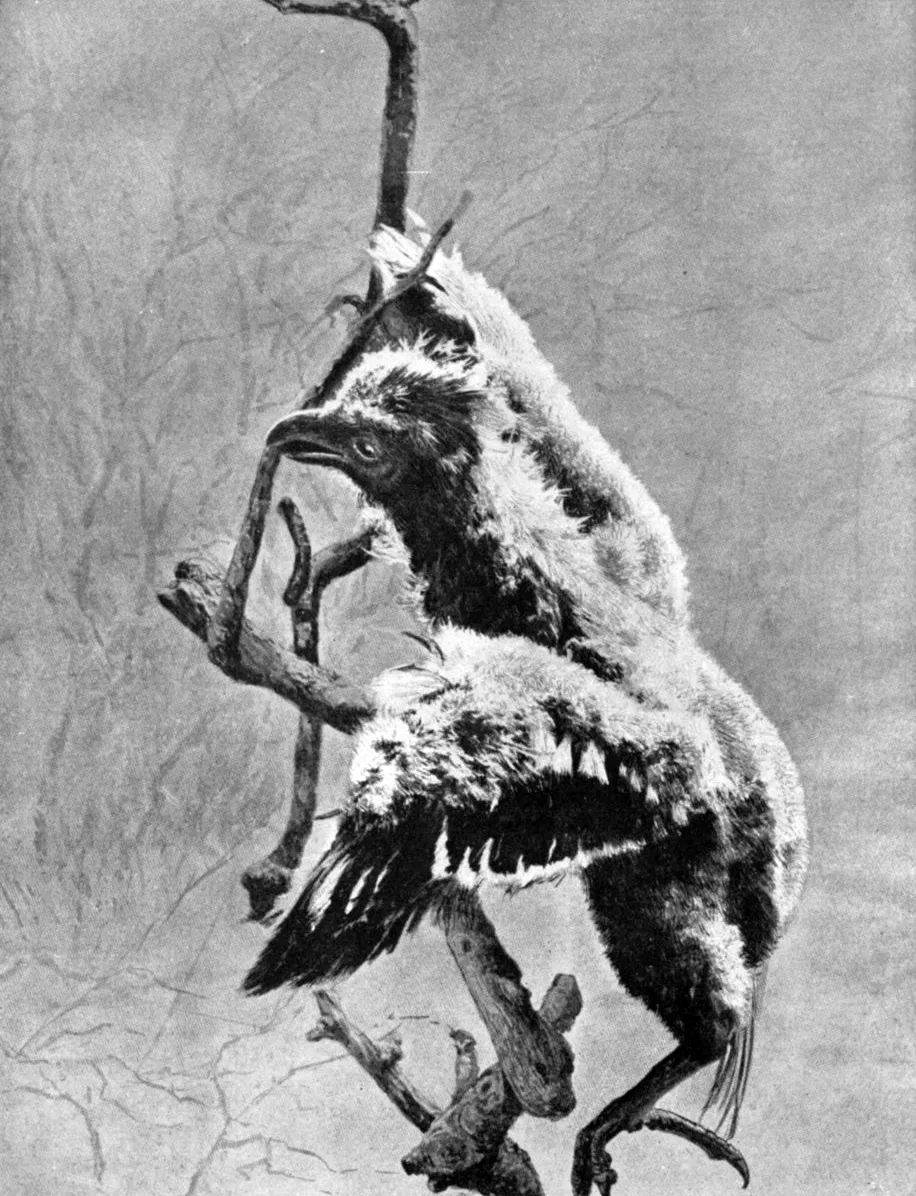
A young hoatzin on a branch, as printed in The Outline of Science in 1922 without a photographer’s name. The caption beside it is about the claws on a newly hatched chick’s wing, but no claw is clearly visible in this print.
“The Hoatzin Inhabits British Guiana, from The Outline of Science, vol. 1”, Unknown author, in J. Arthur Thomson (ed.), The Outline of Science, vol. 1 (1922); public domain.
Full credit
"The Hoatzin Inhabits British Guiana, from The Outline of Science, vol. 1" by Unknown author, in J. Arthur Thomson (ed.), The Outline of Science, vol. 1 (1922) — https://commons.wikimedia.org/wiki/File:Hoatzin_chick.jpg — Public domain (US: published 1922, before 1931; EU: anonymous work published 1922, more than 70 years ago (no photographer or artist credited in the book; original maker not traced); editor J. Arthur Thomson d. 1933)
A newly hatched hoatzin has claws on its thumb and first finger. So says the caption printed with this picture in The Outline of Science, a popular encyclopedia edited by J. Arthur Thomson: “The newly hatched bird has claws on its thumb and first finger and so is enabled to climb on the branches of trees with great dexterity until such time as the wings are strong enough to sustain it in flight.”
Thomson’s thumb and first finger are the front and middle digits of the wing. His numbering counts the thumb apart from the fingers, whereas comparative anatomists number all five digits of a vertebrate hand from 1 to 5. Whether those two clawed wing digits deserve the numbers 1 and 2, or 2 and 3, is the question this page follows.
Which bones are in a bird's wing?
Under the feathers, a bird’s wing is an arm. The humerus, the single long bone of the upper arm, comes first, followed by the radius and ulna, the paired bones of the forearm. Richard Owen, describing the London specimen of Archaeopteryx in 1863, wrote that its humerus “closely resembles that of the bird”, and that “Both ulna and radius closely resemble the antibrachial bones of the bird”, antibrachial meaning of the forearm.
The hand is where a wing departs from an arm. The 1918 edition of Gray’s Anatomy divides the human hand into three segments: the carpus or wrist bones, the metacarpus or palm bones, and the phalanges, the bones of the digits. A bird keeps the same three segments but fuses several of the bones together.
A 2014 developmental study by João Botelho and colleagues reports that early dinosaurs had as many as nine wrist bones, while living birds keep only four. Two of the four remain free as large, independent bones. The other two “fuse to each other and to the metacarpi in the adult, forming part of the carpometacarpus”, the single combined bone of the bird’s palm.
Beyond the palm sit the digits. Owen referred to “the three digits which are developed in the bird’s pinion”, pinion being an old word for the outer wing. The same bone groups arranged in the same order, though adapted for different work, are what make the arm and the wing homologous structures.
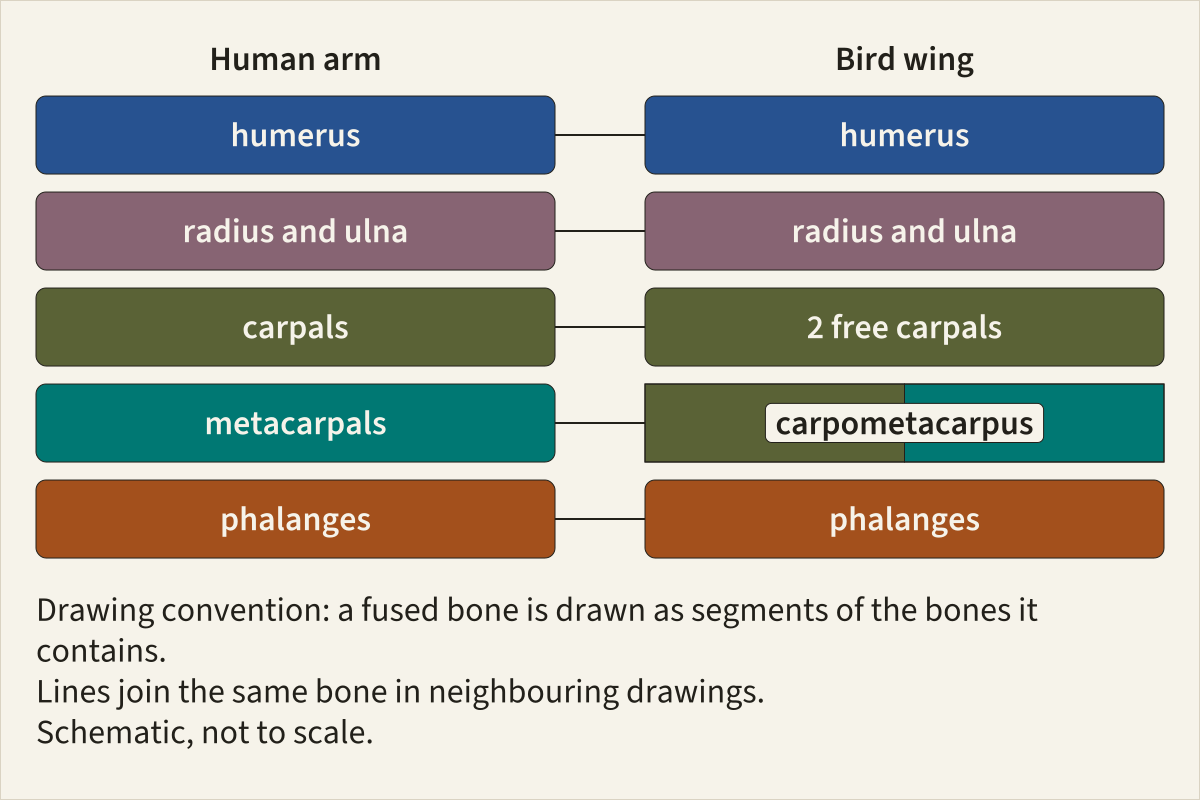
A human arm and a bird wing as two columns of bone blocks, shoulder at the top. Read across each row: every bone group in the arm has a partner in the wing, and the bird’s carpometacarpus is drawn as a wrist segment joined to a palm segment.
Basis Bones from Gray's Anatomy (1918), Owen 1863 and Botelho et al. 2014; colours fixed site-wide.
Bone colours, site table v1.4humerusradius and ulnacarpalsmetacarpalsphalanges
"Human arm and bird wing: the same bone groups" by Feathers, Skeletons & Nests, https://feathersskeletonsandnests.com/skeletons/bird-wing-bones/ , licensed under CC BY 4.0, https://creativecommons.org/licenses/by/4.0/
Data: Botelho J. F. et al. (2014) New developmental evidence clarifies the evolution of wrist bones in the dinosaur–bird transition. PLoS Biology 12(9): e1001957, https://doi.org/10.1371/journal.pbio.1001957, CC BY 4.0
Which three fingers does a bird keep?
A bird usually keeps three digits. Two independent kinds of evidence disagree about which three. Vargas and colleagues called it “a classic problem of evolutionary biology” in 2008 and summarised it in one sentence: “Comparative morphology identifies the digits of the wing of birds as 1,2 and 3, but they develop at embryological positions that become digits 2, 3 and 4 in other amniotes.” Amniotes are the reptiles, birds and mammals.
The fossil reading depends on shape and on counting finger bones. The fingers of early birds such as Archaeopteryx carry 2, 3 and 4 phalanges, the same counts as digits 1, 2 and 3 in crocodilians, the closest living relatives of birds. According to the 2008 study, comparisons with early dinosaurs, lizards and early amniotes point the same way.
The embryo reading depends on where each digit begins. In a developing limb, digits first appear as condensations, small clusters of cells that later become cartilage and eventually bone. In an alligator or a mouse, the first condensation to form lines up with the ulna and becomes digit 4; Vargas and colleagues call this line the primary axis. In a bird’s wing the primary axis becomes the back digit of the three, which places the wing’s digits at positions 2, 3 and 4.
Wagner and Gauthier (1999) trace the controversy back to before the theory of descent was first proposed. One proposed way out, in favour of the embryo reading, was that birds are not theropod dinosaurs at all. Wagner and Gauthier rejected that explanation, because the hypothesis that birds are theropods has gained support with each new fossil discovery, the evidence presented in Are birds dinosaurs?
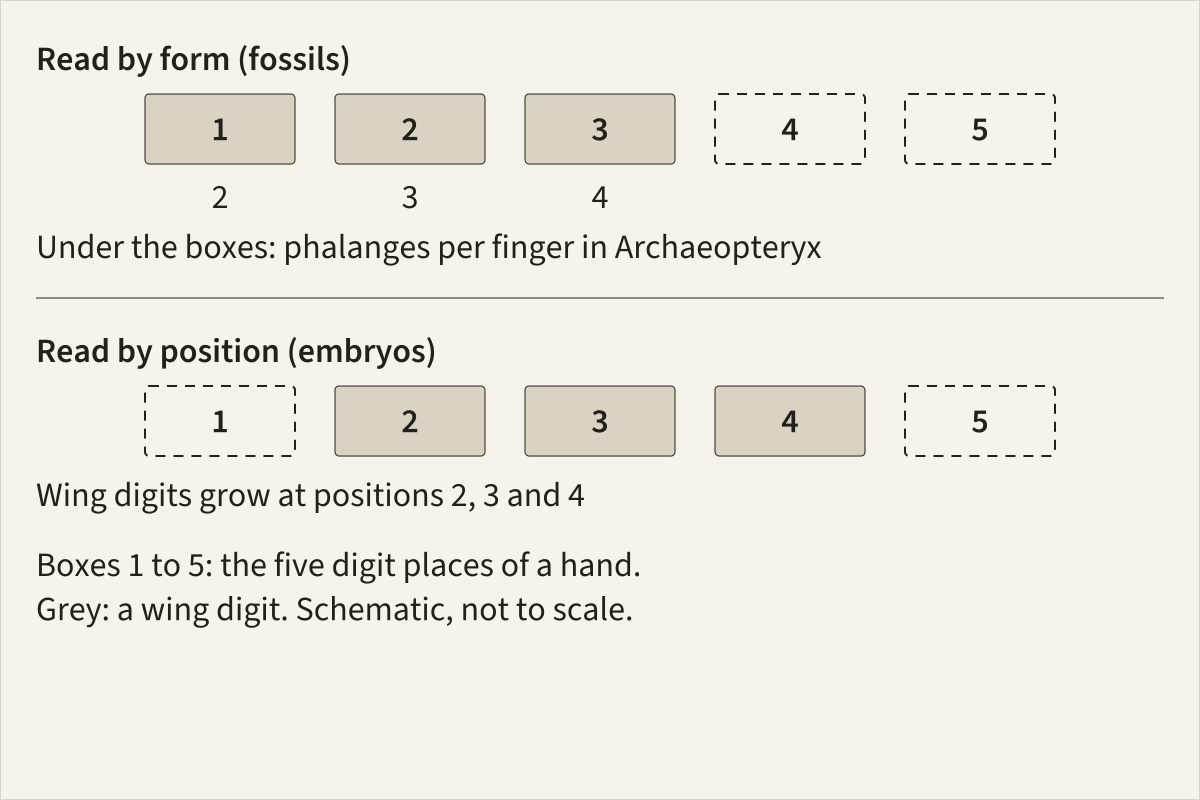
The same three wing digits read two ways. In the top row they are digits 1 to 3, judged by their form; the numbers under the boxes are the phalanges in each finger of Archaeopteryx. In the bottom row they sit at places 2 to 4, judged by where they grow in the embryo.
Basis Both readings as stated by Vargas et al. 2008; schematic, not to scale.
"Two readings of the three wing digits" by Feathers, Skeletons & Nests, https://feathersskeletonsandnests.com/skeletons/bird-wing-bones/ , licensed under CC BY 4.0, https://creativecommons.org/licenses/by/4.0/
Data: Vargas A. O., Kohlsdorf T., Fallon J. F., VandenBrooks J. and Wagner G. P. (2008) The evolution of HoxD-11 expression in the bird wing: insights from Alligator mississippiensis. PLoS ONE 3(10): e3325, https://doi.org/10.1371/journal.pone.0003325, CC BY (version not stated)
How could both readings be right?
Günter Wagner and Jacques Gauthier proposed in 1999 that both readings are correct, because they describe different stages of development. Their frame shift hypothesis separates the embryonic position where a digit originates from the identity it eventually takes. In the lineage leading to birds, they suggest, the condensation at position 1 was lost, and each of the three that remained took on the identity of the digit one position further forward.
Their abstract reads, “CII becomes DI, CIII becomes DII, and CIV becomes DIII”, where C marks a condensation and D a finished digit. Their paper also proposes a reason for the shift: the inner three fingers, especially the thumb, remained functionally important in the ancestors of birds, while development in other animals tends to eliminate the last condensation to form, which in the hand is the one at position 1. Keeping the functional fingers while losing that position would require a change in the identity each remaining condensation develops.
Vargas and colleagues tested one prediction of the hypothesis. A gene called HoxD-11 is expressed late in the developing digits of a mouse, except in digit 1; a chicken wing similarly lacks that expression only in the front digit, which develops at position 2. If the frame shift really happened, the closest living relatives of birds should resemble the mouse.
In alligator embryos, the 2008 study found late HoxD-11 expression absent only in digit 1. The authors concluded that this is “consistent with the hypothesis that both digit morphology as well as HoxD-11 expression are shifted towards posterior in the bird wing”. As of 2008 the result supported the frame shift without settling the question, and the authors encouraged comparisons across a broader range of species.
A 2014 study by João Botelho and colleagues, Vargas among them, still described “an important debate” over the wing digits while citing newer developmental evidence for 1, 2 and 3.
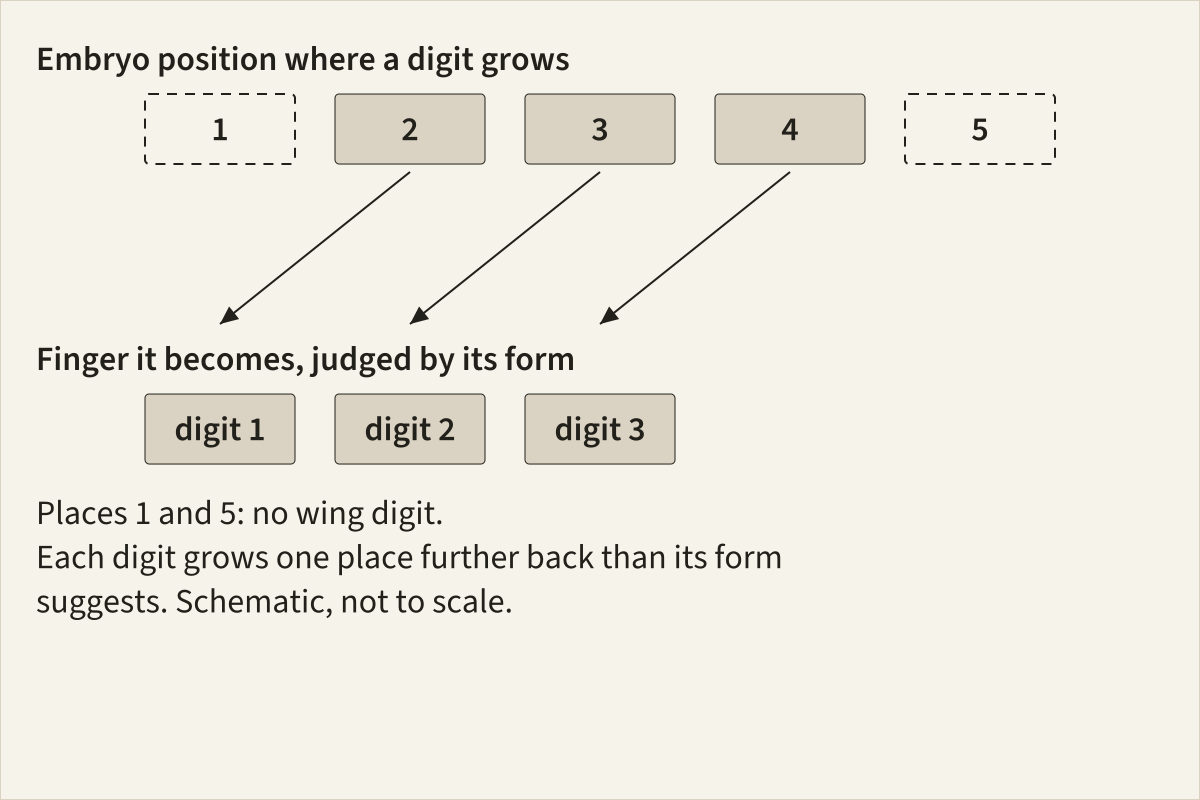
The frame shift hypothesis as a diagram: each arrow runs from the embryo place where a wing digit grows to the finger its finished form matches. The table below gives the same mapping in words.
Basis Mapping as stated by Vargas et al. 2008 for the hypothesis of Wagner & Gauthier 1999; schematic, not to scale.
"The frame shift hypothesis for the bird wing" by Feathers, Skeletons & Nests, https://feathersskeletonsandnests.com/skeletons/bird-wing-bones/ , licensed under CC BY 4.0, https://creativecommons.org/licenses/by/4.0/
Data: Vargas A. O., Kohlsdorf T., Fallon J. F., VandenBrooks J. and Wagner G. P. (2008) The evolution of HoxD-11 expression in the bird wing: insights from Alligator mississippiensis. PLoS ONE 3(10): e3325, https://doi.org/10.1371/journal.pone.0003325, CC BY (version not stated)
| Embryo place | Wing digit, judged by form | Source |
|---|---|---|
| 1 | No wing digit | Vargas et al. 2008 |
| 2 | Digit 1 | Vargas et al. 2008 |
| 3 | Digit 2 | Vargas et al. 2008 |
| 4 | Digit 3 | Vargas et al. 2008 |
| 5 | None in the finished wing | Vargas et al. 2008 |
Which birds have claws on their wings?
The hoatzin chick is not the only bird with a clawed wing. Owen wrote in 1863 that the front digit of the bird’s wing “remains free, and in some species supports a claw or spur”. His footnote names the spur-winged goose and the jacana among its examples and states that the screamer has two spurs. He added that in the kiwi, Apteryx, the digit matching the middle one of flying birds carries “a terminal curved claw”.
Owen used those living birds as a contrast with the London specimen of Archaeopteryx. In that slab of lithographic stone he identified two “moderately long and slender free digits, each terminated by a strong, curved, sharp-pointed claw”. On that interpretation, he concluded, Archaeopteryx “differs markedly from all known birds in having two free unguiculate digits in the hand”, unguiculate meaning clawed. The history of the fossil itself is covered in Archaeopteryx.
Later descriptions count more claws. Wagner and Gauthier describe Archaeopteryx as having large, curved, grasping claws on all three of its inner fingers, the typical hand of its theropod relatives. Both counts appear here side by side, each with its source. Wagner and Gauthier also note that the kiwi wing has only two fingers.
Reduced wing digits were already noted in the nineteenth century. In 1859 Charles Darwin presumed that the bird’s “bastard-wing” is “a digit in a rudimentary state”, one of the diminished structures discussed in vestigial structures. For the hoatzin, the 1922 caption links the claws to climbing through branches until the wings can support the chick. The caption says nothing about older birds.
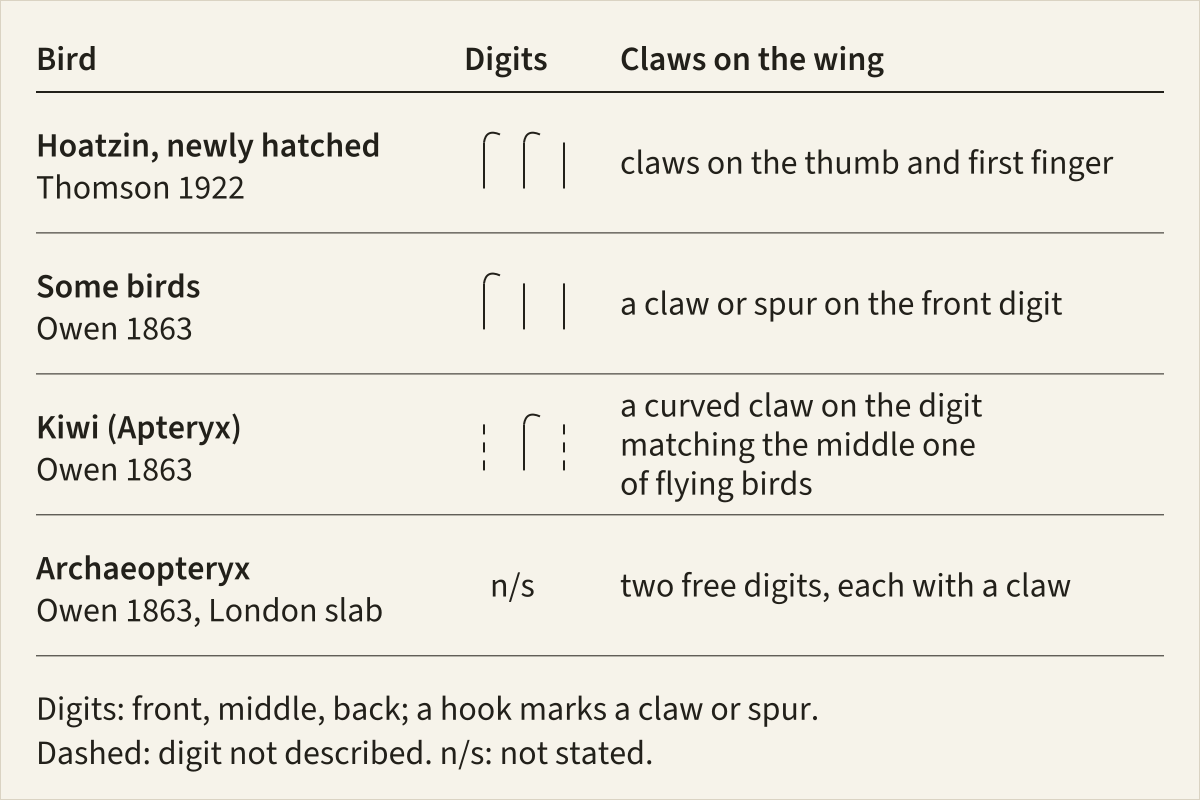
Wing claws recorded in the sources read for this page. In each small drawing the three strokes are the front, middle and back digits, a dashed stroke is a digit the source does not describe, and a hook marks a claw or spur; Owen did not say which two digits bore the claws in Archaeopteryx.
Basis Rows from Thomson 1922 and Owen 1863; schematic, not to scale.
"Claws on bird wings, by source" by Feathers, Skeletons & Nests, https://feathersskeletonsandnests.com/skeletons/bird-wing-bones/ , licensed under CC BY 4.0, https://creativecommons.org/licenses/by/4.0/
| Bird | Claws on the wing | Source |
|---|---|---|
| Hoatzin, newly hatched | Claws on the thumb and first finger | Thomson 1922 |
| Some birds (spur-winged goose, jacana, screamer) | A claw or spur on the front digit | Owen 1863, p. 39 |
| Kiwi (Apteryx) | A curved claw on the digit matching the middle one of flying birds | Owen 1863, p. 39 |
| Archaeopteryx, London specimen | Two free digits, each with a claw | Owen 1863, pp. 38–39 |
Same bones, elsewhere:
- Archaeopteryx: clawed fingers in a fossil from the Jurassic.
- Homologous structures: the same arm bones in a whale and a bat.
Sources
- Alexander O. Vargas, Tiana Kohlsdorf, John F. Fallon, John VandenBrooks and Günter P. Wagner, "The evolution of HoxD-11 expression in the bird wing: insights from Alligator mississippiensis", PLoS ONE 3, no. 10 (2008): e3325. doi.org/10.1371/journal.pone.0003325Read: full textText licence: CC BY (version not stated in the article) (terms)
- Günter P. Wagner and Jacques A. Gauthier, "1,2,3 = 2,3,4: A solution to the problem of the homology of the digits in the avian hand", Proceedings of the National Academy of Sciences 96, no. 9 (1999): 5111–5116. doi.org/10.1073/pnas.96.9.5111Read: full text
- João Francisco Botelho, Luis Ossa-Fuentes, Sergio Soto-Acuña, Daniel Smith-Paredes, Daniel Nuñez-León, Miguel Salinas-Saavedra, Macarena Ruiz-Flores and Alexander O. Vargas, "New developmental evidence clarifies the evolution of wrist bones in the dinosaur–bird transition", PLoS Biology 12, no. 9 (2014): e1001957. doi.org/10.1371/journal.pbio.1001957Read: full text; Introduction and Figure 1 legend usedText licence: CC BY 4.0 (terms)
- Richard Owen, "On the Archeopteryx of von Meyer, with a description of the fossil remains of a long-tailed species, from the lithographic stone of Solenhofen", Philosophical Transactions of the Royal Society of London 153 (1863): 33–47, plates I–IV. archive.org/details/per_abstracts-of-the-pape…Read: pages 33, 34, 36, 37, 38 and 39 checked against the page images; plate IV explanation
- J. Arthur Thomson (ed.), The Outline of Science: A Plain Story Simply Told, vol. 1 (New York and London: G. P. Putnam's Sons, 1922), plate "The Hoatzin Inhabits British Guiana", facing p. 82. gutenberg.pglaf.org/cache/epub/20417/pg20417-images.h…Read: plate caption and list of illustrations
- Henry Gray, Anatomy of the Human Body, 20th edition, edited by Warren H. Lewis (Philadelphia: Lea & Febiger, 1918), pp. 219, 221, 227, 230, 266–267, 277 and 1044. archive.org/details/anatomyofhumanbo1918grayRead: pages 219, 221, 227, 230, 266, 267, 277 and 1044, checked against the page images
- Charles Darwin, On the Origin of Species by Means of Natural Selection, 1st edition (London: John Murray, 1859), chapter XIII. gutenberg.pglaf.org/cache/epub/1228/pg1228.txtRead: full text of chapter XIII (sections Morphology and Rudimentary, atrophied, or aborted organs)
Cite this page
Feathers, Skeletons & Nests. “Bird Wing Bones: Usually Three Digits, but Which Three?.” first published 17 November 2026. https://feathersskeletonsandnests.com/skeletons/bird-wing-bones/ (accessed on the date you read it).
How facts are sourcedAll correctionsReport an error on this page (contact@feathersskeletonsandnests.com)
More from the Skeletons drawer
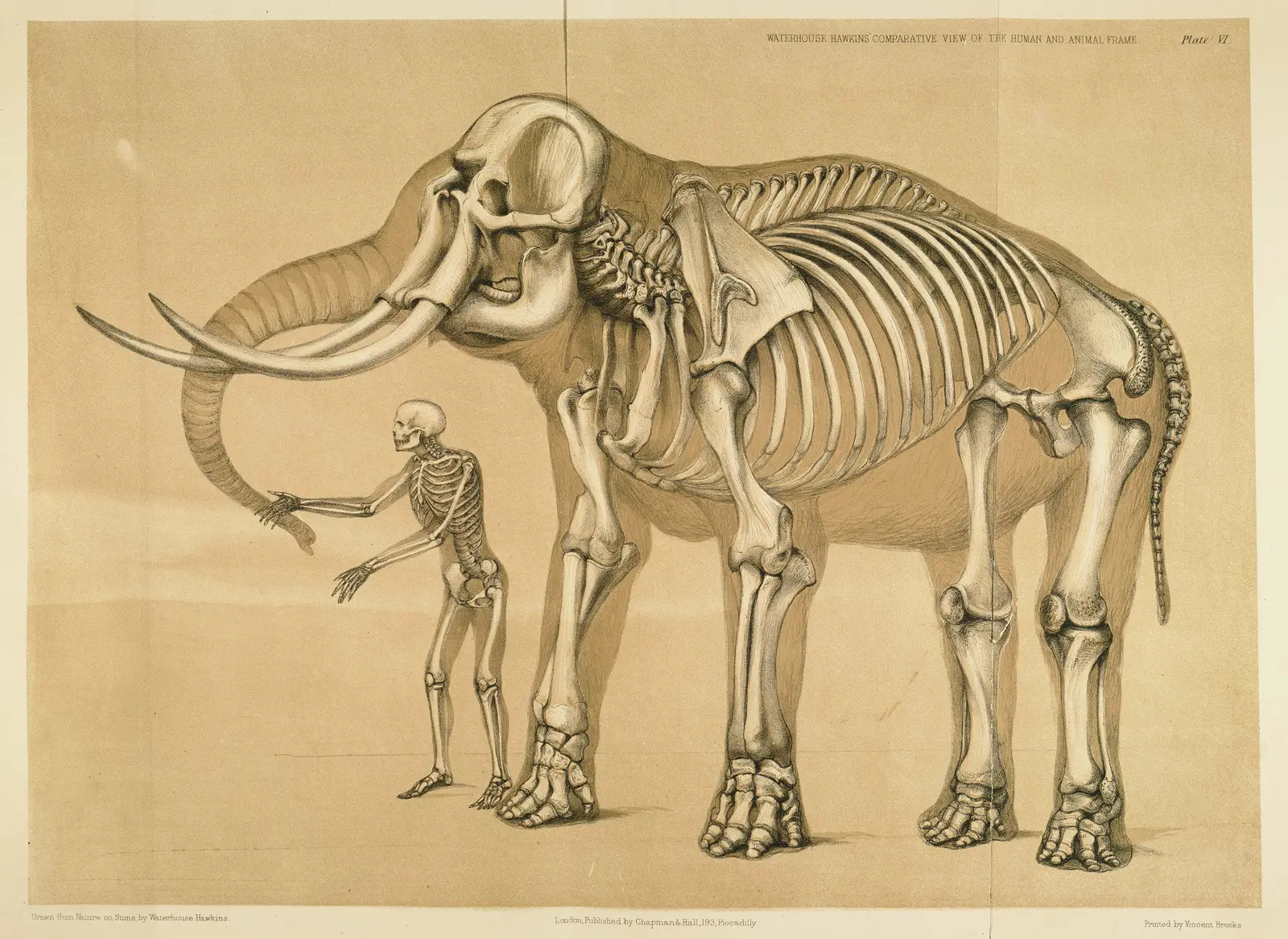
Homologous Structures: Same Bones, Different Counts
- Kind
- In-depth explainer
- Added
Picture credit
"Plate VI, Man and the elephant, from A Comparative View of the Human and Animal Frame" by Benjamin Waterhouse Hawkins — https://commons.wikimedia.org/wiki/File:Comparative_view_of_the_human_and_elephant_frame,_Benjamin_Waterhouse_Hawkins,_1860.jpg — Public domain (US: published 1860; EU: artist Benjamin Waterhouse Hawkins d. 1894, who drew the plate on stone himself (printer Vincent Brooks, dates not checked))
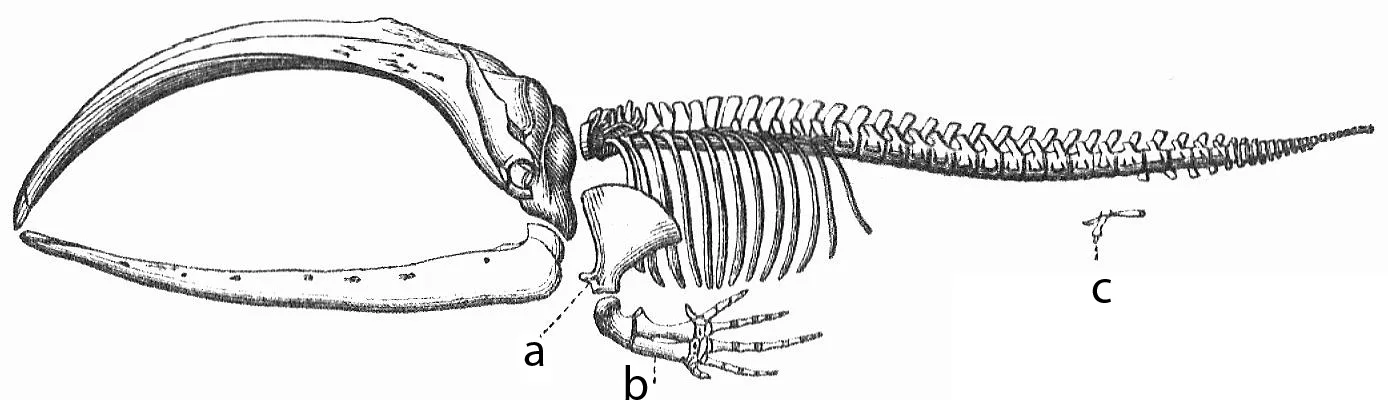
Vestigial Structures: A Whale’s Hip Bones Anchor Muscles
- Kind
- Comparison and reading
- Added
Picture credit
"Skeleton of a baleen whale, from Meyers Konversations-Lexikon, 4th edition" by Unknown author, Meyers Konversations-Lexikon (1888) — https://commons.wikimedia.org/wiki/File:Whale_skeleton.png — Public domain (US: published 1888, before 1931; EU: anonymous work published 1888, more than 70 years ago)
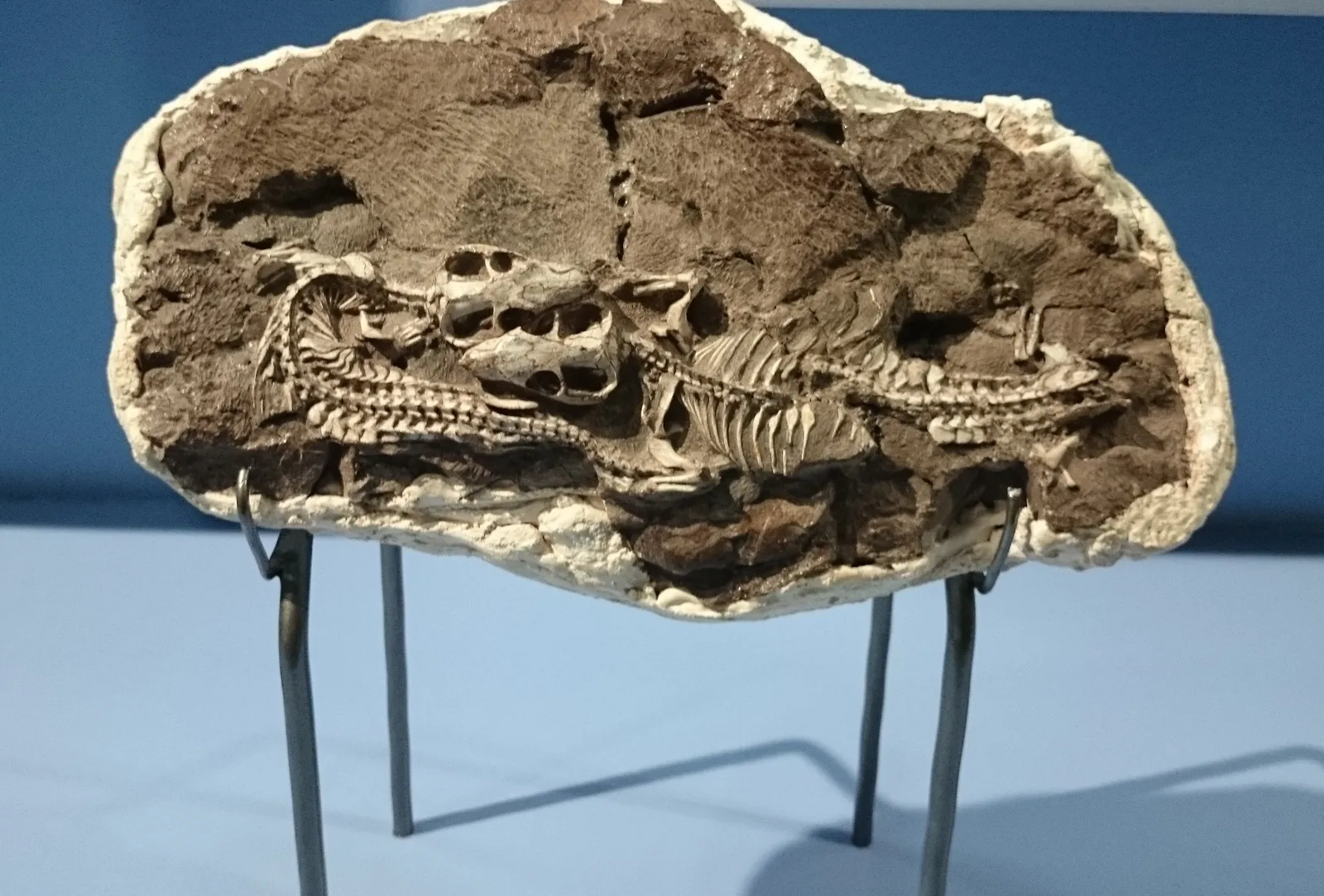
Middle Ear Evolution: Two Jaw Bones Became Ear Bones
- Kind
- In-depth explainer
- Added
Picture credit
"Thrinaxodon fossil, Iziko South African Museum" by Nkansahrexford — https://commons.wikimedia.org/wiki/File:Iziko_Thrinaxodon_fossil.JPG — CC BY 3.0 (https://creativecommons.org/licenses/by/3.0/); modified: cropped: top 120 px removed (museum display panel with printed text above the fossil block)