How Many Bones in a Giraffe Neck? Seven, Like Most Mammals
Short answer
A giraffe’s neck has seven bones, the cervical vertebrae, as in a human neck and almost every other mammal. Sloths and manatees are exceptions: a 2011 skeleton study counts six neck vertebrae in manatees, six or fewer in two-toed sloths, and eight or nine in three-toed sloths. The giraffe’s neck is long because each of the seven is very long.
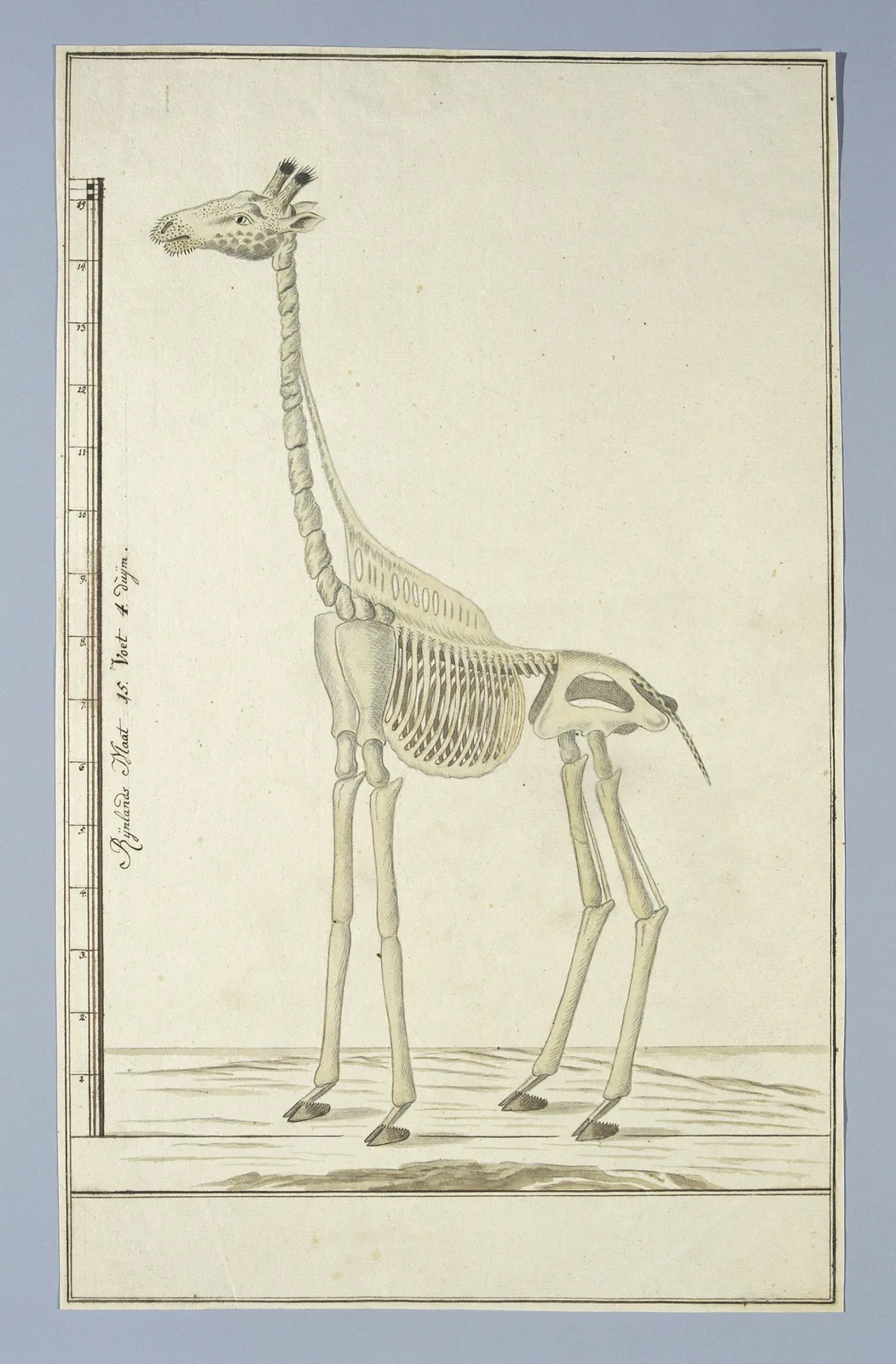
A giraffe skeleton drawn by Robert Jacob Gordon in October 1779, with a scale in Rhineland measure at the left. The head is drawn with its skin on; the neck below it is drawn as bone, block by block.
"Giraffa camelopardalis (Giraf), skelet, from the Robert Jacob Gordon drawings" by Robert Jacob Gordon / Rijksmuseum — https://commons.wikimedia.org/wiki/File:Giraffa_camelopardalis_(Giraf),_skelet,_RP-T-1914-17-152.jpg — CC0 1.0 (https://creativecommons.org/publicdomain/zero/1.0/)
Count the neck bones of a giraffe skeleton and you reach seven, the same number as in a human neck. In mammals the rule holds whatever the neck’s length. The 2011 study, led by Irma Varela-Lasheras, puts it in one line: “Mammals as a rule have seven cervical vertebrae, except for sloths and manatees.” Birds are not bound by it; the same paper notes that a swan’s long neck holds 22 to 25 vertebrae.
How many neck bones does a giraffe have?
A giraffe has seven cervical vertebrae, the bones of the neck between the skull and the chest, numbered C1 to C7 from the head down. Varela-Lasheras and colleagues describe “the stiff necks of giraffes that consist of seven very long vertebrae”. So the neck is long because each bone is long.
Ribs mark where the neck stops: a neck vertebra normally carries no free ribs. In mammals, the same paper notes, the first vertebra with full ribs is normally the eighth bone from the skull. A transitional vertebra, with only small ribs, can sit between the two regions.
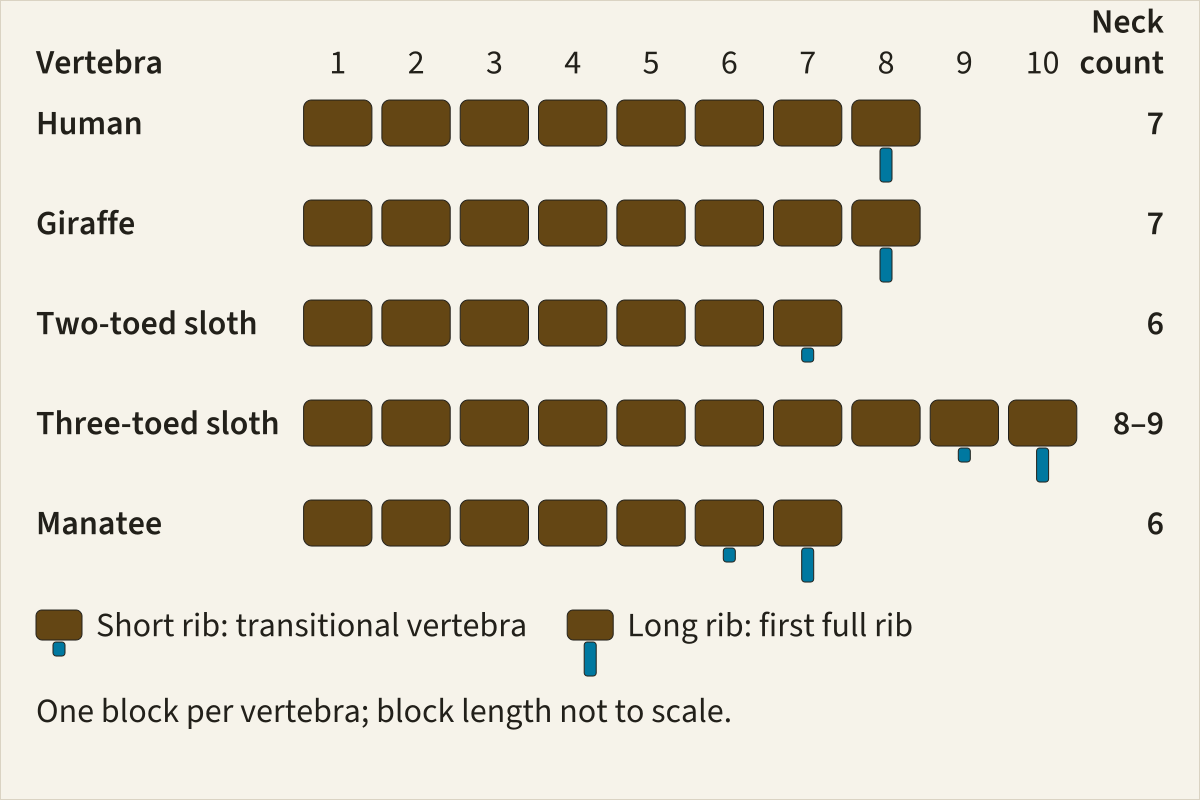
Vertebrae counted from the skull, one block per bone. A short rib marks a transitional vertebra and a long rib the first vertebra with full ribs. The number at the right is the neck count the 2011 study gives.
Basis Counts and rib positions from Varela-Lasheras et al. 2011 (text and Figure 1); colours fixed site-wide.
"Neck vertebrae counted from the skull in a human, a giraffe, two sloths and a manatee" by Feathers, Skeletons & Nests, https://feathersskeletonsandnests.com/skeletons/giraffe-neck/ , licensed under CC BY 4.0, https://creativecommons.org/licenses/by/4.0/
Data: Varela-Lasheras I., Bakker A. J., van der Mije S. D., Metz J. A. J., van Alphen J. and Galis F. (2011) Breaking evolutionary and pleiotropic constraints in mammals: on sloths, manatees and homeotic mutations. EvoDevo 2: 11, https://doi.org/10.1186/2041-9139-2-11, CC BY 2.0
Counting is only half of comparing skeletons. The order in which bones sit, and what they join, says more about which bones match. That is the idea behind homologous structures. A backbone can also change its job without changing its count: in turtles, the vertebrae and ribs grow into the shell, as turtle shell explains.
Which mammals break the seven rule?
Only two groups break it as a rule, sloths and manatees, and the 2011 study compared wild-caught museum skeletons of both with their relatives: anteaters, armadillos, dugongs and hyraxes.
Three-toed sloths (Bradypus) have too many neck bones. In most specimens the first eight vertebrae had a full neck shape, the ninth was transitional with small ribs, and the tenth was the first with complete ribs. Two-toed sloths (Choloepus) have too few: four to six vertebrae of full neck shape, then a transitional one.
Manatees, like two-toed sloths, have fewer. In every manatee skeleton examined, the seventh vertebra was already a full chest vertebra, and the sixth was transitional. The paper’s figure shows a West African manatee (Trichechus senegalensis) with six neck vertebrae.
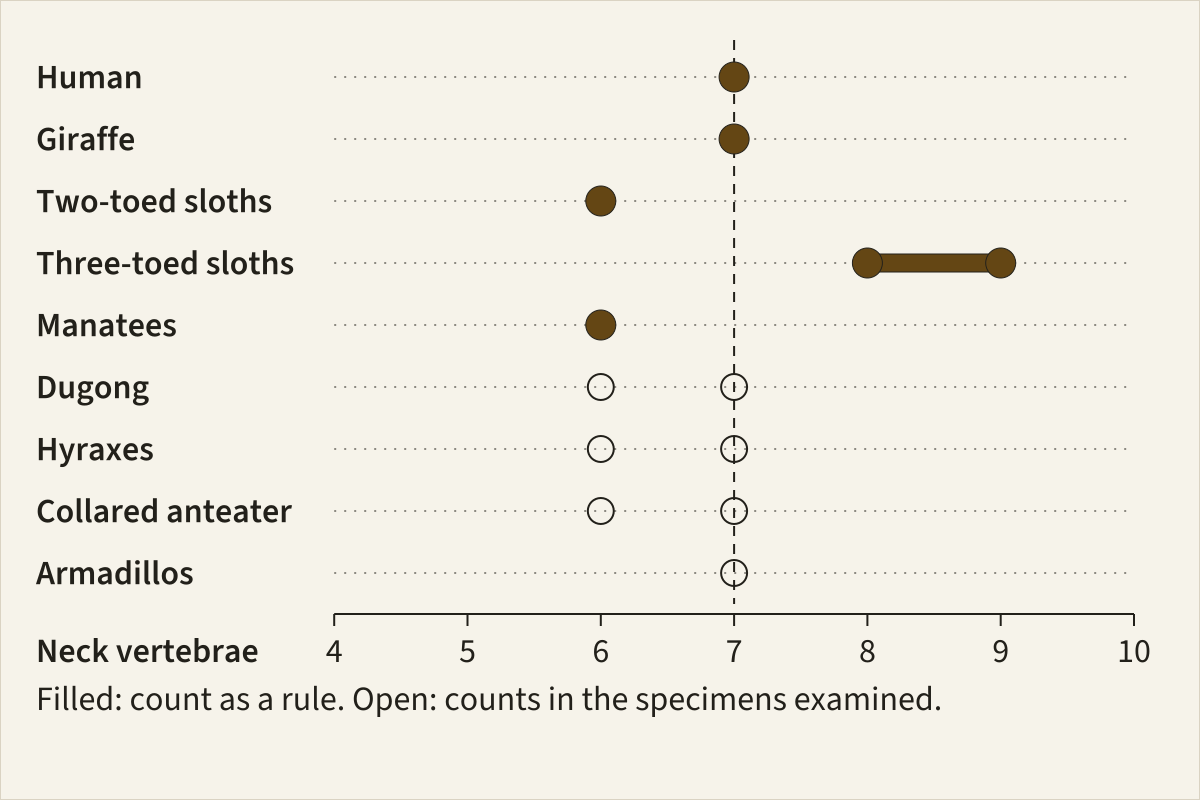
Neck counts in nine groups. Filled dots are the count for the group as a rule; open dots are the counts found in the specimens examined. The dashed line marks seven.
Basis Counts from Varela-Lasheras et al. 2011; human and giraffe rows follow the same paper’s rule of seven.
"Number of neck vertebrae in nine groups of mammals" by Feathers, Skeletons & Nests, https://feathersskeletonsandnests.com/skeletons/giraffe-neck/ , licensed under CC BY 4.0, https://creativecommons.org/licenses/by/4.0/
Data: Varela-Lasheras I., Bakker A. J., van der Mije S. D., Metz J. A. J., van Alphen J. and Galis F. (2011) Breaking evolutionary and pleiotropic constraints in mammals: on sloths, manatees and homeotic mutations. EvoDevo 2: 11, https://doi.org/10.1186/2041-9139-2-11, CC BY 2.0
| Group | Neck vertebrae | What the 2011 study found | Source |
|---|---|---|---|
| Human (Homo sapiens) | 7 | Seven as a rule, as in mammals generally | Varela-Lasheras et al. 2011, Abstract |
| Giraffe (Giraffa camelopardalis) | 7 | Seven very long vertebrae | Varela-Lasheras et al. 2011, Background |
| Two-toed sloths (Choloepus) | 6 | Four to six of full neck shape, then a transitional vertebra | Varela-Lasheras et al. 2011, Background, Results |
| Three-toed sloths (Bradypus) | 8–9 | Eight of full neck shape in most specimens; the ninth transitional | Varela-Lasheras et al. 2011, Background, Results |
| Manatees (Trichechus) | 6 | The sixth transitional; the seventh always a full chest vertebra | Varela-Lasheras et al. 2011, Results, Figure 1 |
| Dugong (Dugong dugon) | 6 or 7 | Six in 6 of 11 specimens | Varela-Lasheras et al. 2011, Results |
| Hyraxes (Procaviidae) | 6 or 7 | Six in 2 of 16 specimens | Varela-Lasheras et al. 2011, Results |
| Collared anteater (Tamandua tetradactyla) | 6 or 7 | Seven in 7 of 8; one had six, then a transitional vertebra | Varela-Lasheras et al. 2011, Results, Table 3 |
| Armadillos | 7 | Seven in all 27 specimens | Varela-Lasheras et al. 2011, Results |
Download the neck vertebra counts (CSV) (what this file records) Data: Varela-Lasheras I., Bakker A. J., van der Mije S. D., Metz J. A. J., van Alphen J. and Galis F. (2011) Breaking evolutionary and pleiotropic constraints in mammals: on sloths, manatees and homeotic mutations. EvoDevo 2: 11, https://doi.org/10.1186/2041-9139-2-11, CC BY 2.0
In the relatives, the rule bent only in some individuals, not across a whole group. Every dugong, anteater and hyrax with a changed count also had other skeletal problems, such as fused or uneven vertebrae and ribs, while the specimens with seven showed none beyond minor ones.
Why sloths and manatees can differ is a hypothesis of the 2011 authors. They argue that the neck count is fixed early in the embryo, while many body parts are being laid out at once. A change at that stage tends to bring other defects with it, known as a pleiotropic effect, and selection weeds it out. They suggest that the very low activity and metabolic rates of sloths and manatees weaken that selection.
Is the first chest vertebra part of the neck?
In the giraffe, it may be in part. Look at a mounted giraffe skeleton from the side: the long neck runs down between the shoulder blades, where the first ribs begin. That junction between neck and chest is where a 2015 study found the giraffe unusual among mammals.
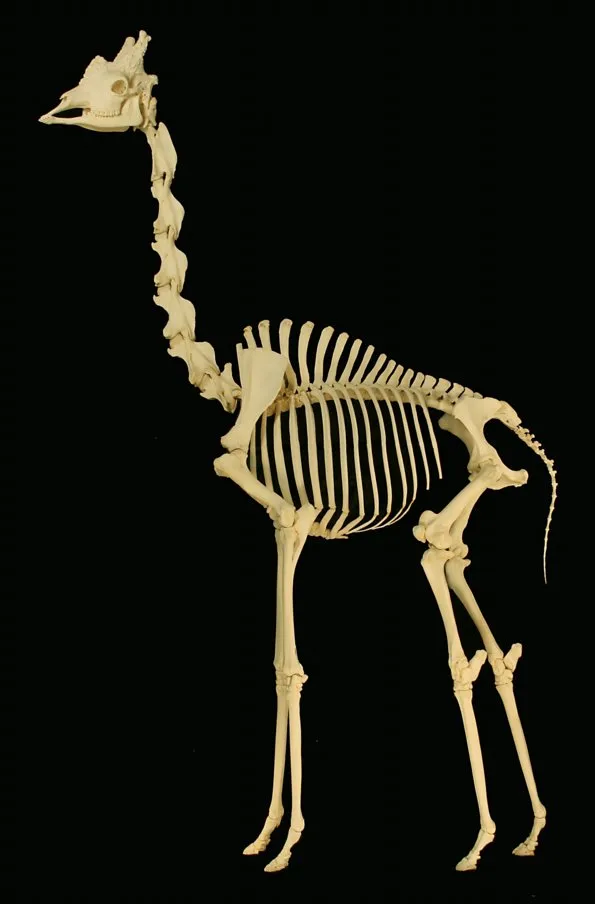
A giraffe skeleton on display at the Museum of Osteology in Oklahoma City, seen from the side. The neck meets the chest at the shoulder blades, where the ribs start.
"Giraffe skeleton on exhibit at the Museum of Osteology, Oklahoma City" by Sklmsta — https://commons.wikimedia.org/wiki/File:Giraffe_skeleton.jpg — CC0 1.0 (https://creativecommons.org/publicdomain/zero/1.0/)
That study, by Melinda Danowitz and colleagues, lists what sets the giraffe’s seventh neck vertebra, C7, apart. It keeps bumps and flat side processes like the vertebrae higher in the neck. The vertebral artery, which runs up the neck through holes in the vertebrae, enters at C7, not at C6 as in other mammals. And C7 is long: 3 to 3.75 times as long as its narrowest width, more than in any other giraffid.
The next bone back has drawn a bolder claim. Nikos Solounias proposed in 1999 that the giraffe’s first chest vertebra, T1, is “cervicalized”, as Danowitz and colleagues summarise it. The nerves to the front leg and the joint with the first rib sit at T1, positions that belong to C7 in other mammals. The proposal concerns how the base of the neck is built; the giraffe still has seven cervical vertebrae.
How did the neck get so long?
The neck grew longer in stages, a 2015 study proposes, and the first stage is older than the giraffe family. Danowitz and colleagues measured 71 neck vertebrae from 11 fossil and living species in and near the giraffe family, and for each third neck vertebra, C3, they divided its length by the narrowest width of its upper surface.
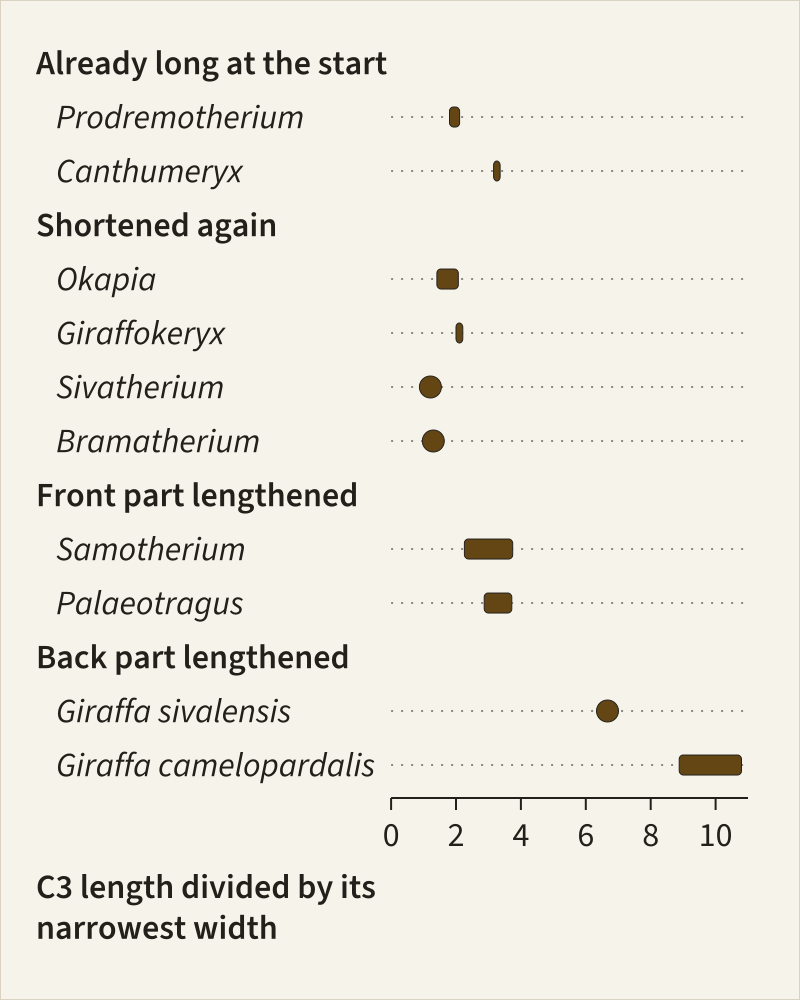
The third neck vertebra in nine giraffids and one close relative, grouped by the stages the 2015 study proposes. Bars show the range measured; a dot is a single value. A higher number means a longer, slimmer bone.
Basis Ratios and stages from Danowitz et al. 2015; Bohlinia left out because no C3 is known.
"Length-to-width ratio of the third neck vertebra in nine giraffids and one close relative, by stage" by Feathers, Skeletons & Nests, https://feathersskeletonsandnests.com/skeletons/giraffe-neck/ , licensed under CC BY 4.0, https://creativecommons.org/licenses/by/4.0/
Data: Danowitz M., Vasilyev A., Kortlandt V. and Solounias N. (2015) Fossil evidence and stages of elongation of the Giraffa camelopardalis neck. Royal Society Open Science 2: 150393, https://doi.org/10.1098/rsos.150393, CC BY 4.0
At the start of the series the neck was already fairly long: Prodremotherium, a possible ancestor of the family, and Canthumeryx, an early giraffid, had C3 bones two to three times as long as they were wide. Then the lines split. The okapi, Giraffokeryx, Sivatherium and Bramatherium shortened their neck bones again. Samotherium and Palaeotragus lengthened the front part of each vertebra, about 7.5 million years ago.
The last stage lengthened the back part of each bone. Giraffa sivalensis shows some of it, and the living giraffe all of it: its C3 is 8.88 to 10.8 times as long as wide. A credit card is about 1.6 times as long as it is wide. A computer comparison backs the two steps: turning a Samotherium C3 into giraffe shape took a stretch of about 1.8 in front of a turning point and 2.9 behind it.
| Stage proposed in the 2015 study | Animal | C3 length to narrowest width |
|---|---|---|
| Already long at the start | Prodremotherium | 1.8–2.11 |
| Already long at the start | Canthumeryx | 3.16–3.36 |
| Shortened again | Okapia (okapi) | 1.41–2.07 |
| Shortened again | Giraffokeryx | 2–2.21 |
| Shortened again | Sivatherium | 1.21 |
| Shortened again | Bramatherium | 1.3 |
| Front part lengthened | Samotherium | 2.26–3.75 |
| Front part lengthened | Palaeotragus | 2.87–3.72 |
| Back part lengthened | Giraffa sivalensis | 6.67 |
| Back part lengthened | Giraffa camelopardalis (giraffe) | 8.88–10.8 |
These fossil animals are not the giraffe’s direct ancestors, the authors stress; their necks show steps along the way, not a family line. Why the neck grew is a separate debate. The same paper notes that reaching high leaves and male neck fights have both been proposed.
The living giraffe still has the usual seven. Under the remodel rule, the habit of asking what an odd bone was remodelled from, the answer here is the same seven bones, made longer.
Same bones, elsewhere:
- Did humans evolve from monkeys?: the family tree that places humans among the apes, all of them mammals with seven neck bones as a rule.
- Vestigial structures: a whale’s hip bones, shrunk far down yet still anchoring muscles.
Sources
- Irma Varela-Lasheras, Alexander J. Bakker, Steven D. van der Mije, Johan A. J. Metz, Joris van Alphen and Frietson Galis, "Breaking evolutionary and pleiotropic constraints in mammals: on sloths, manatees and homeotic mutations", EvoDevo 2 (2011): 11; correction in EvoDevo 12 (2021): 13. doi.org/10.1186/2041-9139-2-11Read: full text; the 2021 correction (Table 1 row order only) also readText licence: CC BY 2.0 (terms)
- Melinda Danowitz, Aleksandr Vasilyev, Victoria Kortlandt and Nikos Solounias, "Fossil evidence and stages of elongation of the Giraffa camelopardalis neck", Royal Society Open Science 2 (2015): 150393. doi.org/10.1098/rsos.150393Read: full textText licence: CC BY 4.0 (terms)
- Nikos Solounias, "The remarkable anatomy of the giraffe's neck", Journal of Zoology 247 (1999): 257–268. doi.org/10.1111/j.1469-7998.1999.tb00989.xRead: bibliography only
Cite this page
Feathers, Skeletons & Nests. “How Many Bones in a Giraffe Neck? Seven, Like Most Mammals.” first published 17 November 2026. https://feathersskeletonsandnests.com/skeletons/giraffe-neck/ (accessed on the date you read it).
How facts are sourcedAll correctionsReport an error on this page (contact@feathersskeletonsandnests.com)
More from the Skeletons drawer
Homologous Structures: Same Bones, Different Counts
- Kind
- In-depth explainer
- Added
Picture credit
"Plate VI, Man and the elephant, from A Comparative View of the Human and Animal Frame" by Benjamin Waterhouse Hawkins — https://commons.wikimedia.org/wiki/File:Comparative_view_of_the_human_and_elephant_frame,_Benjamin_Waterhouse_Hawkins,_1860.jpg — Public domain (US: published 1860; EU: artist Benjamin Waterhouse Hawkins d. 1894, who drew the plate on stone himself (printer Vincent Brooks, dates not checked))
Vestigial Structures: A Whale’s Hip Bones Anchor Muscles
- Kind
- Comparison and reading
- Added
Picture credit
"Skeleton of a baleen whale, from Meyers Konversations-Lexikon, 4th edition" by Unknown author, Meyers Konversations-Lexikon (1888) — https://commons.wikimedia.org/wiki/File:Whale_skeleton.png — Public domain (US: published 1888, before 1931; EU: anonymous work published 1888, more than 70 years ago)
Middle Ear Evolution: Two Jaw Bones Became Ear Bones
- Kind
- In-depth explainer
- Added
Picture credit
"Thrinaxodon fossil, Iziko South African Museum" by Nkansahrexford — https://commons.wikimedia.org/wiki/File:Iziko_Thrinaxodon_fossil.JPG — CC BY 3.0 (https://creativecommons.org/licenses/by/3.0/); modified: cropped: top 120 px removed (museum display panel with printed text above the fossil block)