Whale Evolution: Ankles Tied Whales to Even-Toed Mammals
Short answer
Whales evolved from early even-toed hoofed mammals, the group that also holds pigs, cattle, camels and hippos. Fossil whales about 47 million years old from Pakistan have ankle bones with features diagnostic of that group (Gingerich and colleagues, 2001). DNA studies place hippos as whales' closest living relatives, though a 2001 skeleton-based analysis by Thewissen and colleagues did not. Fossils add the raoellid Indohyus as closer still, a placement later work found unstable.
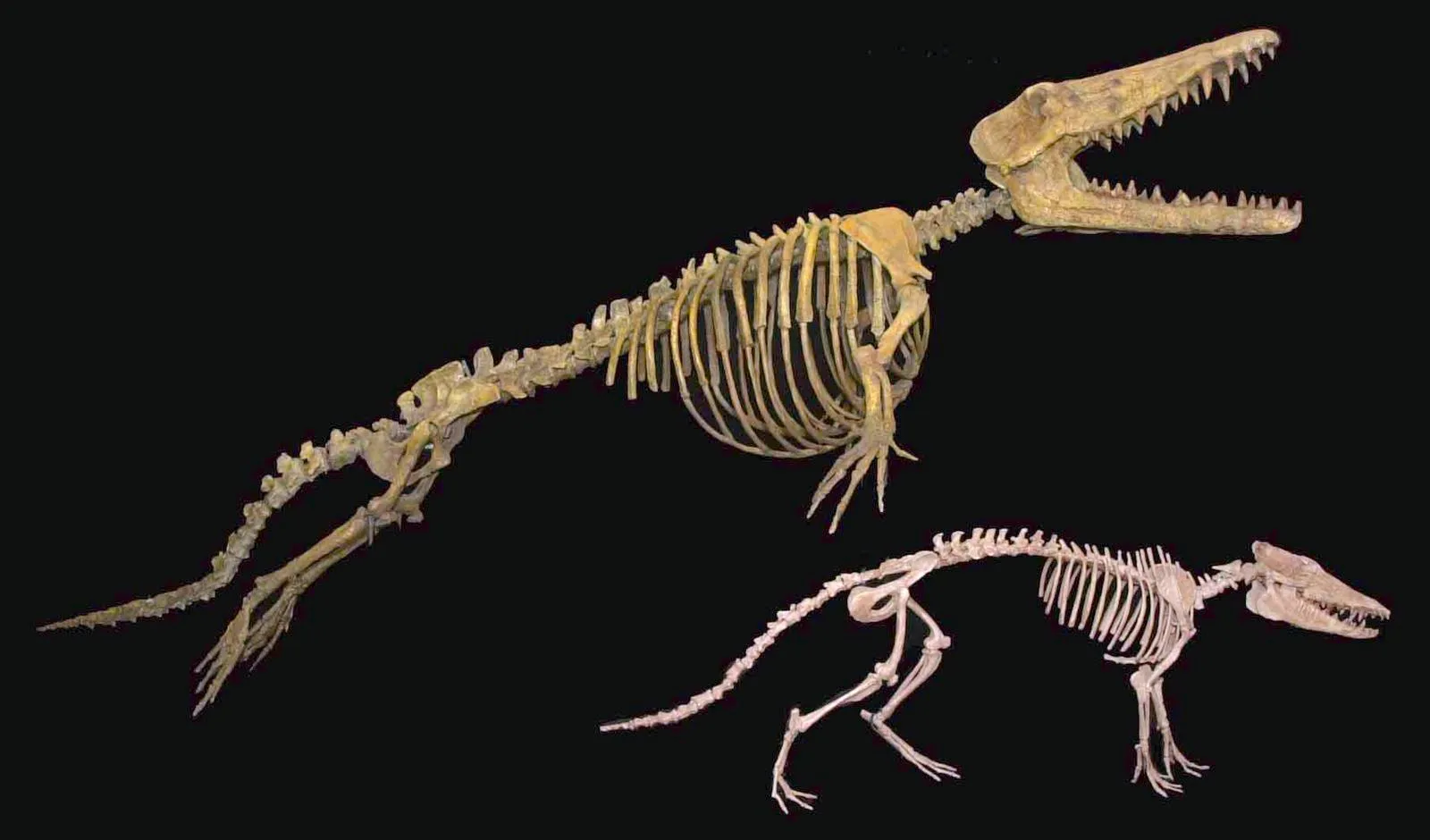
Skeletal mounts of two early whales, published by Hans Thewissen in 2009: Ambulocetus above and the smaller Pakicetus below. Look at the back end of each: both still have hind legs and feet.
"Pakicetus and Ambulocetus skeletons, comparison" by Hans Thewissen — https://commons.wikimedia.org/wiki/File:Pakicetus_Ambulocetus_Skeletons_comparison.jpg — CC BY 2.0 (https://creativecommons.org/licenses/by/2.0/)
One small ankle bone carries much of the case that whales came from hoofed mammals. Modern whales lack hind limbs (Thewissen et al. 2001), so that evidence comes from fossil whales that still had legs.
Among them is Pakicetus. Thewissen and colleagues (2001) described skeletons of two pakicetids from the early Eocene: Pakicetus attocki, which they call wolf-sized, and the fox-sized Ichthyolestes pinfoldi. Their paper calls these animals terrestrial cetaceans, meaning whales that lived on land.
What did whales evolve from?
Tree Redrawn from published trees, each node with its source; no branch lengths or dates.
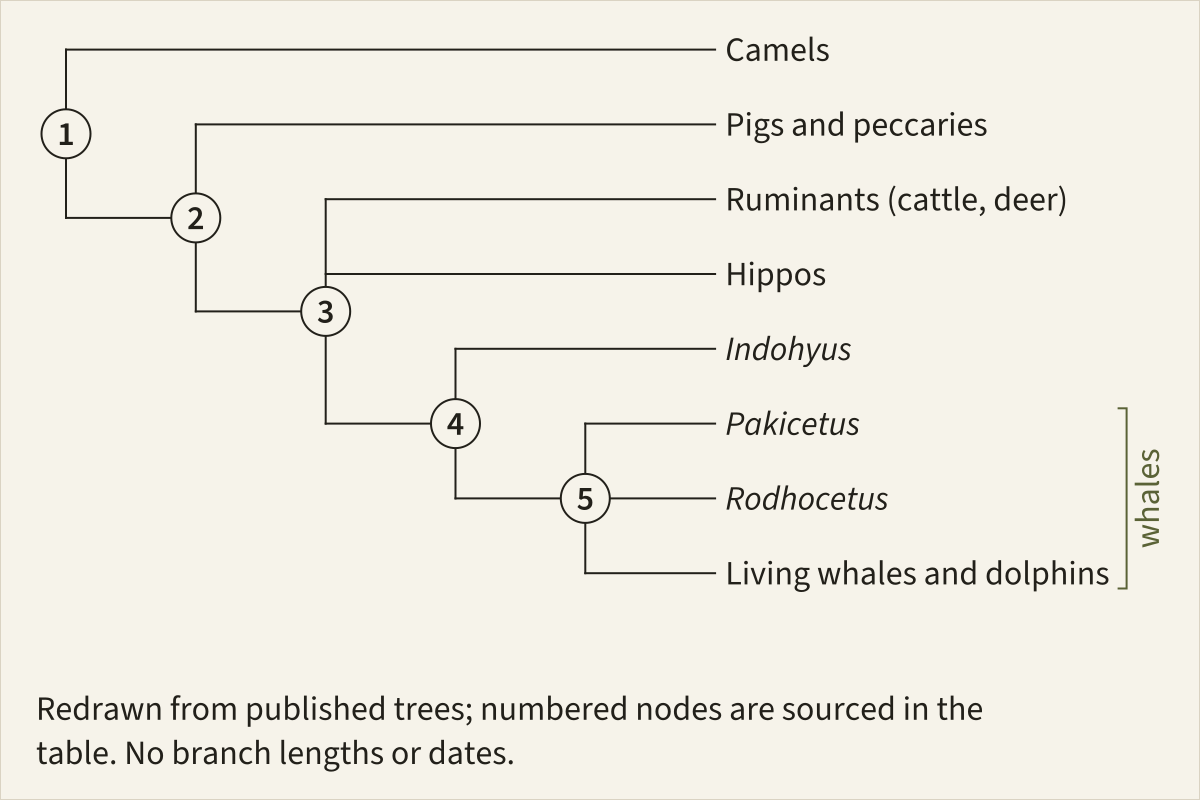
Each numbered circle is a branch point, the common ancestor of every group on the branches that split from it. Node 3 has three branches because molecular and morphological studies disagree on whether hippos are the closest living relatives of whales. Node 5 leaves the order of the three whale tips open.
Basis Each numbered node is sourced in the table below.
"Where whales sit among the even-toed hoofed mammals" by Feathers, Skeletons & Nests, https://feathersskeletonsandnests.com/fossils/whale-evolution/ , licensed under CC BY 4.0, https://creativecommons.org/licenses/by/4.0/
Whales sit inside the artiodactyls, the even-toed hoofed mammals such as deer, cattle, pigs and camels. That list of examples comes from a 1999 commentary by David Hillis. He notes that a link between whales and hoofed mammals was first proposed in 1883, but that there was little evidence tying whales to any one group of them until the last two decades before his commentary.
Spaulding, O'Leary and Gatesy (2009) described their study, at the time, as “the largest total evidence analysis of morphological and molecular information for Artiodactyla”. It scored 661 phenotypic characters, from bones, teeth, soft tissue and behaviour, and 46,587 molecular characters for 33 living and 48 extinct taxa. Its shortest trees place whales inside the artiodactyls, close to the extinct Indohyus. The mesonychians, an extinct group of archaic hoofed mammals, fall outside.
Older studies pointed elsewhere. Thewissen and colleagues (2001) summarise that earlier skeleton-based analyses had placed whales closest to the mesonychians. Their own analysis, with the new pakicetid skeletons, put whales closer to the artiodactyls than to any mesonychian. Gingerich and colleagues reached the same conclusion that year from fossil whale hands and feet, that whales evolved from early artiodactyls rather than from mesonychians.
The tree is not settled everywhere. Spaulding and colleagues found that trees only two steps longer than the shortest move the mesonychians inside the artiodactyls and push Indohyus away from whales. When they analysed only the characters that fossilize, bones and teeth, whales fell outside the artiodactyls altogether, a signal the authors describe as incongruent with the molecular data.
| Node | Group | Members on the tree | Sources | Note |
|---|---|---|---|---|
| 1 | Artiodactyla, with whales inside | all eight tips | Spaulding, O'Leary & Gatesy 2009; Nikaido, Rooney & Okada 1999 | camels branching first rests on one DNA locus in Nikaido 1999 and on the agreement subtree of Spaulding 2009 |
| 2 | Pigs and peccaries with the rest | all tips except camels | Spaulding et al. 2009; Nikaido et al. 1999 | grouping as recovered in both studies |
| 3 | Ruminants, hippos and whales | ruminants, hippos, Indohyus, whales | Nikaido et al. 1999; Spaulding et al. 2009 | hippos join whales in DNA and combined data, not in Thewissen's 2001 morphological analysis, which is why the node is drawn unresolved |
| 4 | Raoellids and whales | Indohyus, Pakicetus, Rodhocetus, living whales | Thewissen et al. 2007; Spaulding et al. 2009 | unstable: trees two steps longer move Indohyus away |
| 5 | Whales, living and extinct | Pakicetus, Rodhocetus, living whales and dolphins | Spaulding et al. 2009; Thewissen et al. 2001; Gingerich et al. 2001 | order of the three tips left open here |
Why does one ankle bone matter so much?
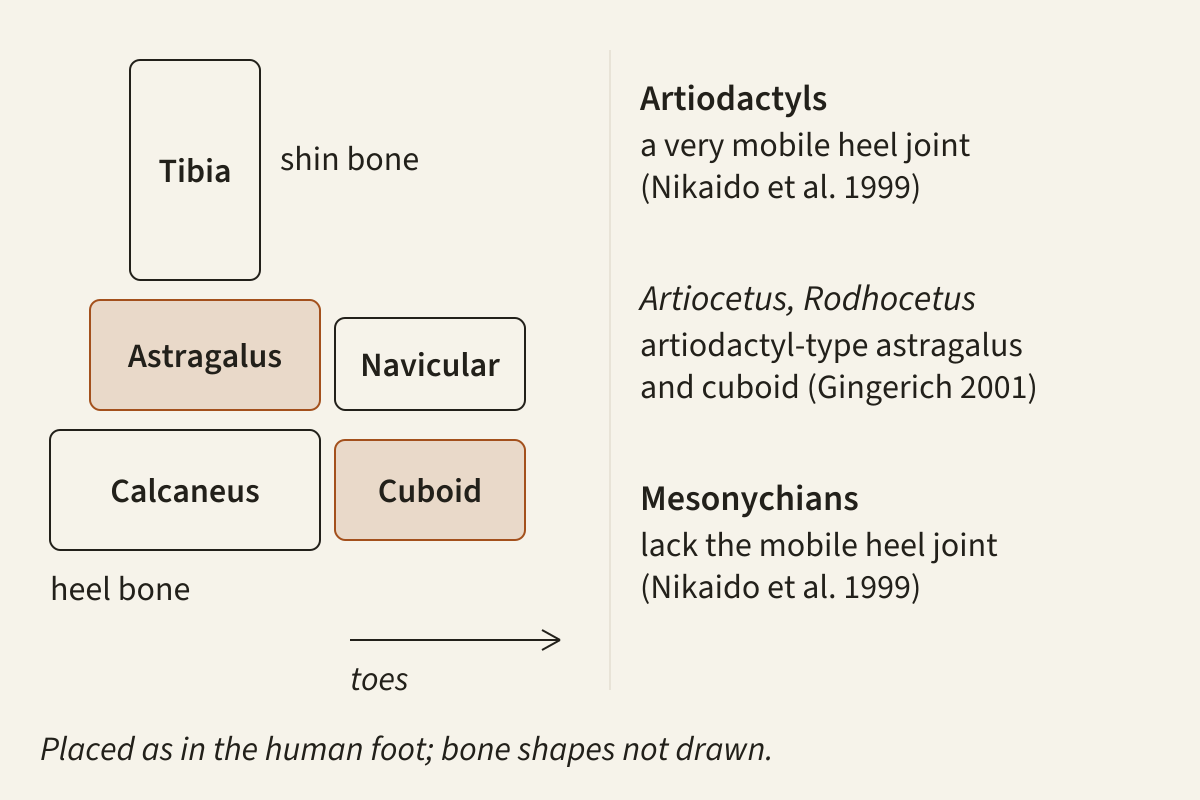
A block diagram of the ankle bones named in this section, placed as Gray's Anatomy describes them in the human foot. The two bones marked in rust are the ones Gingerich and colleagues found artiodactyl-like in two early whales. Bone shapes are not drawn.
Basis Bone positions from Gray's Anatomy (1918), pages 266 and 267; findings from Gingerich et al. 2001 and Nikaido et al. 1999; schematic, not to scale.
"Ankle bones named in the whale ankle evidence" by Feathers, Skeletons & Nests, https://feathersskeletonsandnests.com/fossils/whale-evolution/ , licensed under CC BY 4.0, https://creativecommons.org/licenses/by/4.0/
The astragalus is the ankle bone that the shin rests on. Gray's Anatomy (1918) heads its entry “The Talus (astragalus; ankle bone)” and describes the bone as supporting the tibia, the shin bone, above and resting on the calcaneus, the heel bone, below. The heel bone in turn meets the cuboid, which sits in front of it. Those two bones, the astragalus and the cuboid, are the ones that matter here.
Gingerich and colleagues (2001) described partial skeletons of two fossil whales from Pakistan, Artiocetus clavis and Rodhocetus balochistanensis. According to the authors, they are among the oldest known protocetids, an early family of whales. Both have an astragalus and a cuboid with features that the authors call diagnostic of artiodactyls. R. balochistanensis also has nearly complete front and hind limbs.
Artiodactyls have an unusually mobile joint in the heel, while most mammals keep a stiffer one. Nikaido and colleagues (1999), summarising earlier work, describe this joint as a shared derived trait of all modern artiodactyls that is also present to some extent in early whales. Because mesonychians lack it, they argue that mesonychians might not be the direct ancestors of early whales, and that the likeness between mesonychian and early whale teeth might have evolved separately.
Hillis (1999) explains part of the difficulty. In adapting to water, whales have greatly modified many of the structures used to classify even-toed hoofed mammals: their hind limbs are lost and their front limbs are flippers. Ankle bones can only be compared in fossil whales that still had hind legs.
Are whales related to hippos?
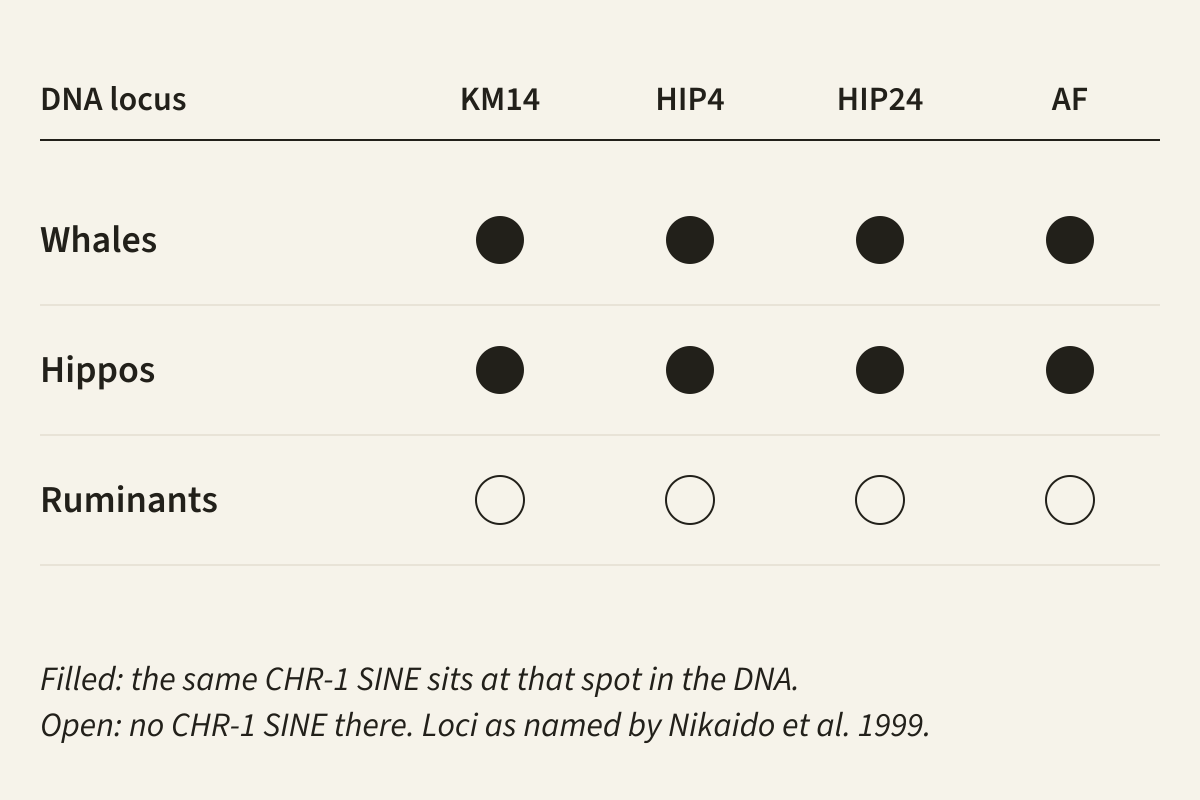
The same piece of mobile DNA, the CHR-1 SINE, at four spots in the genome. Whales and hippos carry it at all four; ruminants do not, which Nikaido and colleagues read as the mark of a shared whale and hippo ancestor. Morphological work had disagreed.
Basis Loci and results from Nikaido et al. 1999, Results; drawing only, no sequence shown.
"The same SINE insertion in whale and hippo DNA" by Feathers, Skeletons & Nests, https://feathersskeletonsandnests.com/fossils/whale-evolution/ , licensed under CC BY 4.0, https://creativecommons.org/licenses/by/4.0/
Yes, closely, though morphology and DNA disagreed for years. Hippos were long thought closer to pigs and peccaries than to whales, Hillis (1999) explains, so traits shared by whales and hippos were written off as convergence. In 1985 Sarich proposed, from a study of serum immunology, that hippos are closer to whales than to other artiodactyls. By 1999 Hillis counted sequence studies of 15 different DNA and protein data sets in support.
Nikaido, Rooney and Okada (1999) used SINEs and LINEs, stretches of mobile DNA that are very rarely lost once inserted in the genome. At four loci they found the same SINE in whales and hippos but not in ruminants, the mark of a shared ancestor. Their 20 insertion events fit a single tree with no conflicting characters. Hippos and whales also share hairless skin and calls made under water, traits read as convergence while morphology grouped hippos with pigs.
Hillis warned against overselling the method. In the Nikaido data, 21% of the elements are missing, and the peccary lacks data for 90% of the loci. In its closing paragraph, his commentary says such studies “are not magic bullets”.
Skeleton-based work pointed elsewhere. Thewissen and colleagues (2001) ran a cladistic analysis of anatomy that included the new pakicetid skeletons. It found that whales are the sister group neither of mesonychians nor of hippos. It supported whales as relatives of the artiodactyls but stopped short of naming any one family as their closest kin.
Which fossil sits closest to whales?
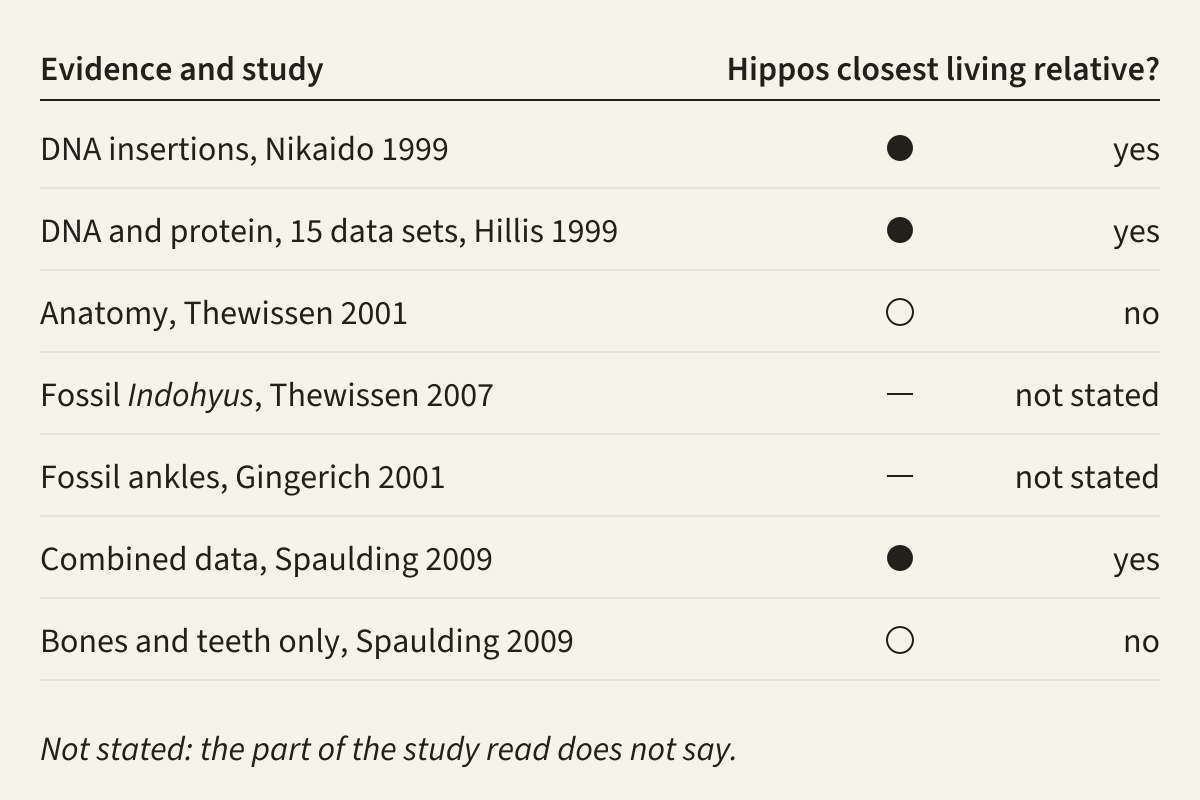
Seven lines of evidence and what each says about hippos. DNA studies and the combined analysis answer yes; the morphological analysis of Thewissen and colleagues (2001) and the bones-and-teeth analysis answer no; the two fossil studies do not address hippos in the parts read here.
Basis Answers as stated in Nikaido et al. 1999, Hillis 1999, Thewissen et al. 2001 and 2007, Gingerich et al. 2001 and Spaulding et al. 2009.
"What seven lines of evidence say about hippos and whales" by Feathers, Skeletons & Nests, https://feathersskeletonsandnests.com/fossils/whale-evolution/ , licensed under CC BY 4.0, https://creativecommons.org/licenses/by/4.0/
The closest fossil relative proposed so far in the sources read here is Indohyus. Thewissen and colleagues (2007) named a candidate from the fossil record: the raoellids, extinct artiodactyls from the Eocene of south Asia, as the sister group of whales. Their raoellid Indohyus resembles whales, and differs from other artiodactyls, in its ears, its premolars, the density of its limb bones and the oxygen isotopes in its teeth. They read raoellids as aquatic waders, which would mean life in water began before the first whales.
The combined analysis of Spaulding and colleagues (2009) holds both answers at once. Among living animals, hippos are the closest relatives of whales; Indohyus sits closer still, on the whale side of that split. The authors call the close link between Indohyus and whales “the primary agreement among all of these analyses”. Yet in their own data, removing the carnivores from the analysis moves Indohyus next to hippos instead.
| Evidence | Study | Points to | Hippos the closest living relative? |
|---|---|---|---|
| DNA insertions (SINEs, LINEs) | Nikaido et al. 1999 | hippos | yes |
| DNA and protein sequences, 15 data sets | as counted by Hillis 1999 | hippos | yes |
| Anatomy, with the new pakicetid skeletons | Thewissen et al. 2001 | artiodactyls, no single family named | no |
| Fossil raoellid Indohyus | Thewissen et al. 2007 | raoellids | not stated in the abstract |
| Fossil ankle bones | Gingerich et al. 2001 | early artiodactyls, not mesonychians | not stated in the abstract |
| Combined DNA, anatomy and behaviour | Spaulding et al. 2009 | Indohyus, then hippos | yes |
| Bones and teeth only | Spaulding et al. 2009 | mesonychians, outside artiodactyls | no |
Did early whales have legs?

Plate 81 from James W. Gidley's 1913 paper on a skeleton mounted in the United States National Museum, labelled on the plate as American Zeuglodon and catalogued today as Basilosaurus. It is a skeletal plate. Look far behind the ribs: a small bone is drawn below the backbone, not joined to it.
"Plate 81, Skeleton of American Zeuglodon, from A recently mounted Zeuglodon skeleton in the United States National Museum" by Gidley, J. W. (1913), Proceedings of the United States National Museum 44, plate 81 — https://commons.wikimedia.org/wiki/File:Gidley-1913-Basilosaurus-skeleton-reconstruction.JPEG — Public domain (US: published 1913, before 1931; EU: author J. W. Gidley d. 1931; plate artist not named on the plate)
Yes. Rodhocetus balochistanensis, a whale about 47 million years old, is known from nearly complete front and hind limbs (Gingerich et al. 2001). The two skeletons in the photo at the top of this page also carry hind legs and feet, and the 2001 paper by Thewissen and colleagues describes the pakicetids as whales that lived on land.
The tie between the legs and the backbone went late. Spaulding and colleagues (2009) used the joint between the pelvis and the backbone as their marker for a whale committed to life in water, and they found it was lost late: “Not until the last common ancestor of Dorudon, Basilosaurus, and crown Cetacea did cetaceamorphans lose the articulation between the pelvis and the vertebral column”. They also conclude that a shift to eating meat, read from tooth shape, came before that loss.
That later group includes Basilosaurus, and Gidley's plate shows how far its body plan had moved: a skull and a short chest at one end, then a long run of large vertebrae. Living whales have gone further and lack hind limbs. The hip bones that many of them still carry inside the body are the subject of vestigial structures, and the finger bones inside a whale's flipper are traced in homologous structures.
Where and when did early whales live?
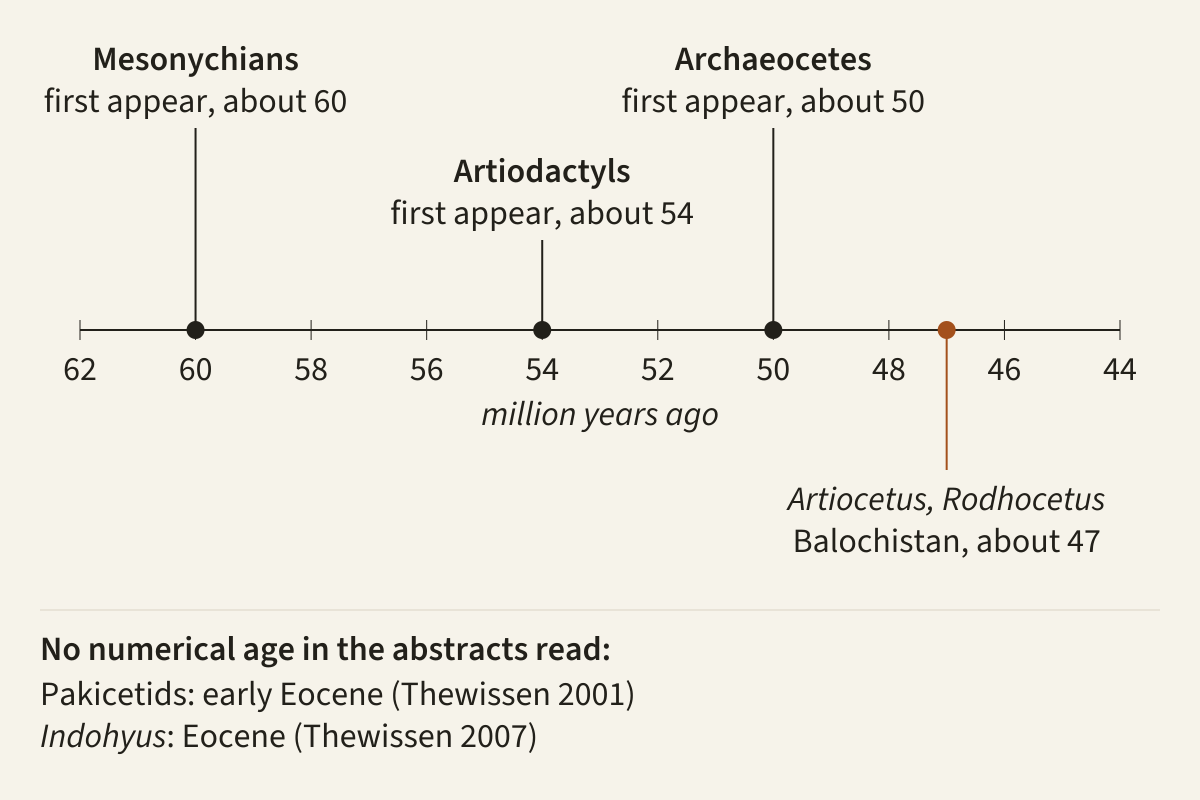
The dated events in this article, from 62 million years ago at the left to 44 at the right. The upper marks are first appearances from Nikaido and colleagues' 1999 summary; the rust mark is the two Balochistan whales. Groups with no numerical age are listed below the line.
Basis Ages from Nikaido et al. 1999 (citing earlier fossil studies) and Gingerich et al. 2001; groups without a numerical age are listed without a position.
"Dated events in early whale evolution" by Feathers, Skeletons & Nests, https://feathersskeletonsandnests.com/fossils/whale-evolution/ , licensed under CC BY 4.0, https://creativecommons.org/licenses/by/4.0/
The early whales in the sources read here come from south Asia. Artiocetus and Rodhocetus come from strata of early Lutetian age, about 47 million years old, in eastern Balochistan Province, Pakistan (Gingerich et al. 2001). Thewissen and colleagues (2007) place the raoellids, Indohyus among them, in the Eocene of south Asia, and the title of their paper names India. The pakicetids are early Eocene (Thewissen et al. 2001).
Nikaido and colleagues (1999), citing earlier fossil studies, give rough first appearances: mesonychians around 60 million years ago, artiodactyls around 54 million years ago and archaeocetes, the early whales, around 50 million years ago. They point out a problem those dates raise. If mesonychians sat inside the artiodactyls, they would appear in the fossil record before any artiodactyl does.
Thewissen and colleagues (2007) note that the first ten million years of whale evolution are documented by a series of fossil skeletons. A fossil skeleton that its first describer could not place, part crocodile and part fish in his eyes, is the subject of Mary Anning’s ichthyosaur, and the opposite move, from water onto land, is the story of Tiktaalik roseae.
| Event | Age given | Place given | Source |
|---|---|---|---|
| Mesonychians first appear | about 60 million years ago | not given | Nikaido et al. 1999, citing earlier work |
| Fossil artiodactyls first appear | about 54 million years ago | not given | Nikaido et al. 1999, citing earlier work |
| Archaeocetes (early whales) first appear | about 50 million years ago | not given | Nikaido et al. 1999, citing earlier work |
| Pakicetids (Pakicetus, Ichthyolestes) | early Eocene | not given in the abstract | Thewissen et al. 2001 |
| Raoellids (Indohyus) | Eocene | south Asia; title names India | Thewissen et al. 2007 |
| Artiocetus and Rodhocetus | about 47 million years ago, early Lutetian | eastern Balochistan Province, Pakistan | Gingerich et al. 2001 |
Same bones, elsewhere:
- Vestigial structures: the hip bones whales still carry.
- Tiktaalik roseae: the opposite move, from water onto land.
Sources
- Philip D. Gingerich, Munir ul Haq, Iyad S. Zalmout, Intizar Hussain Khan and M. Sadiq Malkani, "Origin of whales from early artiodactyls: hands and feet of Eocene Protocetidae from Pakistan", Science 293, no. 5538 (2001): 2239–2242. doi.org/10.1126/science.1063902Read: abstract only
- J. G. M. Thewissen, E. M. Williams, L. J. Roe and S. T. Hussain, "Skeletons of terrestrial cetaceans and the relationship of whales to artiodactyls", Nature 413 (2001): 277–281. doi.org/10.1038/35095005Read: abstract only
- J. G. M. Thewissen, Lisa Noelle Cooper, Mark T. Clementz, Sunil Bajpai and B. N. Tiwari, "Whales originated from aquatic artiodactyls in the Eocene epoch of India", Nature 450 (2007): 1190–1194. doi.org/10.1038/nature06343Read: abstract only
- Masato Nikaido, Alejandro P. Rooney and Norihiro Okada, "Phylogenetic relationships among cetartiodactyls based on insertions of short and long interpersed elements: hippopotamuses are the closest extant relatives of whales", Proceedings of the National Academy of Sciences 96, no. 18 (1999): 10261–10266. doi.org/10.1073/pnas.96.18.10261Read: full text
- David M. Hillis, "SINEs of the perfect character", Proceedings of the National Academy of Sciences 96, no. 18 (1999): 9979–9981. doi.org/10.1073/pnas.96.18.9979Read: full text
- Michelle Spaulding, Maureen A. O'Leary and John Gatesy, "Relationships of Cetacea (Artiodactyla) among mammals: increased taxon sampling alters interpretations of key fossils and character evolution", PLoS ONE 4, no. 9 (2009): e7062. doi.org/10.1371/journal.pone.0007062Read: full textText licence: CC BY (version not stated in the article) (terms)
- Henry Gray, Anatomy of the Human Body, 20th edition, edited by Warren H. Lewis (Philadelphia: Lea & Febiger, 1918), pp. 219, 221, 227, 230, 266–267, 277 and 1044. archive.org/details/anatomyofhumanbo1918grayRead: pages 219, 221, 227, 230, 266, 267, 277 and 1044, checked against the page images
Cite this page
Feathers, Skeletons & Nests. “Whale Evolution: Ankles Tied Whales to Even-Toed Mammals.” first published 17 November 2026. https://feathersskeletonsandnests.com/fossils/whale-evolution/ (accessed on the date you read it).
How facts are sourcedAll correctionsReport an error on this page (contact@feathersskeletonsandnests.com)
More from the Fossils drawer
How Do Fossils Form? Often, Minerals Fill the Pores in Bone
- Kind
- In-depth explainer
- Added
Picture credit
"Plate 37, Various Forms of Ammonites, from Geology and Mineralogy Considered with Reference to Natural Theology" by William Buckland — https://commons.wikimedia.org/wiki/File:Geology_and_Mineralogy_considered_with_reference_to_Natural_Theology,_plate_37.png — Public domain (US: published 1837; EU: author William Buckland d. 1856 (plate engraver not individually traced; Public Domain Mark on the file page); anyone working on the plate in 1837, 119 years before 1956, could not credibly have died after 1955)
Archaeopteryx: A Lone Feather Was Its First Type Specimen
- Kind
- Specimen entry
- Added
Picture credit
"London Archaeopteryx" by Allan Henderson — https://commons.wikimedia.org/wiki/File:London_Archaeopteryx.jpg — CC BY 2.0 (https://creativecommons.org/licenses/by/2.0/)
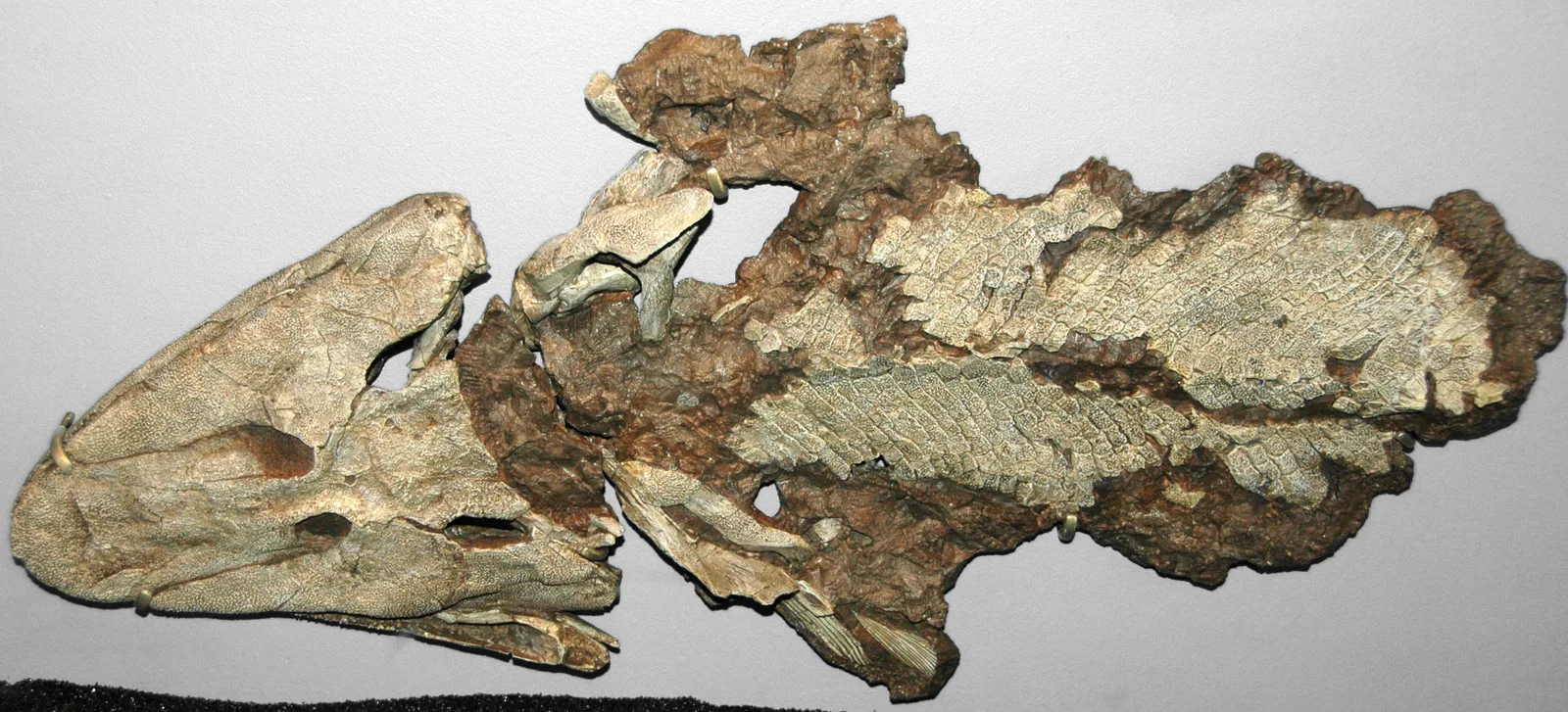
Tiktaalik roseae: A Fish With a Neck and a Wrist Joint
- Kind
- Specimen entry
- Added
Picture credit
"Tiktaalik roseae (fish to amphibian transitional fossil) (Fram Formation, Upper Devonian; Ellesmere Island, Arctic Canada) 1" by James St. John — https://commons.wikimedia.org/wiki/File:Tiktaalik_roseae_(fish_to_amphibian_transitional_fossil)_(Fram_Formation,_Upper_Devonian;_Ellesmere_Island,_Arctic_Canada)_1_(49755118288).jpg — CC BY 2.0 (https://creativecommons.org/licenses/by/2.0/)