Turtle Shell: Its Ribs and Backbone Are Part of the Shell
Short answer
A turtle shell is bone, partly the turtle’s own skeleton: in the upper shell, broadened ribs and vertebral spines are joined to bone formed in the skin, according to a 2019 study by Rainer Schoch and colleagues. Much of the lower shell is thought to have formed from enlarged belly ribs called gastralia. Because the shell is attached to the backbone, a turtle cannot leave it.
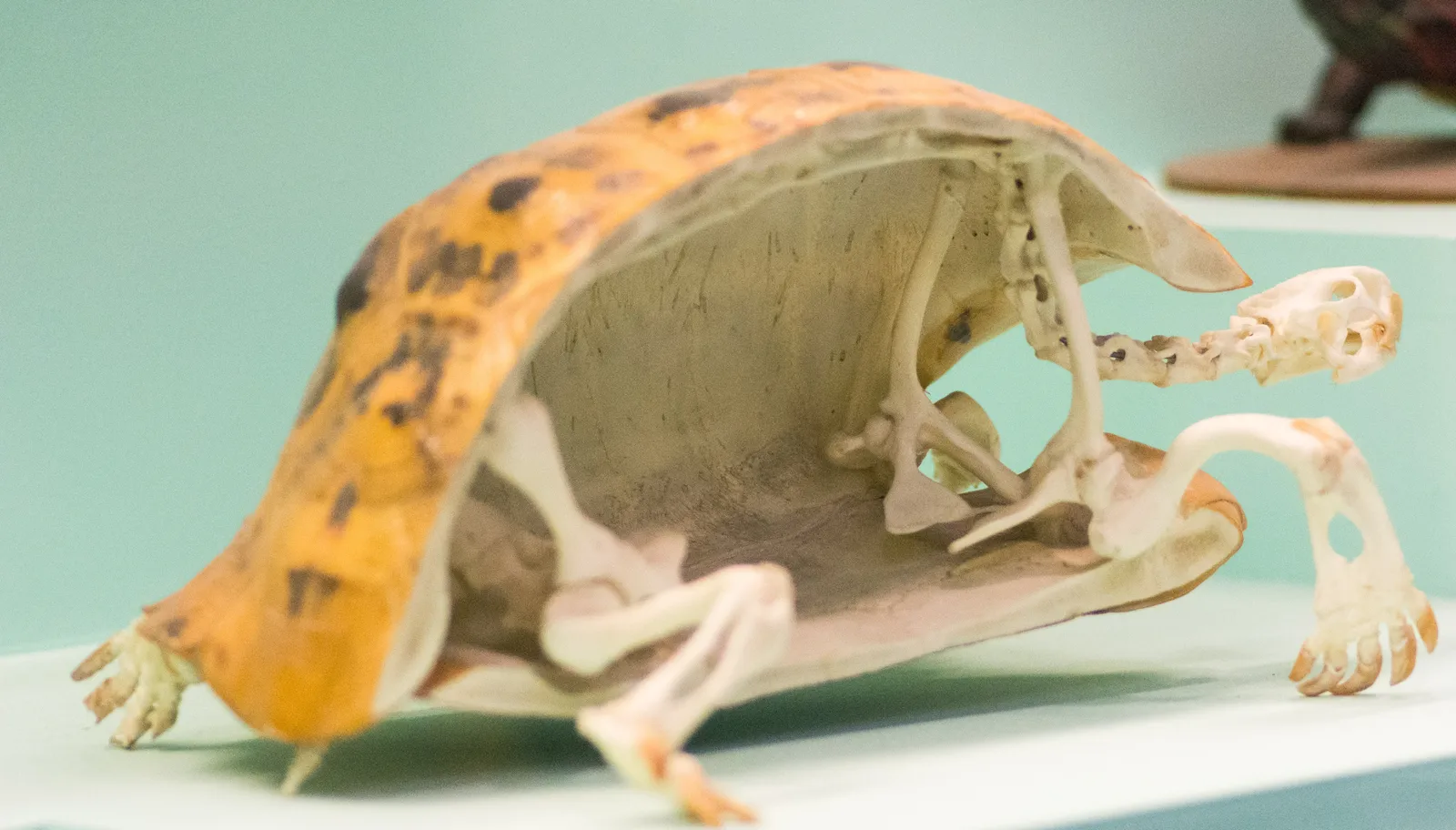
A tortoise skeleton with one side of the shell cut away, on display in the Natural History Museum, London. The neck runs forward to the skull, and the bones that carry the legs hang under the roof of the shell.
"Turtle skeleton cross-section" by Peter Taylor — https://commons.wikimedia.org/wiki/File:Turtle_skeleton_cross-section_(46292294134).jpg — CC BY 2.0 (https://creativecommons.org/licenses/by/2.0/); modified: cropped: bottom 552 px removed (museum display panel with printed text below the skeleton), cropped: right 348 px removed (most of a second mounted turtle at the top right)
Look inside a turtle shell and its roof turns out to be built from the animal’s own ribs and backbone. In the cut-away tortoise above, the skeleton hangs directly beneath that roof. The 2019 paper explains that, unlike those of other reptiles, the trunk ribs of turtles are immobile and extend outward into the skin, where dermal bone covers them.
What is a turtle shell made of?
A turtle shell is bone, and in most turtles that bone is protected by a layer of keratin plates called scutes. The upper shell, the carapace, forms when “broadened ribs and neural spines are combined with secondary metaplastic ossifications, which are sutured to form a rigid shell,” in the words of Schoch and colleagues. Neural spines are the bony projections on top of the vertebrae. Metaplastic ossifications are bone that develops in the dermis, the deep layer of the skin.
A 2020 study of shell shape by Laura Dziomber and colleagues names five kinds of bone in a typical carapace: neurals, costals, a nuchal, peripherals and pygals. The costals are where the ribs ended up. Each costal combines a trunk rib with a covering of bone from the skin. The 2019 paper describes the costals as homologous with the ribs of other amniotes, the vertebrate group that includes reptiles, birds and mammals.
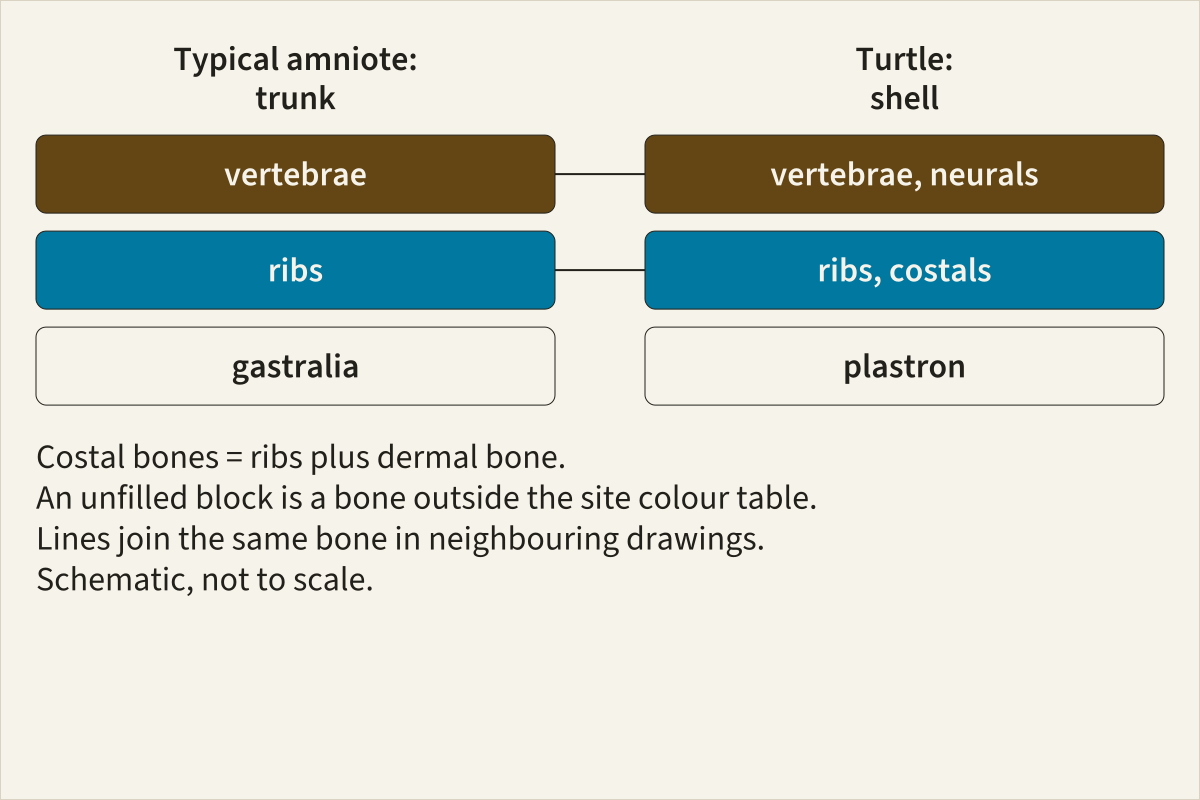
The trunk bones of a typical amniote beside the bones of a turtle shell, one block per group of bones. Lines join the vertebrae to the vertebrae and the ribs to the ribs; the belly ribs, or gastralia, and the plastron are drawn unfilled.
Basis Bones of the shell from Schoch et al. 2019 and Dziomber et al. 2020; colours fixed site-wide.
"Trunk bones of a typical amniote and of a turtle shell" by Feathers, Skeletons & Nests, https://feathersskeletonsandnests.com/skeletons/turtle-shell/ , licensed under CC BY 4.0, https://creativecommons.org/licenses/by/4.0/
Data: Schoch R. R., Klein N., Scheyer T. M., Sues H.-D. (2019) Microanatomy of the stem-turtle Pappochelys rosinae indicates a predominantly fossorial mode of life and clarifies early steps in the evolution of the shell. Scientific Reports 9: 10430, https://doi.org/10.1038/s41598-019-46762-z, CC BY 4.0; Dziomber L., Joyce W. G., Foth C. (2020) The ecomorphology of the shell of extant turtles and its applications for fossil turtles. PeerJ 8: e10490, https://doi.org/10.7717/peerj.10490, CC BY 4.0
The bottom shell, the plastron, has a different history. According to the 2019 paper, the plastron develops without any contribution from the internal skeleton, and researchers have long assumed that much of it formed from fused gastralia, the rod-like ribs of the belly muscles, with bones of the shoulder girdle at the front. The 2020 study lists the gastralia, the clavicle and the interclavicle among the structures incorporated into the shell. On the outside, the scutes are reduced in softshell turtles, pig-nosed turtles and leatherback turtles.
Can a turtle come out of its shell?
No turtle can come out of its shell, because the shell is part of its skeleton. Turtles are “unique among tetrapods in the possession of a bony shell that is integrated with the axial skeleton,” the 2019 paper states, and the axial skeleton includes the backbone and the ribs. A turtle’s trunk ribs do not move. They run outward into the skin inside the costal bones.
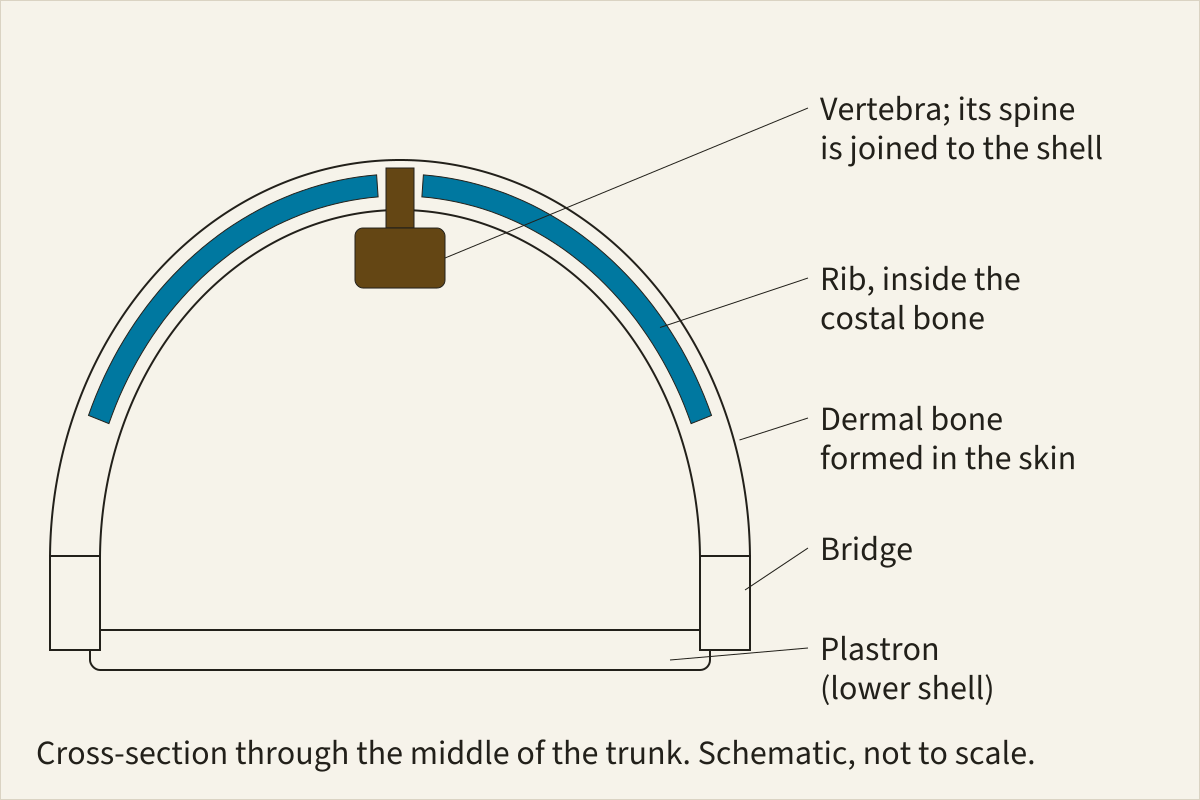
A slice across the middle of a turtle’s trunk. A vertebra sits at the top of the arch with its spine joined to the shell, the ribs run inside the shell layer, and the plastron below meets the upper shell at the bridge on each side.
Basis Shell layers after Schoch et al. 2019 and Dziomber et al. 2020; schematic, not to scale.
"Cross-section of a turtle shell" by Feathers, Skeletons & Nests, https://feathersskeletonsandnests.com/skeletons/turtle-shell/ , licensed under CC BY 4.0, https://creativecommons.org/licenses/by/4.0/
Data: Schoch R. R., Klein N., Scheyer T. M., Sues H.-D. (2019) Microanatomy of the stem-turtle Pappochelys rosinae indicates a predominantly fossorial mode of life and clarifies early steps in the evolution of the shell. Scientific Reports 9: 10430, https://doi.org/10.1038/s41598-019-46762-z, CC BY 4.0; Dziomber L., Joyce W. G., Foth C. (2020) The ecomorphology of the shell of extant turtles and its applications for fossil turtles. PeerJ 8: e10490, https://doi.org/10.7717/peerj.10490, CC BY 4.0
The upper and lower shells meet along each side at a section called the bridge. Think of an old house whose beams were moved out into the walls and plastered over, so that nobody could remove the walls without removing the beams.
Turtle ribs stayed ribs. That sets them apart from the jaw bones that became middle ear bones in mammals. A giraffe shows another way to remodel a backbone, with longer neck vertebrae instead of additional ones.
Which came first, broad ribs or a full shell?
Fossils suggest that broad ribs appeared before a complete upper shell, and that the lower shell was completed first. The 2019 paper compares stem-turtles, extinct relatives on the evolutionary line leading to living turtles. In its words, Pappochelys, Eorhynchochelys and Odontochelys “share broadened, T-shaped ribs” that “do not form a complete carapace,” yet differ in the plastron, “revealing two steps in the evolutionary sequence.”
According to Schoch et al. 2019, the oldest known putative stem-turtle is Eunotosaurus, from the Permian period. The putative stem-turtle Eunotosaurus had broadened but still very long trunk ribs, with thin, rod-like gastralia arranged two per row. Pappochelys, from the Middle Triassic of Germany, had short, broad ribs that could still move slightly, although fibres in the bone suggest that neighbouring ribs were already connected. Its gastralia had thickened into a rigid basket.
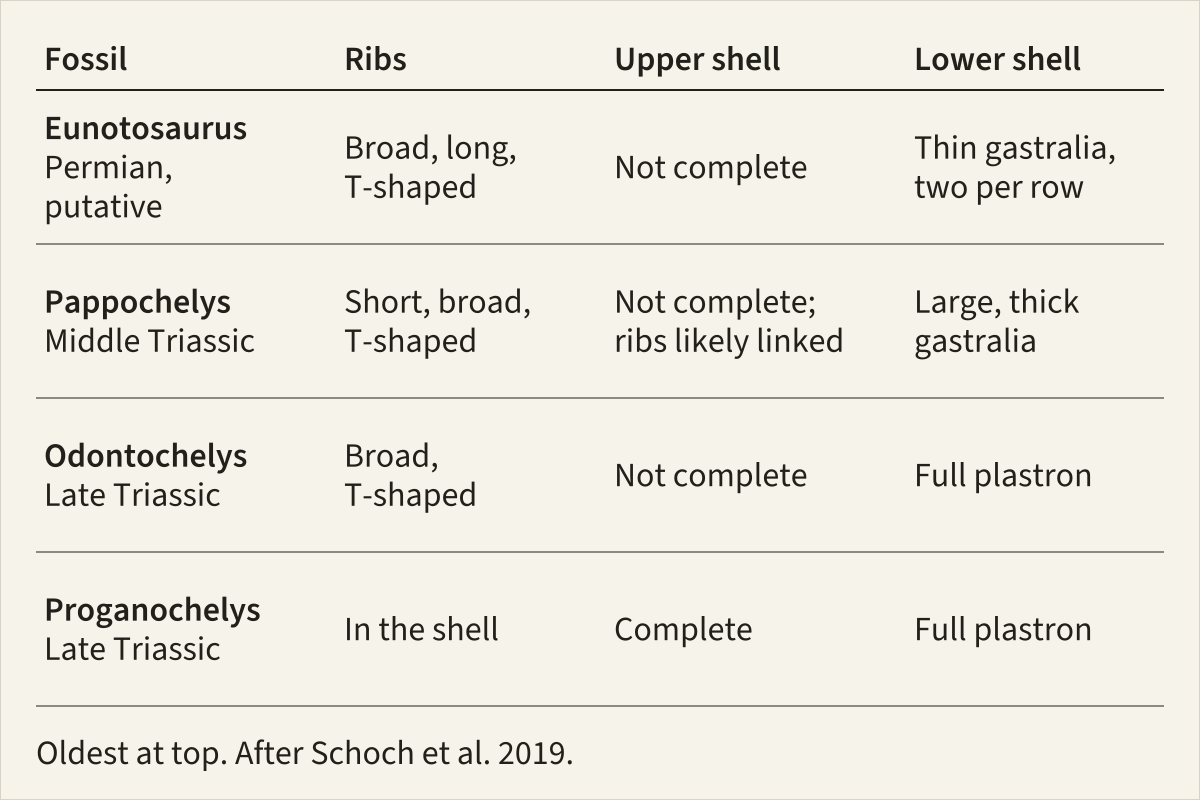
Three fossil stem-turtles and one putative stem-turtle in age order, oldest at the top, with the ribs, the upper shell and the lower shell of each as described in a 2019 study.
Basis Fossil states from Schoch et al. 2019 (CC BY 4.0); a proposed sequence, not a family tree.
"Ribs and shell in three stem-turtles and a putative stem-turtle" by Feathers, Skeletons & Nests, https://feathersskeletonsandnests.com/skeletons/turtle-shell/ , licensed under CC BY 4.0, https://creativecommons.org/licenses/by/4.0/
Data: Schoch R. R., Klein N., Scheyer T. M., Sues H.-D. (2019) Microanatomy of the stem-turtle Pappochelys rosinae indicates a predominantly fossorial mode of life and clarifies early steps in the evolution of the shell. Scientific Reports 9: 10430, https://doi.org/10.1038/s41598-019-46762-z, CC BY 4.0
| Fossil | Age | Ribs | Upper shell | Lower shell |
|---|---|---|---|---|
| Eunotosaurus (putative stem-turtle) | Permian | Broad, very long, T-shaped | Not complete | Thin gastralia, two per row |
| Pappochelys | Middle Triassic | Short, broad, T-shaped | Not complete; ribs likely linked | Large, thick gastralia |
| Odontochelys | Late Triassic | Broad, T-shaped | Not complete | Fully formed plastron |
| Proganochelys | Late Triassic | Part of a complete shell | Complete | Complete plastron |
Download the fossil steps table (CSV) (what this file records) Data: Schoch R. R., Klein N., Scheyer T. M., Sues H.-D. (2019) Microanatomy of the stem-turtle Pappochelys rosinae indicates a predominantly fossorial mode of life and clarifies early steps in the evolution of the shell. Scientific Reports 9: 10430, https://doi.org/10.1038/s41598-019-46762-z, CC BY 4.0
Odontochelys, from the Late Triassic of China, already had a fully formed plastron but still no complete carapace. Fully shelled stem-turtles such as Proganochelys appear later. The authors propose an explanation for this order: the ribs still had joints, which “might explain why the carapace evolved more slowly than the plastron,” since the rib cage still had to move for breathing.
Based on the evidence available in 2019, the same paper concludes that these early steps probably took place on land rather than in water. In that interpretation, the early shell was driven by the need to strengthen the trunk during digging rather than by protection in water. How bones like these survive long enough to be studied is the subject of how fossils form.
Why do turtle shells look so different?
Turtle shells differ in overall shape, and the number and contacts of their bones and scutes “vary immensely across turtles,” Dziomber and colleagues write. Their 2020 study compared the three-dimensional shape of shells from 69 living turtles and three fossils. Teardrop-shaped shells are more typical of turtles living in the open ocean, while highly domed shells are common among turtles living on land.
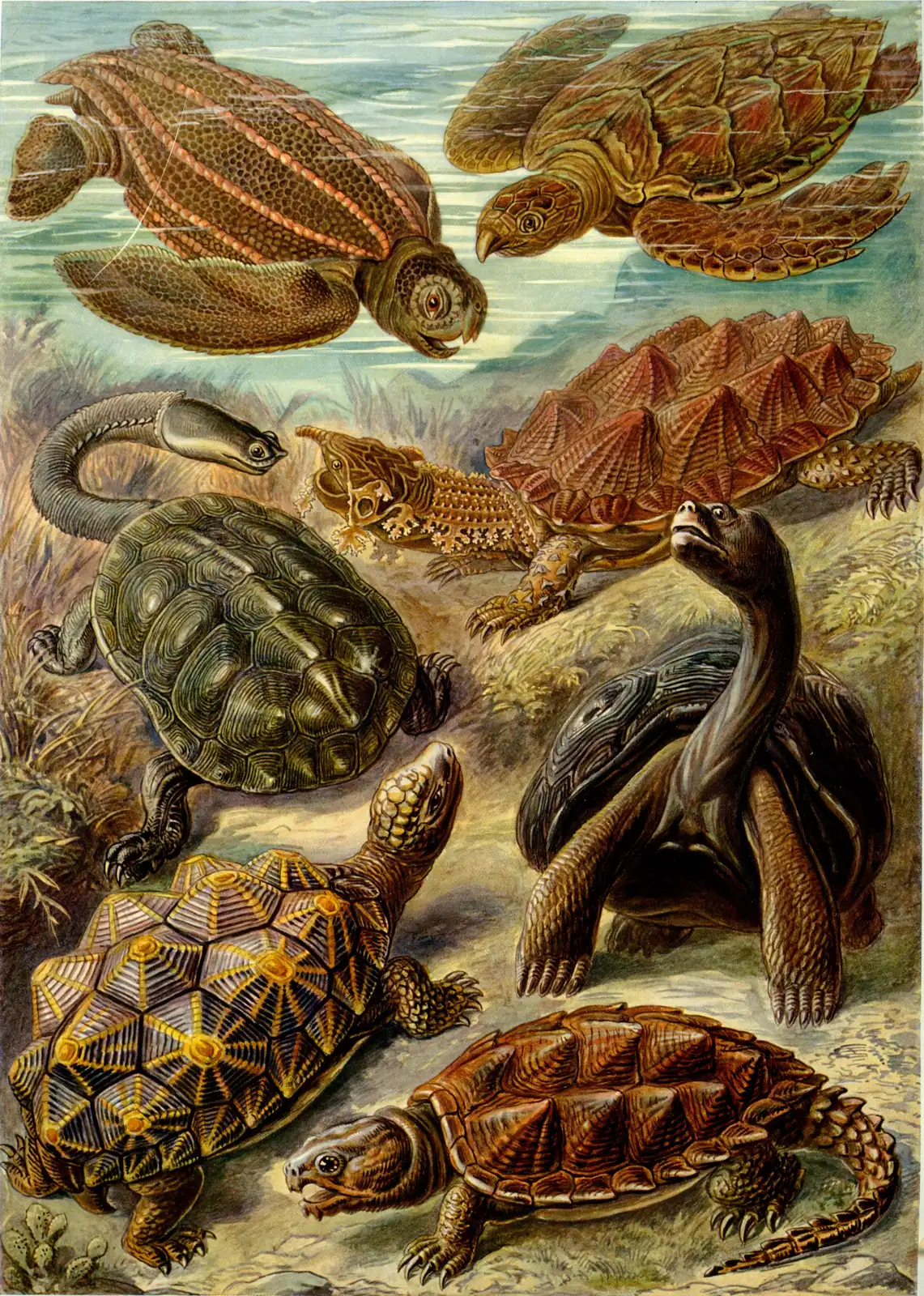
Plate 89 of Ernst Haeckel’s Kunstformen der Natur (1904), Chelonia. The file record lists seven species, among them the leatherback turtle, at the top left with ridges along its back, and the geometric tortoise, at the bottom left with star patterns on its scutes.
"Chelonia, plate 89, from Kunstformen der Natur" by Ernst Haeckel, Kunstformen der Natur (1904), plate 89 — https://commons.wikimedia.org/wiki/File:Haeckel_Chelonia.jpg — Public domain (US: published 1904, before 1931; EU: artist Ernst Haeckel d. 1919, lithographer Adolf Giltsch d. 1911)
Shape alone is an unreliable guide to habitat, however. Most living turtles in the study had an intermediate shell shape regardless of habitat. The pancake tortoise is a greatly flattened turtle that lives on land. The authors conclude that the rule of thumb linking a domed shell to life on land “should be avoided, as many turtles perceived to be highly domed have an aquatic ecology.”
The leatherback on the plate belongs to one of the groups with reduced scutes. Its back shows ridges instead of separate plates. Whatever the outside looks like, a turtle grows its shelter from its own bones, while a termite colony constructs one from soil, as in a termite mound.
Same bones, elsewhere:
- Middle ear evolution: bones that changed jobs, from the jaw to the ear.
- How do fossils form?: how fossil stem-turtles were preserved well enough to read.
Sources
- Rainer R. Schoch, Nicole Klein, Torsten M. Scheyer and Hans-Dieter Sues, "Microanatomy of the stem-turtle Pappochelys rosinae indicates a predominantly fossorial mode of life and clarifies early steps in the evolution of the shell", Scientific Reports 9 (2019): 10430. doi.org/10.1038/s41598-019-46762-zRead: full textText licence: CC BY 4.0 (terms)
- Laura Dziomber, Walter G. Joyce and Christian Foth, "The ecomorphology of the shell of extant turtles and its applications for fossil turtles", PeerJ 8 (2020): e10490. doi.org/10.7717/peerj.10490Read: full textText licence: CC BY 4.0 (terms)
Cite this page
Feathers, Skeletons & Nests. “Turtle Shell: Its Ribs and Backbone Are Part of the Shell.” first published 17 November 2026. https://feathersskeletonsandnests.com/skeletons/turtle-shell/ (accessed on the date you read it).
How facts are sourcedAll correctionsReport an error on this page (contact@feathersskeletonsandnests.com)
More from the Skeletons drawer
Homologous Structures: Same Bones, Different Counts
- Kind
- In-depth explainer
- Added
Picture credit
"Plate VI, Man and the elephant, from A Comparative View of the Human and Animal Frame" by Benjamin Waterhouse Hawkins — https://commons.wikimedia.org/wiki/File:Comparative_view_of_the_human_and_elephant_frame,_Benjamin_Waterhouse_Hawkins,_1860.jpg — Public domain (US: published 1860; EU: artist Benjamin Waterhouse Hawkins d. 1894, who drew the plate on stone himself (printer Vincent Brooks, dates not checked))
Vestigial Structures: A Whale’s Hip Bones Anchor Muscles
- Kind
- Comparison and reading
- Added
Picture credit
"Skeleton of a baleen whale, from Meyers Konversations-Lexikon, 4th edition" by Unknown author, Meyers Konversations-Lexikon (1888) — https://commons.wikimedia.org/wiki/File:Whale_skeleton.png — Public domain (US: published 1888, before 1931; EU: anonymous work published 1888, more than 70 years ago)
Middle Ear Evolution: Two Jaw Bones Became Ear Bones
- Kind
- In-depth explainer
- Added
Picture credit
"Thrinaxodon fossil, Iziko South African Museum" by Nkansahrexford — https://commons.wikimedia.org/wiki/File:Iziko_Thrinaxodon_fossil.JPG — CC BY 3.0 (https://creativecommons.org/licenses/by/3.0/); modified: cropped: top 120 px removed (museum display panel with printed text above the fossil block)