Termite Mound: In One Study, Day and Night Flip the Airflow
Short answer
In termite mounds measured in India, air in the outer ridges, or flutes, drifted slightly upward by day and flowed clearly downward at night; by the authors' reasoning, the central chimney did the reverse. Daily temperature swings, not wind, drove the flip: in these Odontotermes obesus mounds, the flutes warm faster than the core by day, cool faster at night.
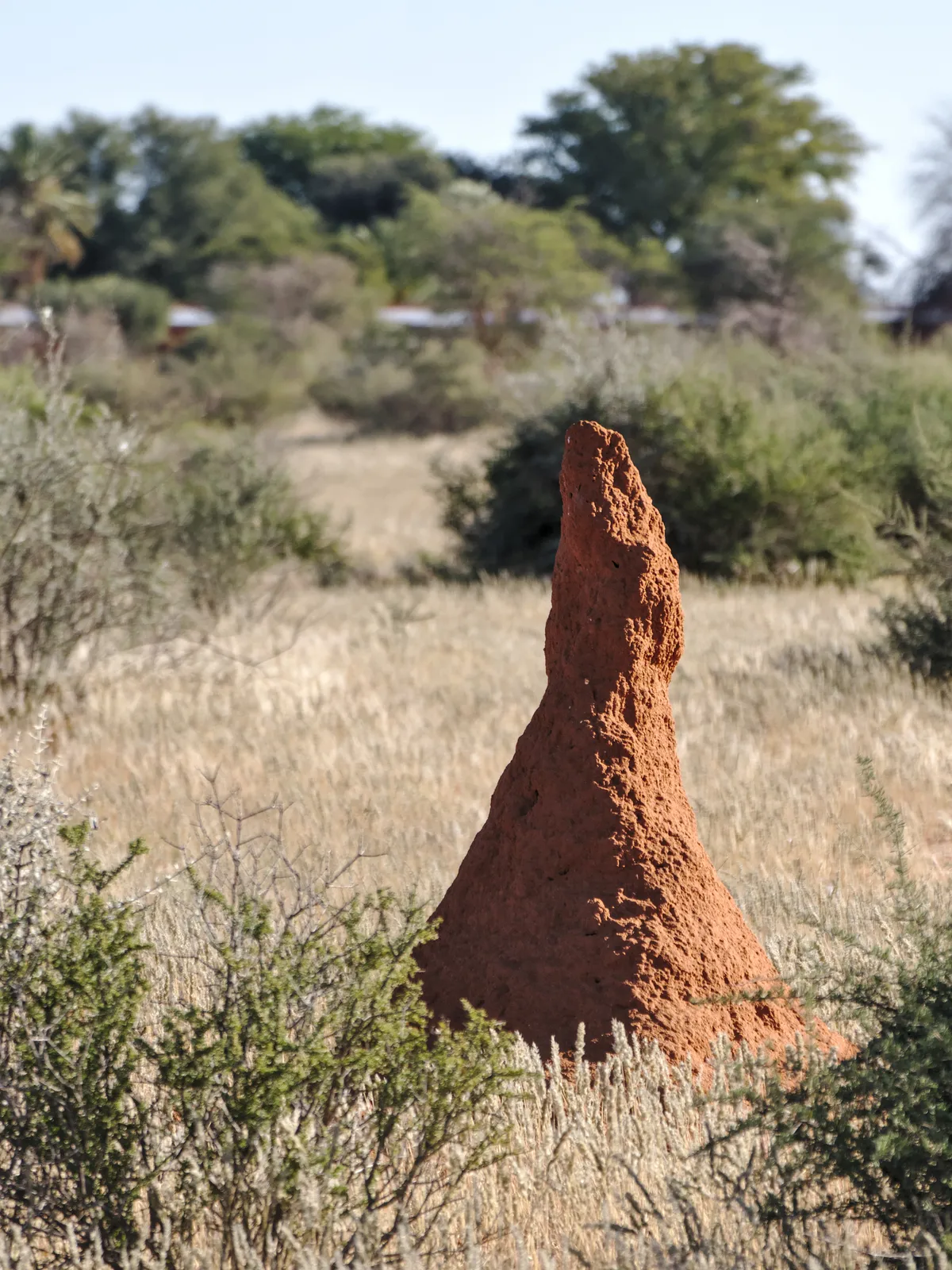
A termite mound rising from dry grass in the Kalahari, Namibia. The photo's file record does not name the termite species; the airflow study on this page was made on mounds in India.
"Namibia Kalahari Desert Termite Mound" by Alexander Klink — https://commons.wikimedia.org/wiki/File:Namibia_Kalahari_Desert_Termite_Mound.jpg — CC BY 4.0 (https://creativecommons.org/licenses/by/4.0/)
Inside a termite mound near Bangalore, India, air runs one way by day and the other way by night. That reversal was measured inside the mound's own air passages, a few minutes at a time, not inferred from the outside. Hunter King, Samuel Ocko and L. Mahadevan published the measurements in 2015, working on mounds of Odontotermes obesus, a fungus-growing termite that their paper describes as common in southern Asia.
Which way does the air move, and when?
An Odontotermes obesus mound stands about 1 to 2 metres above the ground; the tallest are about the height of a door. Ridges called flutes run down its sides like buttresses, and each flute holds a vertical air passage, or conduit, close to the surface. A wide central chimney runs down the middle toward the nest. King and colleagues found the passages joined at the top and in the nest below, so air can travel around a closed loop.
In the mounds studied, the air in the flutes changed direction with the time of day. By day it drifted slightly upward. At night it flowed clearly downward, and many night readings ran past the sensor's reliable range. Speeds were of the order of a centimetre per second, about a hundredth of the pace of a slow walk at 1 metre per second.
The chimney, by the authors' account, carries the return flow. Because the passages form a loop and the outer walls let almost no air through in bulk, the authors reason that air in the centre has to move opposite to the air in the flutes. By that reasoning, air sank down the chimney by day and rose up it at night.
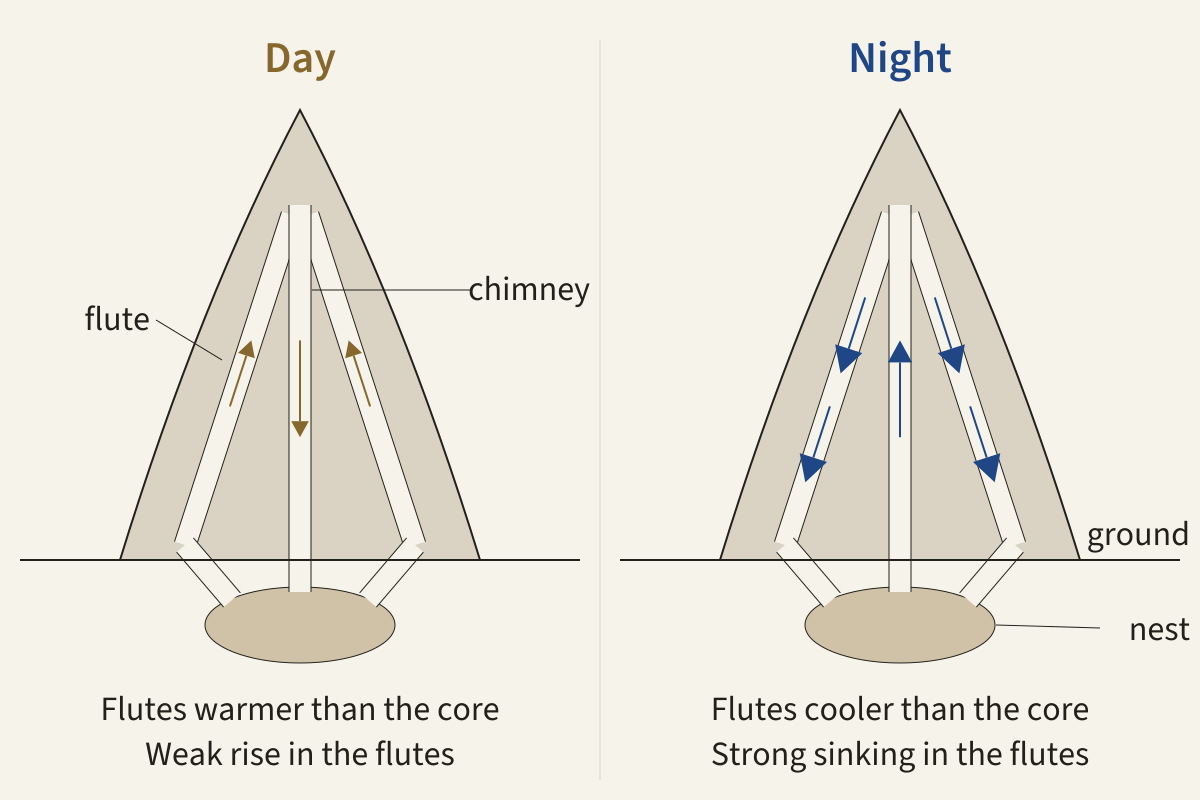
The same mound drawn twice. By day, a weak rise of air in the flutes is balanced by sinking in the chimney; by night the flutes carry a strong downward flow and the chimney a rising one. The flute flow was measured; the chimney direction is the authors' inference. Arrow size shows only weak against strong.
Basis Flow directions in Odontotermes obesus mounds as described by King, Ocko and Mahadevan (2015); schematic, not to scale.
"Air flow in a termite mound by day and by night" by Feathers, Skeletons & Nests, https://feathersskeletonsandnests.com/animal-builders/termite-mound/ , licensed under CC BY 4.0, https://creativecommons.org/licenses/by/4.0/
| In the mounds studied | Flutes (outer ridges) | Central chimney (inferred) |
|---|---|---|
| Day | slight upward flow | downward flow |
| Night | strong downward flow | upward flow |
Do termites live inside the mound?
Mostly they do not. In Odontotermes obesus, the nest that holds the young termites and the fungus the colony cultivates lies underground. The tall mound above is entered mainly for building and repair and is otherwise largely empty, King and colleagues write. Its walls are made of tightly packed grains of clay soil, laid by termites only a few millimetres long.
How the insects coordinate that building is still an open question. Citing earlier work, the paper describes mound building as decentralized, with no colony member directing the rest, and calls the behaviour behind it not well understood. The authors suggest that feedback cues are likely to matter, and that knowing the air flows inside could help explain how the shape arises.
What drives the flow if not the wind?
The driver is the shape of the mound meeting the daily cycle of warm and cool air. The flutes are thin and exposed, so they heat up quickly in the day and lose heat quickly at night. The core is massive and changes temperature slowly. In daylight the air in the flutes ends up warmer and lighter than the air in the core, so it rises; after dark the flutes are the cooler side, and their air sinks.
The measurements back this up in three ways. The temperature difference between flutes and centre rose and fell in step with the flow. An abandoned mound, with no termites in it, showed the same pattern of temperatures and flows, which rules out the colony's own body heat as the main driver. Temperature sensors along the centre of a live mound also found the nest to be almost always the coolest point on that axis.
A rough calculation in the paper checks the scale. Treating the passages as one closed loop of pipe 3 centimetres in radius, with a 3 °C difference between its two sides, the authors arrived at about 35 centimetres per second, roughly ten times the speeds they measured. They put the gap down to the narrow, uneven passages of a real mound. The point, they write, is that the temperature differences they observed are enough to drive flow of the measured order.
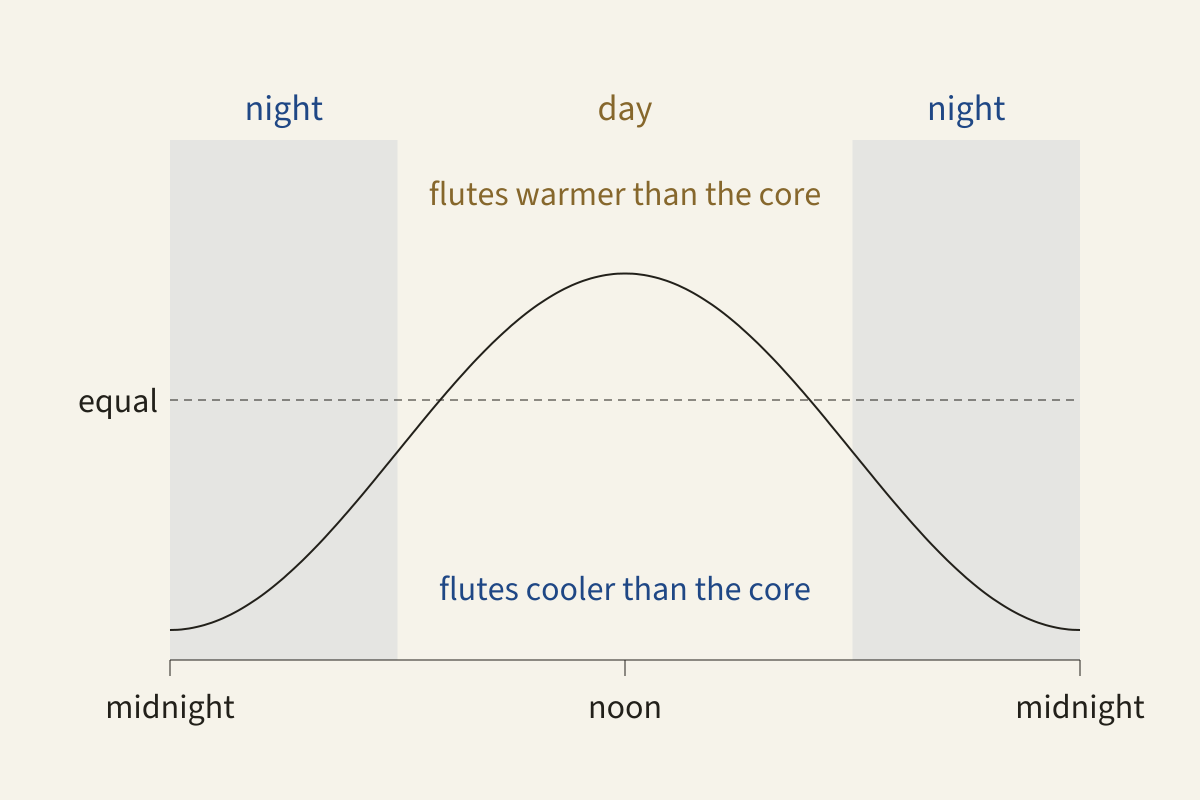
Which side of the mound is warmer through one day, drawn as a schematic curve: the flutes are warmer than the core in daylight and cooler at night, when the gap is larger.
Basis Sign of the flute-minus-core temperature difference as described by King, Ocko and Mahadevan (2015); schematic, no measured values plotted.
"Which is warmer, the flutes or the core, through one day" by Feathers, Skeletons & Nests, https://feathersskeletonsandnests.com/animal-builders/termite-mound/ , licensed under CC BY 4.0, https://creativecommons.org/licenses/by/4.0/
Why not the wind?
Wind was the obvious alternative, and earlier studies had proposed it. The walls, though, are 37 to 47 percent air by volume, held in pores only about 5 µm across. Air can diffuse through such a wall, but it is very hard to push through it in bulk; the paper likens the surface to a windbreaker that still breathes.
Around these mounds the wind typically ran from calm to about 5 metres per second, a gentle breeze. The authors found this too weak to force much air through the walls, “effectively ruling out wind as the primary driving source” (preprint, p. 1).
Their numbers make the gap plain. A 5 metre per second wind could push air through the wall at about 0.01 millimetres per second, around a thousandth of the speed in the flutes. A powerful fan, run steadily or in pulses just outside a mound, set off at most negligible flickers of flow inside. Nor was direct sunlight the main driver: flutes on all four compass sides of one mound behaved alike, and shading an abandoned mound left its daily pattern in place.
How was the airflow measured?
Measuring air inside a working mound is awkward. The flows are small, the walls are opaque, and the termites attack anything pushed inside, coating it with building material, often within about 10 minutes. They then keep rebuilding around it for hours, which changes the very passage being measured.
King and colleagues built their own sensor from three tiny glass-bead thermistors, temperature sensors set in a line. The middle bead released a brief pulse of heat, and whichever outer bead warmed more showed the direction and strength of the flow. The probe sat in the conduit at the base of a flute, through a small hole the researchers cut, for only a few minutes. A live mound is a working colony's home; one seen in the wild is best watched from a distance and left undisturbed.
The study covered 78 flutes on 25 live mounds, mostly in shaded forest. Each mound was visited two or three times at different hours. No flute was measured twice. An abandoned mound, with no termites to damage the sensor, was read continuously.
In one large live mound, air was drawn from the nest and from the chimney about 1.5 metres up, every 15 minutes for most of a day. Carbon dioxide built up to nearly 6 percent of the nest air by day and stayed low everywhere at night.
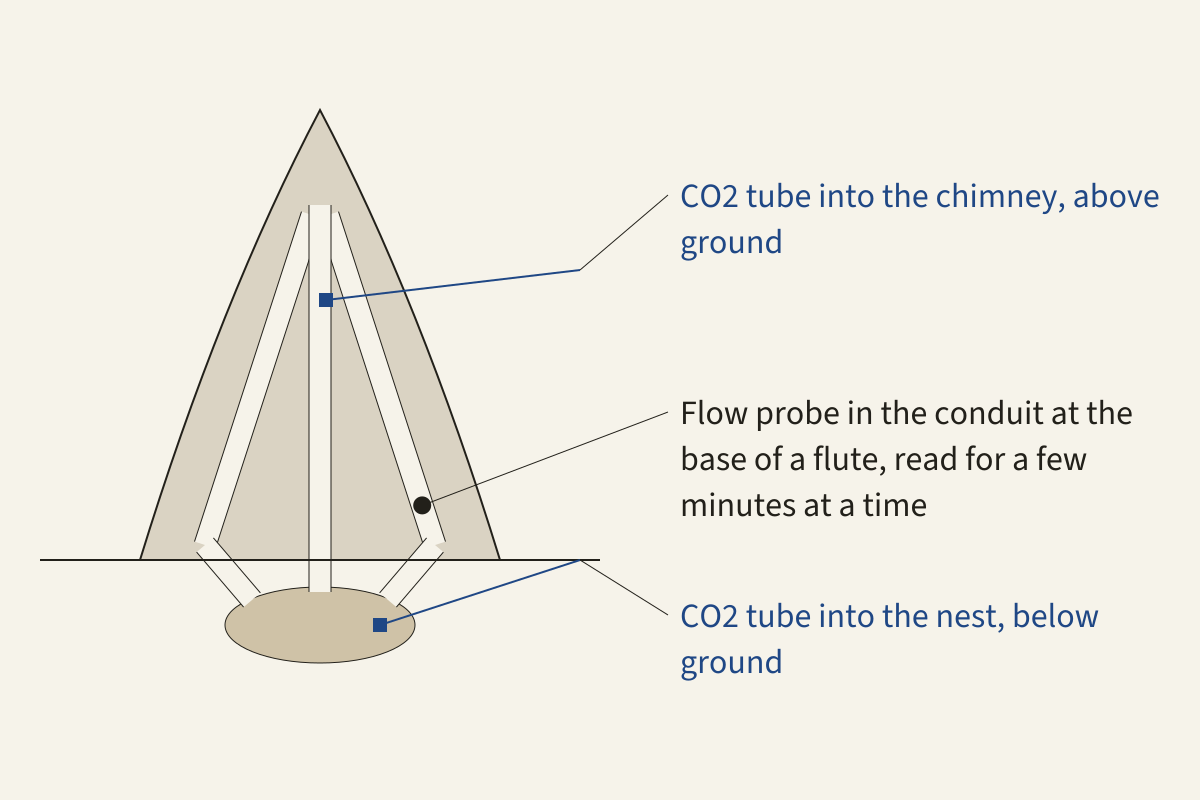
Where the instruments went: a flow probe in the conduit at the base of a flute, and sampling tubes for carbon dioxide in the chimney and in the underground nest.
Basis Sensor and sampling positions as described by King, Ocko and Mahadevan (2015); schematic, not to scale.
"Where the probes and sampling tubes went" by Feathers, Skeletons & Nests, https://feathersskeletonsandnests.com/animal-builders/termite-mound/ , licensed under CC BY 4.0, https://creativecommons.org/licenses/by/4.0/
The authors also give the limits of their readings. Conduit shapes vary, so a single reading could be off by up to about a factor of two, but not in direction, which is why the day and night trend holds across many flutes. A few flutes went against the trend, as expected in such tangled passages.
| King, Ocko and Mahadevan (2015) | Ocko and colleagues (2017) | |
|---|---|---|
| Termite | Odontotermes obesus | Macrotermes michaelseni |
| Setting | near Bangalore, India; mostly shaded forest | African mounds |
| What was measured | air flow in 78 flutes of 25 live mounds; one abandoned mound continuously; carbon dioxide in one mound | air speeds and temperatures inside the mounds |
| Main finding | flow up the flutes by day and down at night, driven by daily temperature swings | overall mechanism similar, with differences in solar heating and in carbon dioxide |
| Read for this page | full text (preprint) | abstract only |
Do other termite mounds work the same way?
All of the 2015 data came from one species. The authors expected the same mechanism to dominate in similarly massive mounds with no holes to the outside. That was their expectation, not a measurement.
A 2017 study led by Samuel Ocko turned to an African termite, Macrotermes michaelseni, in a very different environment. Its abstract reports that air speeds and temperatures measured inside the mounds showed an overall mechanism similar to the south Asian species. It also reports differences: heating by the sun as it moves across the sky shaped the African flows more than in the shaded Asian mounds, and carbon dioxide there stayed relatively even, while the Asian mounds turned over their layered gases once a day.
The walls differ too. Odontotermes obesus quickly sealed narrow holes made for sampling, while, according to the 2015 paper, its authors saw Macrotermes michaelseni in Namibia leave such holes open. Termite mounds elsewhere can look very different from the ones measured, like this one in Etosha National Park, whose builders are not identified.
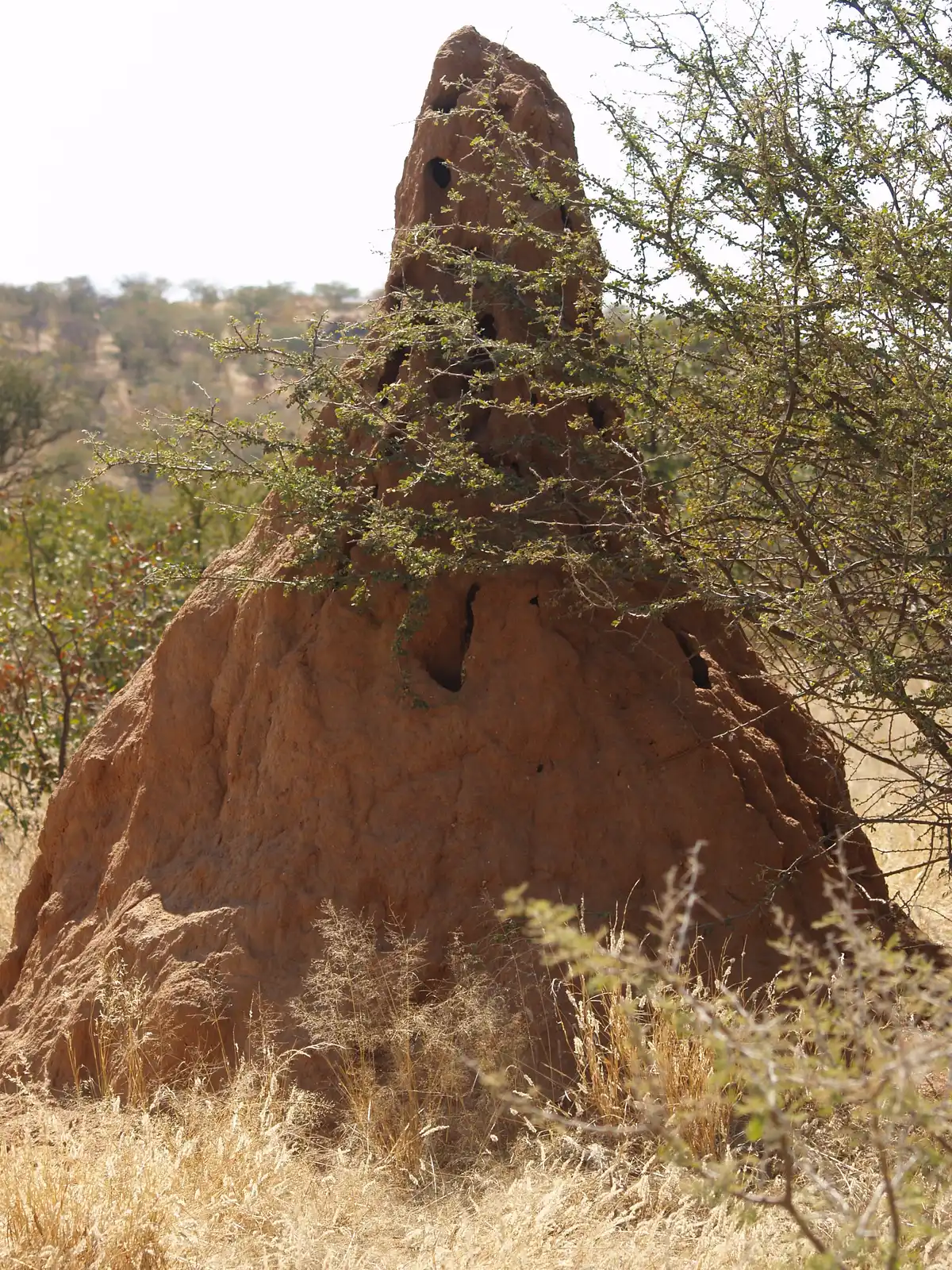
A termite mound in Etosha National Park, Namibia, with dark openings in its upper wall. The photo's file record does not name the termite species.
"Termite mound -Etosha National Park, Namibia-8" by Rui Ornelas — https://commons.wikimedia.org/wiki/File:Termite_mound_-Etosha_National_Park,_Namibia-8.jpg — CC BY 2.0 (https://creativecommons.org/licenses/by/2.0/)
Is a termite mound an air conditioner?
A widely repeated story describes termite mounds as natural air conditioners that hold the inside cool and steady. The measurements in the mounds studied tell a busier story. The air did not settle into one steady state; it reversed between day and night, and carbon dioxide piled up in the nest by day before the night-time flow cleared it.
In the chimney, carbon dioxide rose quickly in the evening, as the reversed flow began pushing nest air upward, then fell gradually as the gas diffused out through the walls. The mechanism runs on change. If flutes and core ever settled at the same temperature, the authors note, the ventilation would stop.
King and colleagues open their paper with a widely accepted idea: mounds give the colony a controlled climate for its fungus and young by managing heat, humidity and gas exchange. Their work addressed the gas-exchange part. They compare the mound to a lung for the colony, an image the 2017 abstract also uses. In closing, they say their study puts numbers on the long-held idea that such mounds buffer a colony against outside swings, by showing how the mound harnesses daily temperature swings to help it breathe.
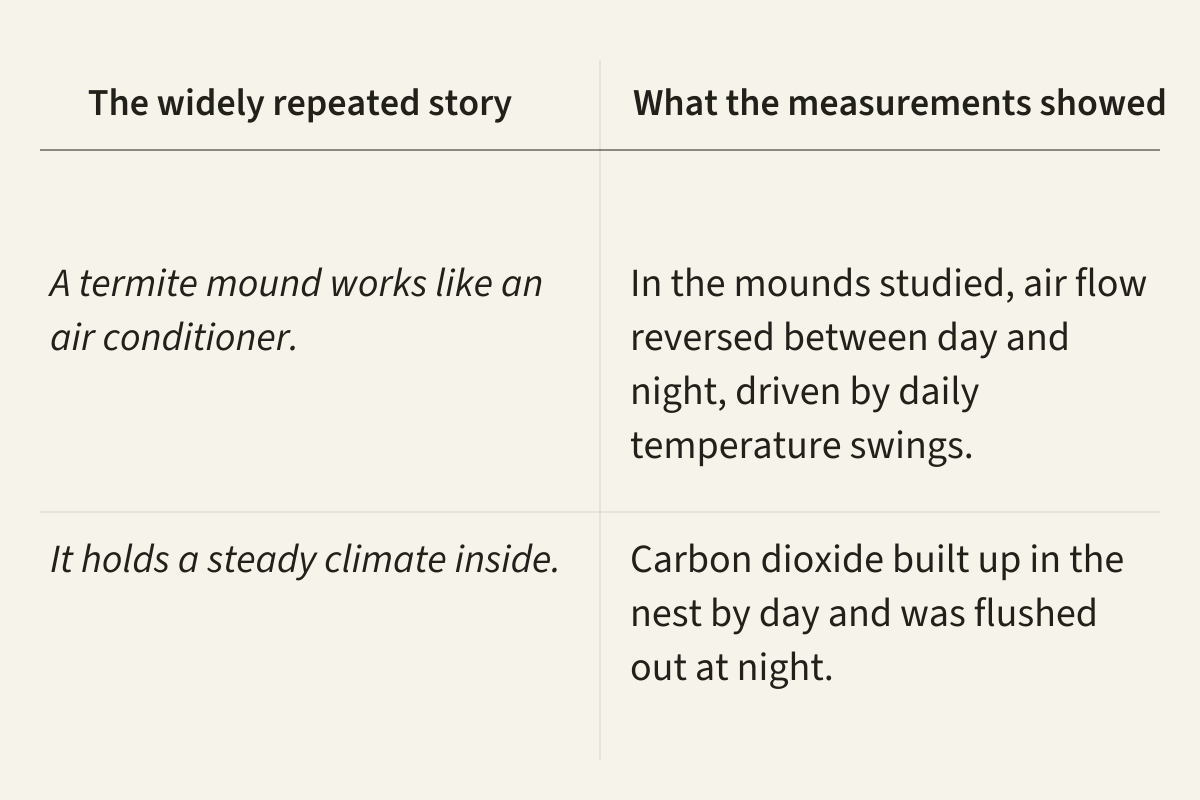
The widely repeated story set beside what was measured in the mounds studied.
Basis Measured results from King, Ocko and Mahadevan (2015); the story column is not attributed to any source.
"A widely repeated story beside what was measured" by Feathers, Skeletons & Nests, https://feathersskeletonsandnests.com/animal-builders/termite-mound/ , licensed under CC BY 4.0, https://creativecommons.org/licenses/by/4.0/
| The widely repeated story | What the measurements showed, in the mounds studied |
|---|---|
| A termite mound works like an air conditioner. | Air flow reversed between day and night, driven by daily temperature swings. |
| It holds a steady climate inside. | Carbon dioxide built up in the nest by day and was flushed out at night. |
The mound is the product of evolved building behaviour in insects a few millimetres long, and calling it either genius or mere instinct skips the part that was measured. Other builders answer other problems: a beaver dam works with water instead of soil, and a bowerbird's court is built for display, not for living in.
Same bones, elsewhere:
- Sociable weaver nest: a bird nest whose chambers a 2020 study found warmer than cold night air.
- Turtle shell: a shelter grown from ribs instead of built from soil.
Sources
- Hunter King, Samuel A. Ocko and L. Mahadevan, "Termite mounds harness diurnal temperature oscillations for ventilation", Proceedings of the National Academy of Sciences 112, no. 37 (2015): 11589–11593; preprint arXiv:1703.08067. arxiv.org/abs/1703.08067Read: full text of the preprint version (arXiv:1703.08067v1)
- Samuel A. Ocko, Hunter King, David Andreen, Paul Bardunias, J. Scott Turner, Rupert Soar and L. Mahadevan, "Solar-powered ventilation of African termite mounds", Journal of Experimental Biology 220, no. 18 (2017): 3260–3269. doi.org/10.1242/jeb.160895Read: abstract only
Cite this page
Feathers, Skeletons & Nests. “Termite Mound: In One Study, Day and Night Flip the Airflow.” first published 17 November 2026. https://feathersskeletonsandnests.com/animal-builders/termite-mound/ (accessed on the date you read it).
How facts are sourcedAll correctionsReport an error on this page (contact@feathersskeletonsandnests.com)
More from the Animal Builders drawer
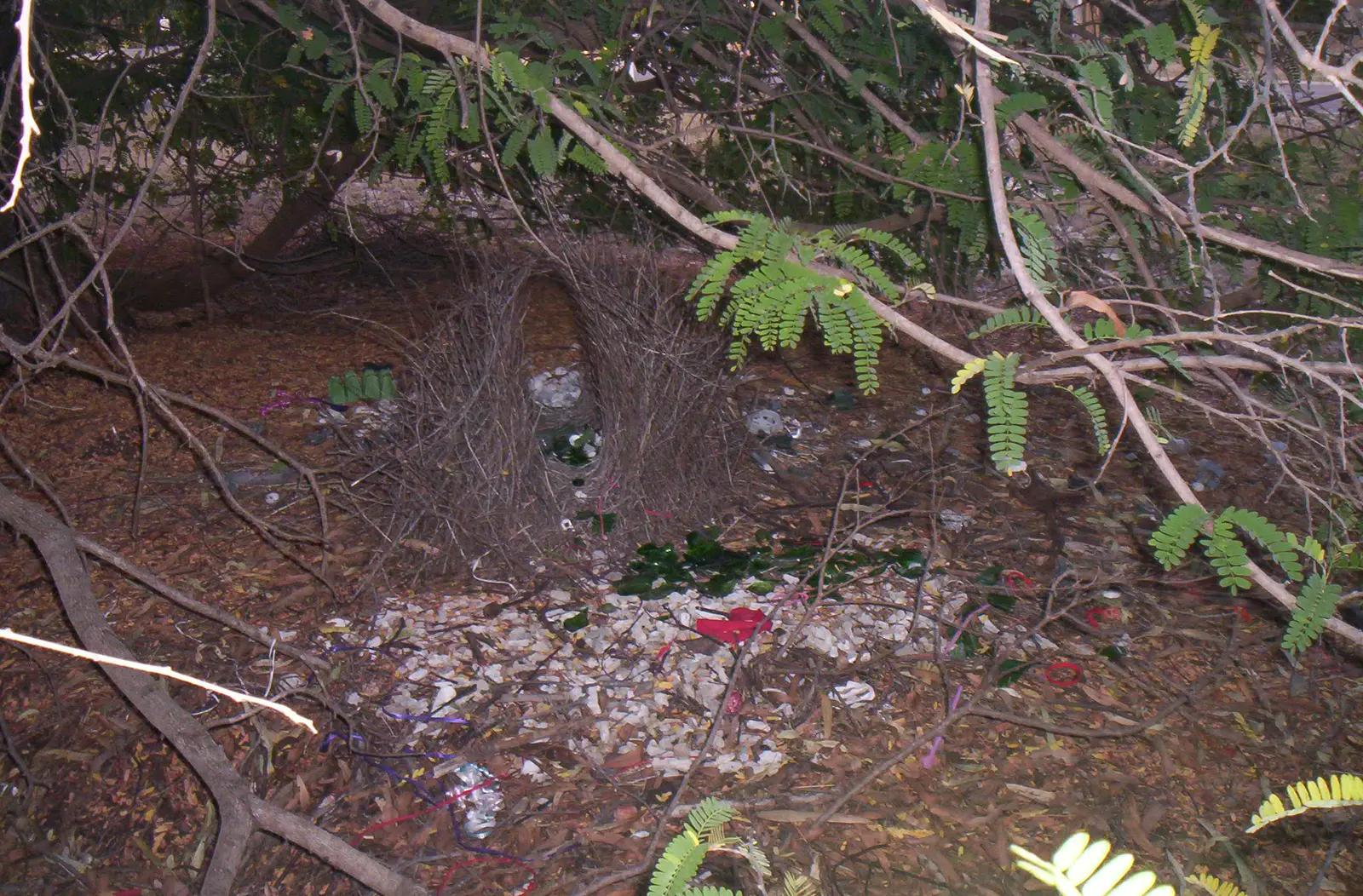
Great Bowerbird: Its Court Stones Are Sorted by Size
- Kind
- Specimen entry
- Added
Picture credit
"Great bowerbird bower, Horseshoe Bay, Bowen" by John Robert McPherson — https://commons.wikimedia.org/wiki/File:Great_bowerbird_bower,_Horseshoe_Bay,_Bowen_101_0183.jpg — CC0 1.0 (https://creativecommons.org/publicdomain/zero/1.0/)
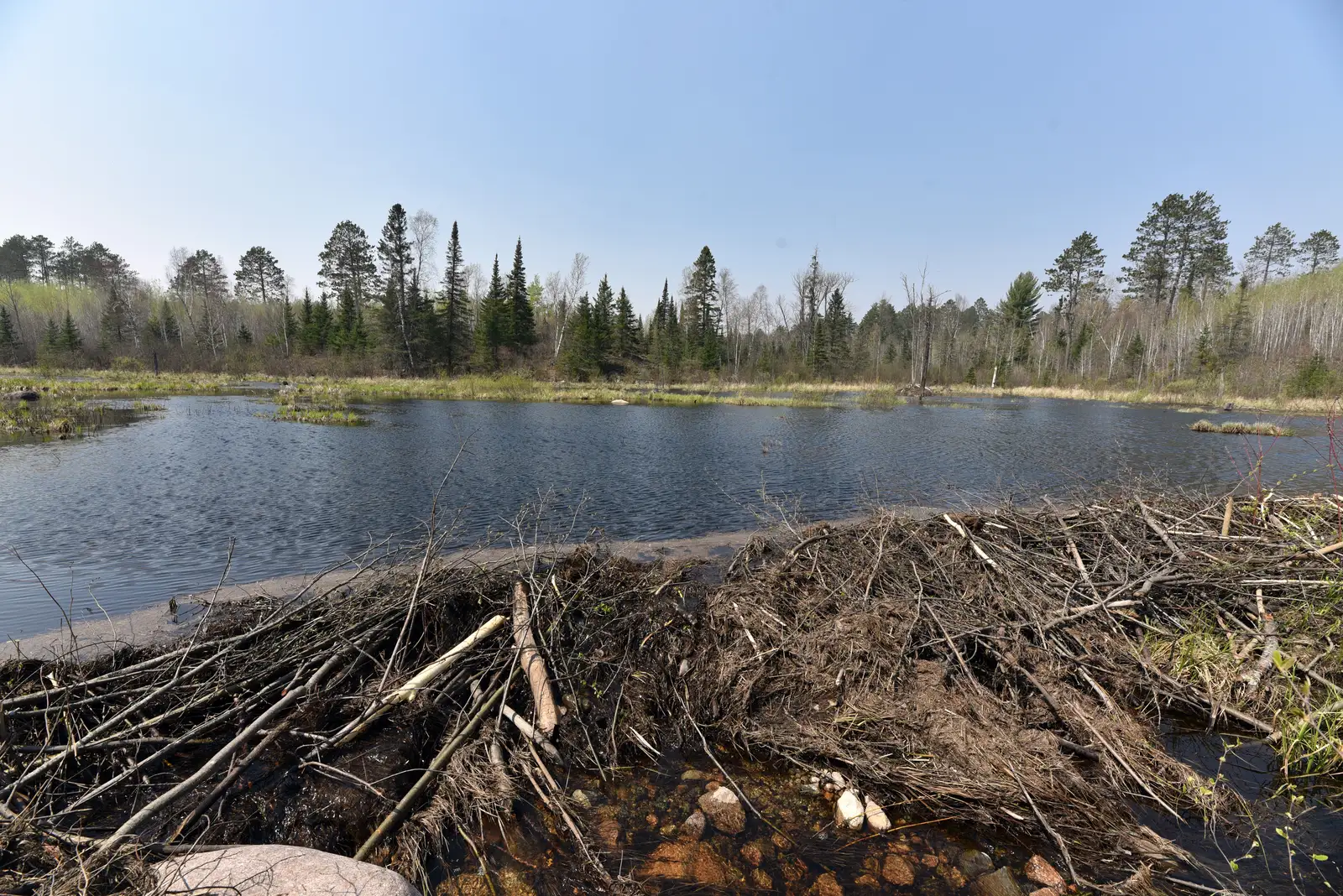
Beaver Dam: Is Running Water’s Sound the Cue to Build?
- Kind
- Specimen entry
- Added
Picture credit
"Beaver dam, St. Louis County, Minnesota" by Courtney Celley/USFWS — https://commons.wikimedia.org/wiki/File:Beaver_dam_(53718655489).jpg — Public domain (US: U.S. Government work (17 U.S.C. §105); USFWS photo by Courtney Celley; EU: no statutory public-domain basis, agency PDM marking); modified: resized: 3,000 x 2,003 px copy of the 6,016 x 4,016 original, no crop, no colour change; camera metadata not copied
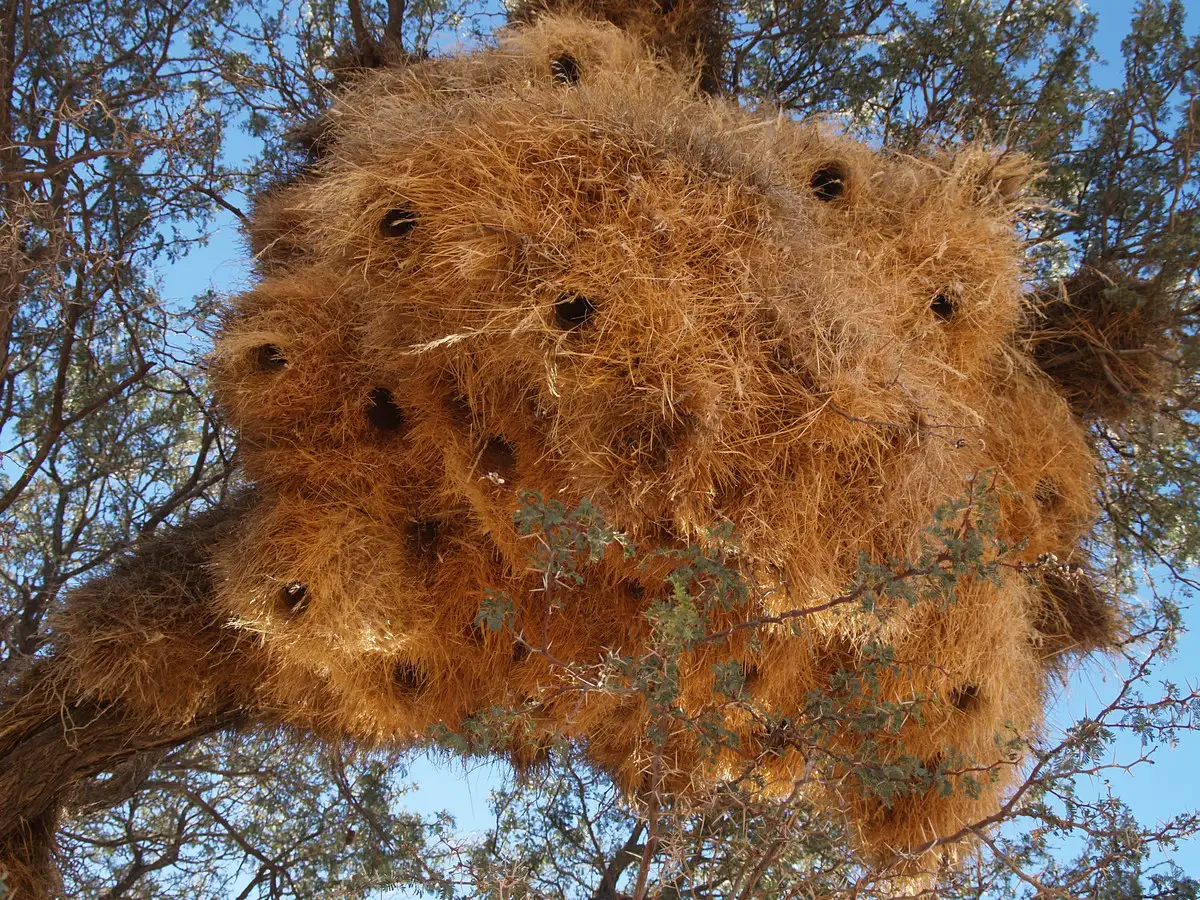
Sociable Weaver Nest Study: Chambers Warmer Than Night Air
- Kind
- Specimen entry
- Added
Picture credit
"Social weaver colony" by Rui Ornelas — https://commons.wikimedia.org/wiki/File:Social_weaver_colony.jpg — CC BY 2.0 (https://creativecommons.org/licenses/by/2.0/); modified: resized: 1,200 x 900 px copy of the 3,264 x 2,448 original, no crop, no colour change; camera metadata not copied