How Do Fossils Form? Often, Minerals Fill the Pores in Bone
Short answer
A buried bone can become a fossil when groundwater carries minerals, most often silica, into its natural pores and leaves them there; this is permineralization. In replacement, a different mineral takes the place of the original hard parts. The US National Park Service says the two processes most often happen together, and a third, recrystallization, can join them.
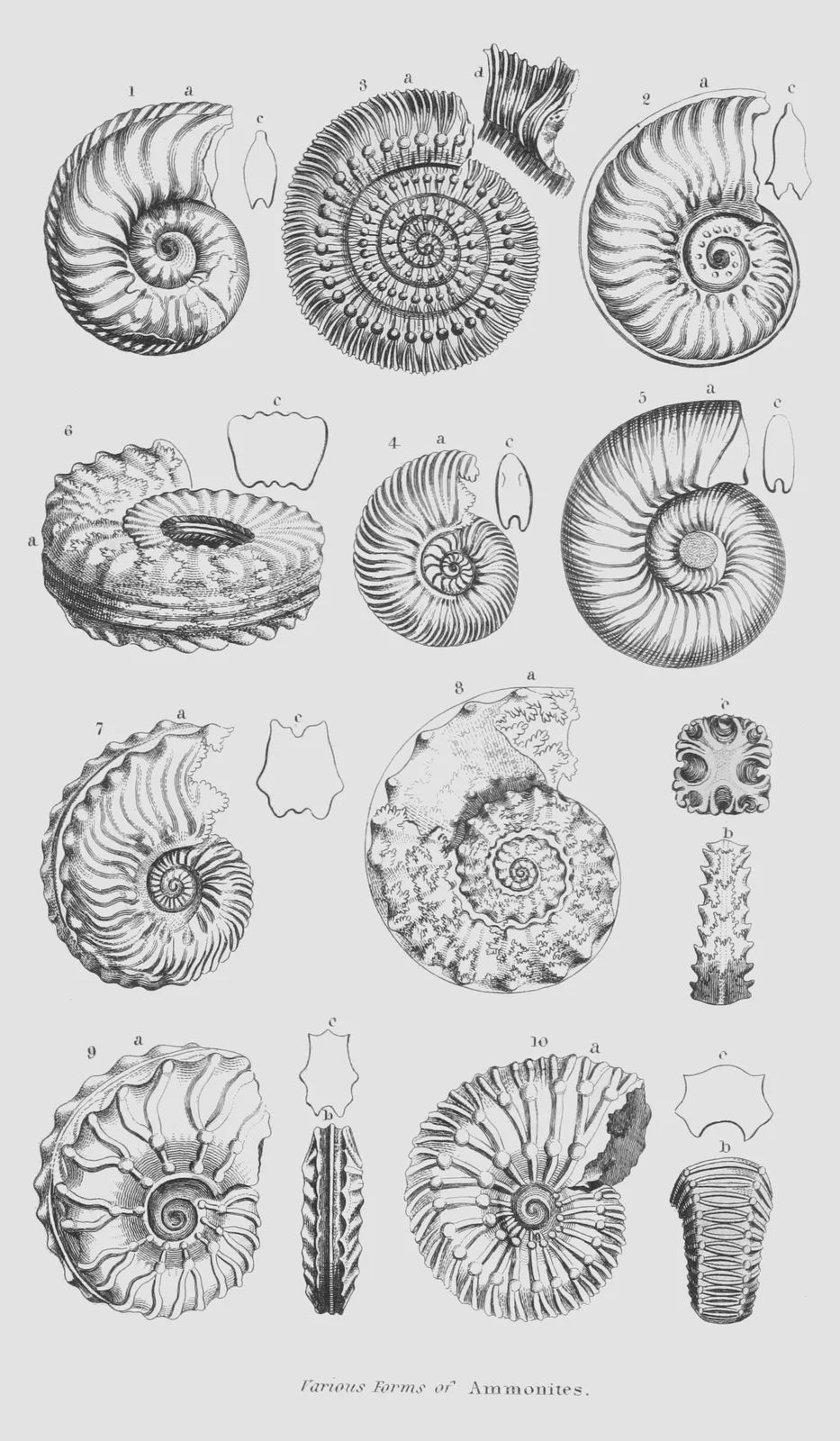
Ten fossil ammonite shells engraved for William Buckland's Geology and Mineralogy, as printed in 1837. The plate's own title reads “Various Forms of Ammonites.”
“Plate 37, Various Forms of Ammonites, from Geology and Mineralogy Considered with Reference to Natural Theology”, William Buckland; Public Domain Mark.
Full credit
"Plate 37, Various Forms of Ammonites, from Geology and Mineralogy Considered with Reference to Natural Theology" by William Buckland — https://commons.wikimedia.org/wiki/File:Geology_and_Mineralogy_considered_with_reference_to_Natural_Theology,_plate_37.png — Public domain (US: published 1837; EU: author William Buckland d. 1856 (plate engraver not individually traced; Public Domain Mark on the file page); anyone working on the plate in 1837, 119 years before 1956, could not credibly have died after 1955)
Look at a broken fossil bone and the spongy inside can still be there, its holes packed with stone. The geologist Gideon Mantell described this in 1838. When bone is petrified, he wrote, “the most delicate parts of the internal structure are preserved, and all the cells filled up with stone or spar, oftentimes of a different colour from that of the walls of the cells” (The Wonders of Geology, vol. 1, p. 51).
The framework of the bone stays. What changes is the empty space inside it, and the sections below follow that change from the moment groundwater reaches a buried bone to the finished fossil in a museum case.
What happens to a bone after burial?
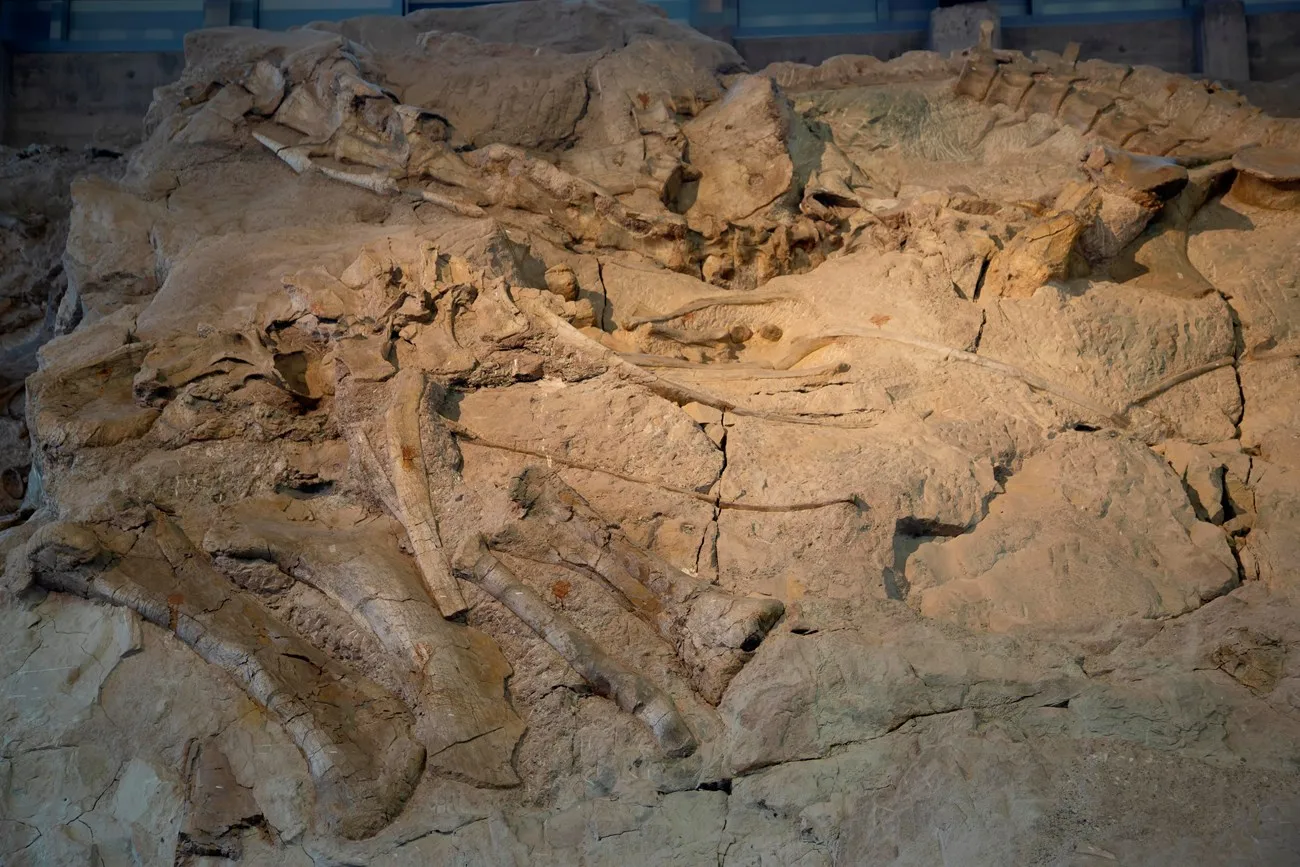
Fossil bones of the dinosaur Camarasaurus still set in the rock wall of the Quarry Exhibit Hall at Dinosaur National Monument, Utah.
"Camarasaurus fossils in the Quarry Exhibit Hall, Dinosaur National Monument, from the NPS article Permineralization and Replacement" by NPS photo — https://www.nps.gov/articles/000/permineralization-and-replacement.htm — Public domain (US: U.S. Government work (17 U.S.C. §105), credited NPS photo; EU: no statutory public-domain basis, the agency claims no copyright in its own photos; No protection is claimed in original U.S. Government works)
The National Park Service (NPS) starts the story with water. Groundwater carrying silica or other dissolved ions flows through small, even microscopic, pores in buried wood, bone or shell. Organic material left in the bone can create a chemical setting that makes those ions come out of solution and stay behind as solid mineral.
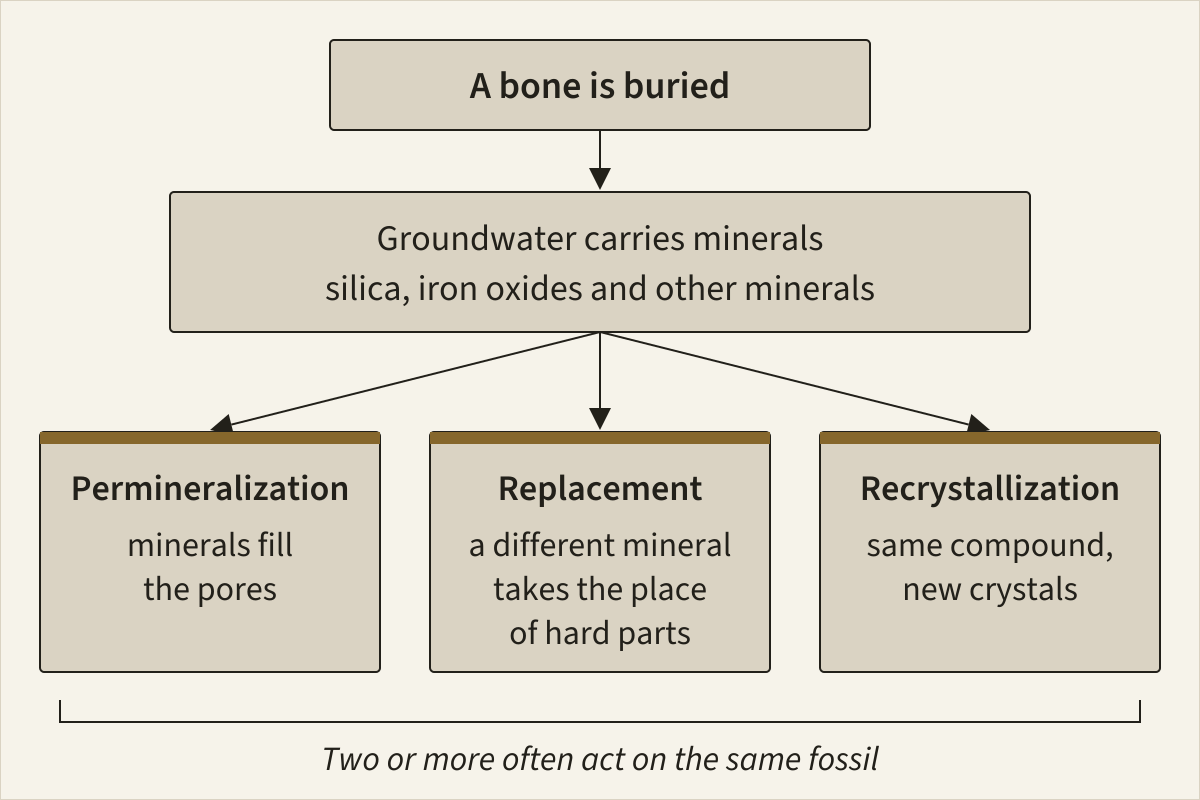
From burial to stone: groundwater brings the minerals, and three processes can follow. A bracket under the three paths notes that more than one often acts on the same fossil.
Basis Definitions from the NPS pages on permineralization, replacement and recrystallization; schematic, not to scale.
"How a buried bone becomes a fossil: three paths" by Feathers, Skeletons & Nests, https://feathersskeletonsandnests.com/fossils/how-fossils-form/ , licensed under CC BY 4.0, https://creativecommons.org/licenses/by/4.0/
Data: National Park Service, Permineralization and Replacement and Recrystallization (U.S. Government works), https://www.nps.gov/articles/000/permineralization-and-replacement.htm, retrieved 2026-11-17
The bones in that quarry wall show the process at work. According to the NPS, they were permineralized by several minerals, mostly silica. Groundwater supplied the silica, iron oxides and other minerals that filled the pores. Bacteria played a part too: as they fed on organic material, they laid down calcium carbonate, which now forms hard lumps called concretions around the fossil bones.
The three paths in the chart are defined separately, but they are not rival explanations. The table below gives each one with its source, one claim to a row.
| Mode | What happens | What survives | Qualifier | Source |
|---|---|---|---|---|
| Permineralization | Minerals carried by groundwater fill the natural pores of buried wood, bone or shell | A three-dimensional internal mould of the tissue; the original shape is usually kept, sometimes with microscopic or cellular detail | Can occur alone, but most often happens together with replacement | NPS, Permineralization and Replacement |
| Replacement | Inorganic minerals take the place of original hard parts that have dissolved away, so the mineral changes | The place of the original hard part, now taken by a different mineral | Can occur without permineralization, but most often happens together with it | NPS, Permineralization and Replacement |
| Recrystallization | One mineral replaces another of the same chemical composition, most often calcite replacing aragonite | The hard part in the same compound with a new crystal structure; some fine detail may be lost, particularly in invertebrate fossils | May take place together with other fossilization processes | NPS, Recrystallization |
| Permineralization of bone (1838 account) | When bone is petrified, all the cells fill up with stone or spar | The most delicate parts of the internal structure, the filling often a different colour from the cell walls | Description from 1838; Mantell used the word petrified | Mantell 1838, vol. 1, p. 51 |
Download the preservation modes table (CSV) (what this file records) Data: National Park Service, Permineralization and Replacement and Recrystallization (U.S. Government works), retrieved 2026-11-17; Gideon Mantell, The Wonders of Geology, vol. 1 (1838), public domain
Not every fossil turns to stone at all. The NPS notes that trace fossils, leaf impressions and remains kept in amber have not been “turned to stone,” and that some fossil wood was carbonized instead of petrified. Palaeontologists usually prefer the words permineralization and replacement to petrification, the same page says, because those words describe the process rather than the stony result.
What is permineralization?
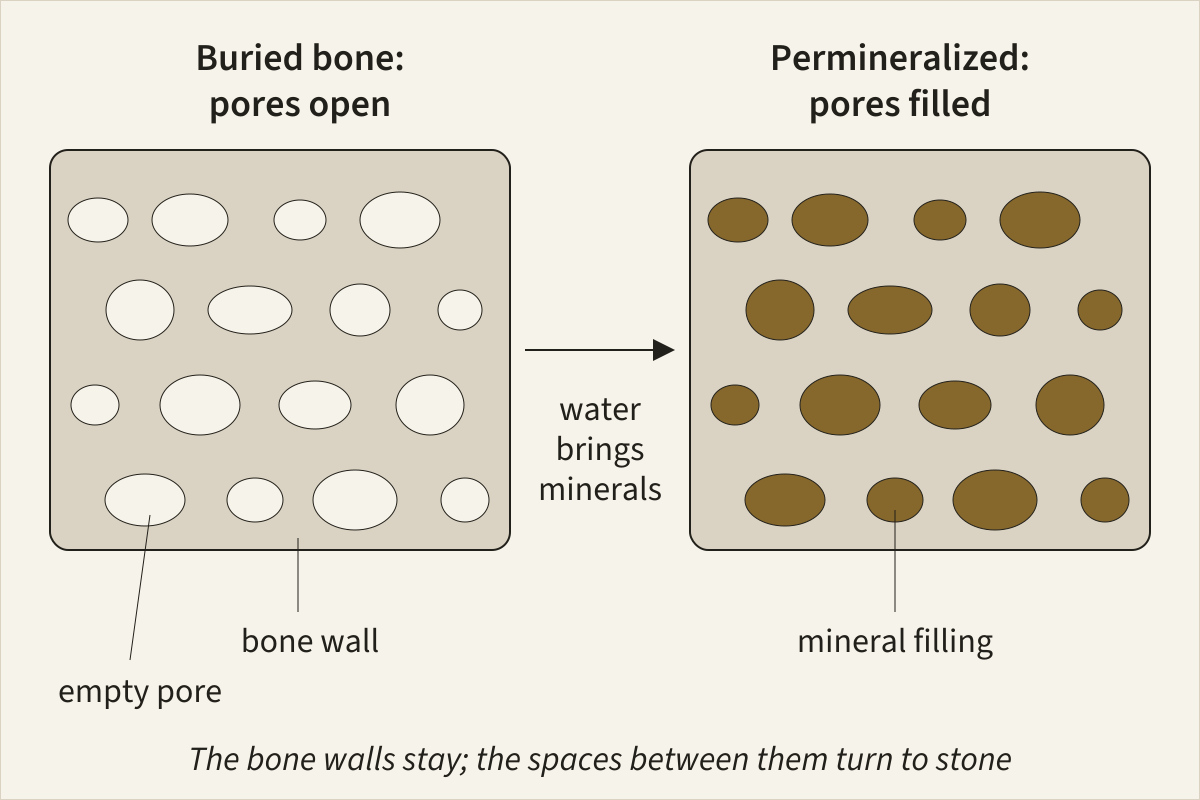
Permineralization in two steps. The bone walls stay in place; only the open pores between them fill with mineral.
Basis NPS definition of permineralization and Mantell 1838; schematic, not to scale.
"Permineralization: minerals fill the pores of buried bone" by Feathers, Skeletons & Nests, https://feathersskeletonsandnests.com/fossils/how-fossils-form/ , licensed under CC BY 4.0, https://creativecommons.org/licenses/by/4.0/
Data: National Park Service, Permineralization and Replacement (U.S. Government work), https://www.nps.gov/articles/000/permineralization-and-replacement.htm, retrieved 2026-11-17; Gideon Mantell, The Wonders of Geology, vol. 1 (1838), p. 51, public domain
The NPS definition is one sentence long: “Permineralization is the infilling of natural pores in original organic material by minerals.” The result, in the same page's words, is “a three-dimensional internal mold of the original organic tissue,” sometimes with detail down to the microscopic or cellular level.
A permineralized bone is like an old house whose empty rooms are packed with stone while every wall stays standing. The floor plan survives, but the house is no longer hollow. In the NPS's words, a permineralized fossil is “denser and heavier than the original organic material,” because its pores have been filled by silica or other minerals.
Permineralized fossils also usually keep the original shape of the bone, wood or shell, according to the NPS, instead of being flattened like some other fossils. The process works most often in hard parts, though it can also happen in soft tissue, the NPS notes.
Silica is the most common mineral involved, particularly in fossil wood and bone. The NPS traces it to weathered rock, to volcanic ash and to the silica skeletons of some sponges and zooplankton. Volcanic ash is a ready source, because the silica in its tiny glass fragments is not locked inside a crystal and dissolves into passing groundwater. Mantell, writing about bone, called the result “a natural, anatomical preparation, of great beauty, and interest.”
Other minerals can do the same job. The NPS groups permineralization and replacement into three main types by the mineral involved: silicification, with silica; pyritization, with pyrite, the iron sulphide known as fool's gold; and carbonate mineralization, with calcium carbonate, which can occur in bone fossils. Pyrite forms when sulphides from decaying organic material react with iron in groundwater, and it can give a fossil a metallic look. Most pyritized fossils come from marine deposits.
How do replacement and recrystallization differ?
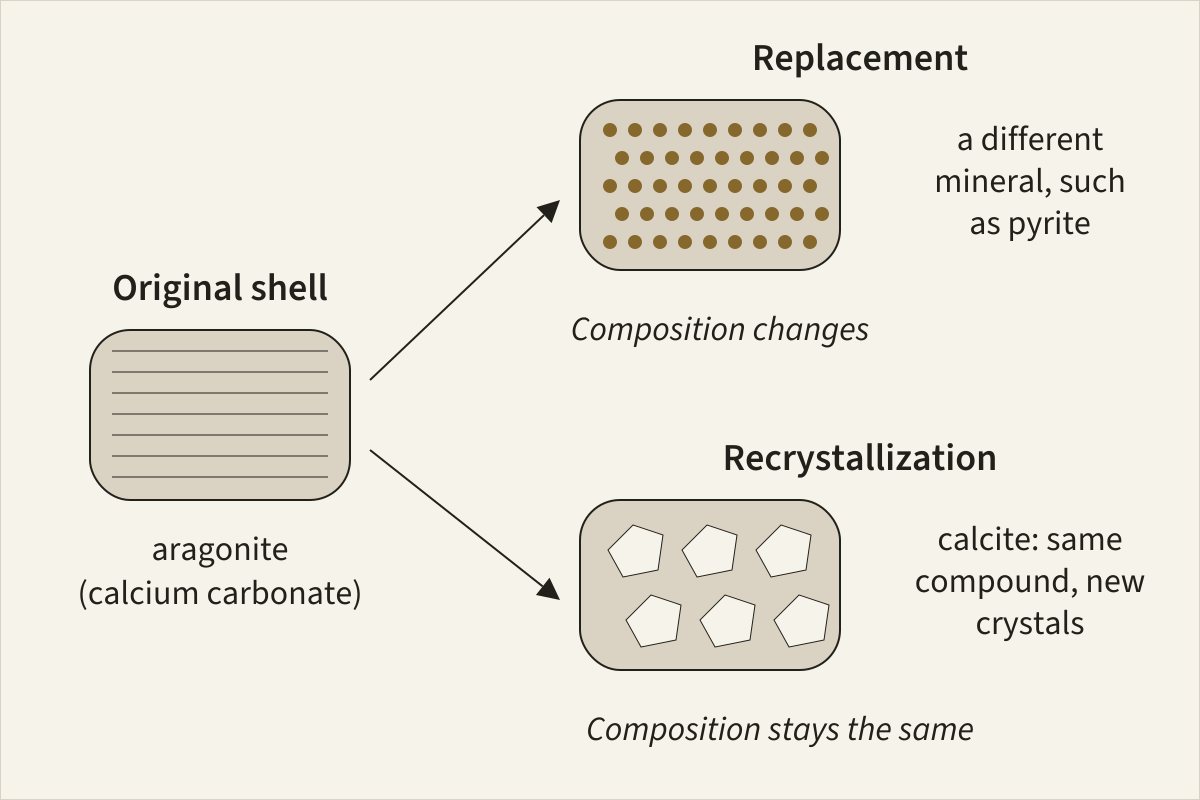
Two ways a shell's mineral can change. In replacement the composition changes; in recrystallization it stays the same and only the crystals are new.
Basis NPS definitions and examples of replacement and recrystallization; schematic, not to scale.
"Replacement and recrystallization of a shell" by Feathers, Skeletons & Nests, https://feathersskeletonsandnests.com/fossils/how-fossils-form/ , licensed under CC BY 4.0, https://creativecommons.org/licenses/by/4.0/
Data: National Park Service, Permineralization and Replacement and Recrystallization (U.S. Government works), https://www.nps.gov/articles/000/recrystallization.htm, retrieved 2026-11-17
Both processes swap one mineral for another, so the difference lies in what the new mineral is made of. The NPS defines replacement as “the substitution of inorganic minerals for the original hard parts of organisms that have been dissolved away.” It “involves a change in the mineralogy of an organism's hard parts, unlike recrystallization which involves minerals of the same chemical composition.”
| Process | Mineral after the change | Example given by the NPS | Effect on detail | Source |
|---|---|---|---|---|
| Replacement | A different mineral from the original | Pyrite can replace the calcium carbonate in some shells | No general statement on the NPS pages | NPS, Permineralization and Replacement |
| Recrystallization | The same compound in a new crystal form | Calcite replaces aragonite, two forms of calcium carbonate | May destroy some fine detail, particularly in invertebrate fossils | NPS, Recrystallization |
Recrystallization most often involves aragonite and calcite. Many invertebrates build their shells from aragonite, and during fossilization calcite may take its place, because calcite is more stable at or near Earth's surface. The NPS adds that recrystallization “may destroy some of the fine details in the fossil organism.”
The sources used here give no single figure for how long a whole fossil takes to form, and this page does not invent one. For one step only, the NPS says the change from aragonite to calcite “can take place as soon as within a few thousand years, but can take longer.”
The processes do not exclude one another. Permineralization and replacement “may occur separately from one another,” the NPS writes, “but the two processes most often happen together.” Its recrystallization page goes further: a single bone fossil can have gone through replacement, permineralization and recrystallization.
Is a fossil bone still bone?
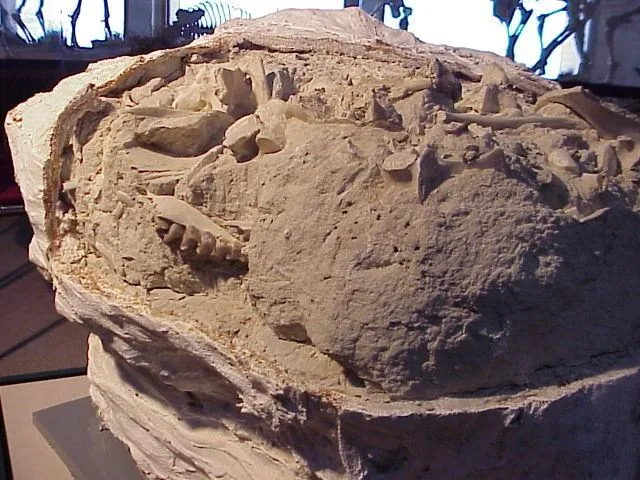
A slab of the bonebed from the Agate Springs quarries, on display in the visitor centre at Agate Fossil Beds National Monument, Nebraska.
"Agate Springs quarries bonebed slab, Agate Fossil Beds National Monument, from the NPS article Recrystallization" by NPS photo — https://www.nps.gov/articles/000/recrystallization.htm — Public domain (US: U.S. Government work (17 U.S.C. §105), credited NPS photo; EU: no statutory public-domain basis, the agency claims no copyright in its own photos; No protection is claimed in original U.S. Government works)
Partly. The shape and inner framework of a fossil bone can survive, but its chemistry has changed. At Agate Fossil Beds National Monument in Nebraska, the NPS describes the bones of Miocene mammals, about 23 to 22 million years old, that went through “several complex and interrelated fossilization processes.”
One change was in the mineral of the bone itself. Living bone is built on hydroxyapatite, a calcium phosphate mineral, and in the Agate bones it was replaced by fluorapatite, a form with more fluorine. The NPS calls this a change “that must occur for bone to become fossilized as the collagen breaks down.”
The NPS lists the other paths alongside that change, without putting them in order. Silica permineralization reduced the pore spaces, in some fossils silica replaced some of the other bone minerals, and the fluorapatite itself dissolved and recrystallized. All three processes from the chart are recorded in the Agate bones. The finished fossils have greater mass, density and hardness than the bones had in the living animals.
A fossil bone from Agate keeps the shape of the animal's bone but not the mineral that animal grew: a copy in stone that still follows the original's walls and spaces.
Mantell drew the same line in 1838, using objects from spring water that had only been coated in stone. Such crusts, he wrote, are “commonly, but erroneously, termed petrifactions” (vol. 1, p. 50). Where the twigs of a crusted bird's nest show through, they “are not permeated by stony matter, but are dry, and brittle.” A true petrifaction, by contrast, has its substance “saturated throughout with mineral matter” (p. 51), so the stone runs all the way through instead of sitting on the outside.
Why do some fossils keep such fine detail?
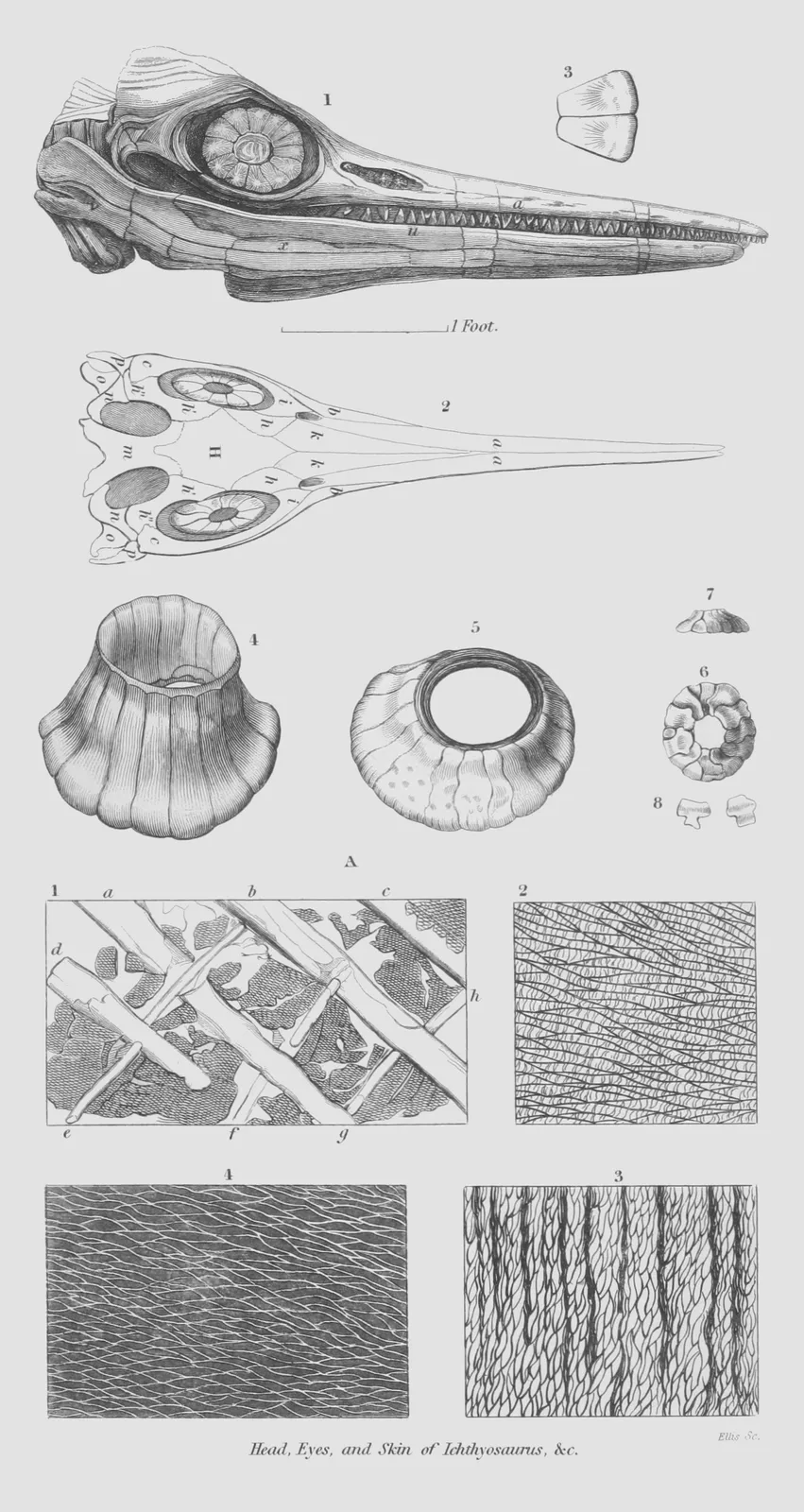
Plate 10 of Buckland's book, titled “Head, Eyes, and Skin of Ichthyosaurus, &c.” Figures 1 and 2 show a skull with its ring of eye plates; figures 4 and 5 are bony eye rings of an owl and a golden eagle, drawn for comparison.
“Plate 10, Head, Eyes, and Skin of Ichthyosaurus, from Geology and Mineralogy Considered with Reference to Natural Theology”, William Buckland; Public Domain Mark.
Full credit
"Plate 10, Head, Eyes, and Skin of Ichthyosaurus, from Geology and Mineralogy Considered with Reference to Natural Theology" by William Buckland — https://commons.wikimedia.org/wiki/File:Geology_and_Mineralogy_considered_with_reference_to_Natural_Theology,_plate_10.png — Public domain (US: published 1837; EU: author William Buckland d. 1856 (plate signed Ellis Sc.; engraver's death year not traced; Public Domain Mark on the file page); the engraver was working on the plate in 1837, 119 years before 1956, so a death after 1955 is not credible)
The NPS notes that permineralization sometimes preserves “details at the microscopic or cellular level.” Where the original hard parts stay in place and the spaces fill, small and thin structures can come through burial intact.
William Buckland's 1836 account of an ichthyosaur shows how far that can go. On the front of the eye socket, he wrote, there is “a circular series of petrified thin bony plates, ranged around a central aperture, where once was placed the pupil” (Geology and Mineralogy, vol. 1, p. 173). Buckland compared the form and thickness of each plate to the scales of an artichoke.
Buckland was just as clear about what did not survive. “The soft parts of the eyes of the Ichthyosauri have of course entirely perished,” he wrote on the next page. The bony ring came through; the eye it held did not. For the same reason, extinct animals on this site appear only as fossils, bones and skeleton plates, with no skin or eyes added.
Fossil jaws hold another record: the two jaw bones that became ear bones. The ichthyosaur skull found by the Anning family has its own entry, Mary Anning's ichthyosaur.
Do plants fossilize the same way?
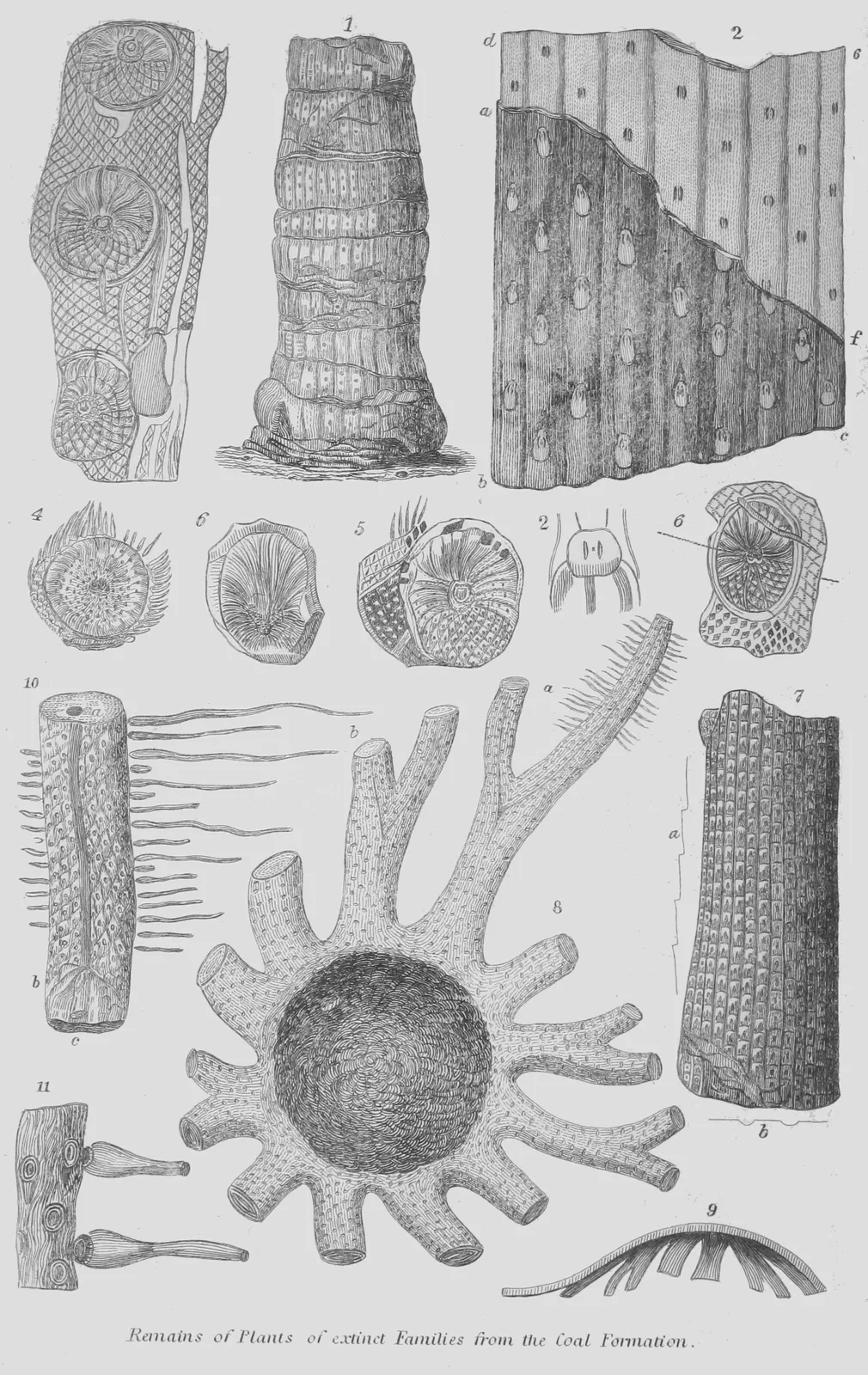
Plate 56 of Buckland's book, titled “Remains of Plants of extinct Families from the Coal Formation”: fossil stems, patterned bark and a rounded base with branching arms.
“Plate 56, Remains of Plants of extinct Families from the Coal Formation, from Geology and Mineralogy Considered with Reference to Natural Theology”, William Buckland; Public Domain Mark.
Full credit
"Plate 56, Remains of Plants of extinct Families from the Coal Formation, from Geology and Mineralogy Considered with Reference to Natural Theology" by William Buckland — https://commons.wikimedia.org/wiki/File:Geology_and_Mineralogy_considered_with_reference_to_Natural_Theology,_plate_56.png — Public domain (US: published 1837; EU: author William Buckland d. 1856 (plate engraver not individually traced; Public Domain Mark on the file page); anyone working on the plate in 1837, 119 years before 1956, could not credibly have died after 1955)
Wood follows the same paths as bone. Mantell wrote in 1838 that wood, “which is so commonly petrified by flint or chalcedony, may be cut so thin, that with a powerful lens the ramifications of the vessels and the structure of their tissues may be seen.” From that structure, he added, the kind of tree can be identified.
The NPS gives modern examples from US parks. At Florissant Fossil Beds National Monument in Colorado, tree stumps buried by volcanic mudflows about 34 million years ago were permineralized as silica from groundwater filled the pores of the wood. At Petrified Forest National Park in Arizona, the wood is “largely permineralized,” some specimens have also gone through replacement, and in others “a small percentage of the woody cell walls have been preserved.”
That last detail mirrors the bone story. In some fossil logs a little of the original wood itself remains, much as the walls of a permineralized bone hold their place while its pores fill. Wood has its own entry: petrified wood.
Same bones, elsewhere:
- Petrified wood: the same pore-filling, in wood
- Archaeopteryx: fine limestone that kept a single feather
Sources
- National Park Service, "Permineralization and Replacement", Fossils and Paleontology (last updated August 16, 2024). www.nps.gov/articles/000/permineralization-an…Read: full textText licence: U.S. Government work. No protection is claimed in original U.S. Government works (terms)
- National Park Service, "Recrystallization", Fossils and Paleontology (last updated May 9, 2024). www.nps.gov/articles/000/recrystallization.htmRead: full textText licence: U.S. Government work. No protection is claimed in original U.S. Government works (terms)
- Gideon Mantell, The Wonders of Geology; or, A Familiar Exposition of Geological Phenomena, vol. 1 (London: Relfe and Fletcher, 1838). archive.org/details/wondersofgeology01mantRead: pages 49–51, checked against the page images
- William Buckland, Geology and Mineralogy Considered with Reference to Natural Theology, 2 vols. (London: William Pickering, 1836). archive.org/details/geologymineralog001buckRead: pages 173–174 of vol. 1, checked against the page images; plates 10, 37 and 56 of vol. 2 (1837 printing)
Cite this page
Feathers, Skeletons & Nests. “How Do Fossils Form? Often, Minerals Fill the Pores in Bone.” first published 17 November 2026. https://feathersskeletonsandnests.com/fossils/how-fossils-form/ (accessed on the date you read it).
How facts are sourcedAll correctionsReport an error on this page (contact@feathersskeletonsandnests.com)
More from the Fossils drawer
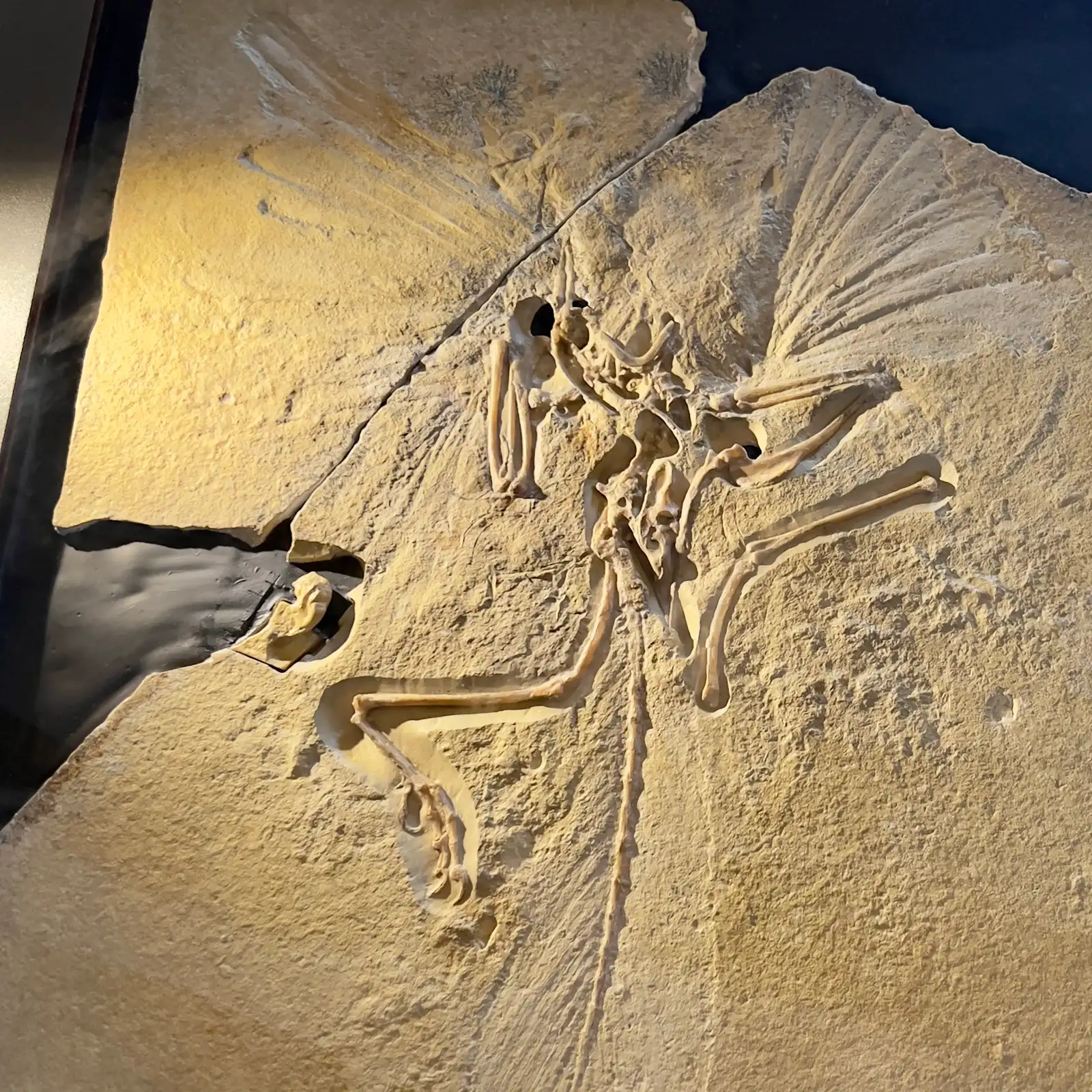
Archaeopteryx: A Lone Feather Was Its First Type Specimen
- Kind
- Specimen entry
- Added
Picture credit
"London Archaeopteryx" by Allan Henderson — https://commons.wikimedia.org/wiki/File:London_Archaeopteryx.jpg — CC BY 2.0 (https://creativecommons.org/licenses/by/2.0/)
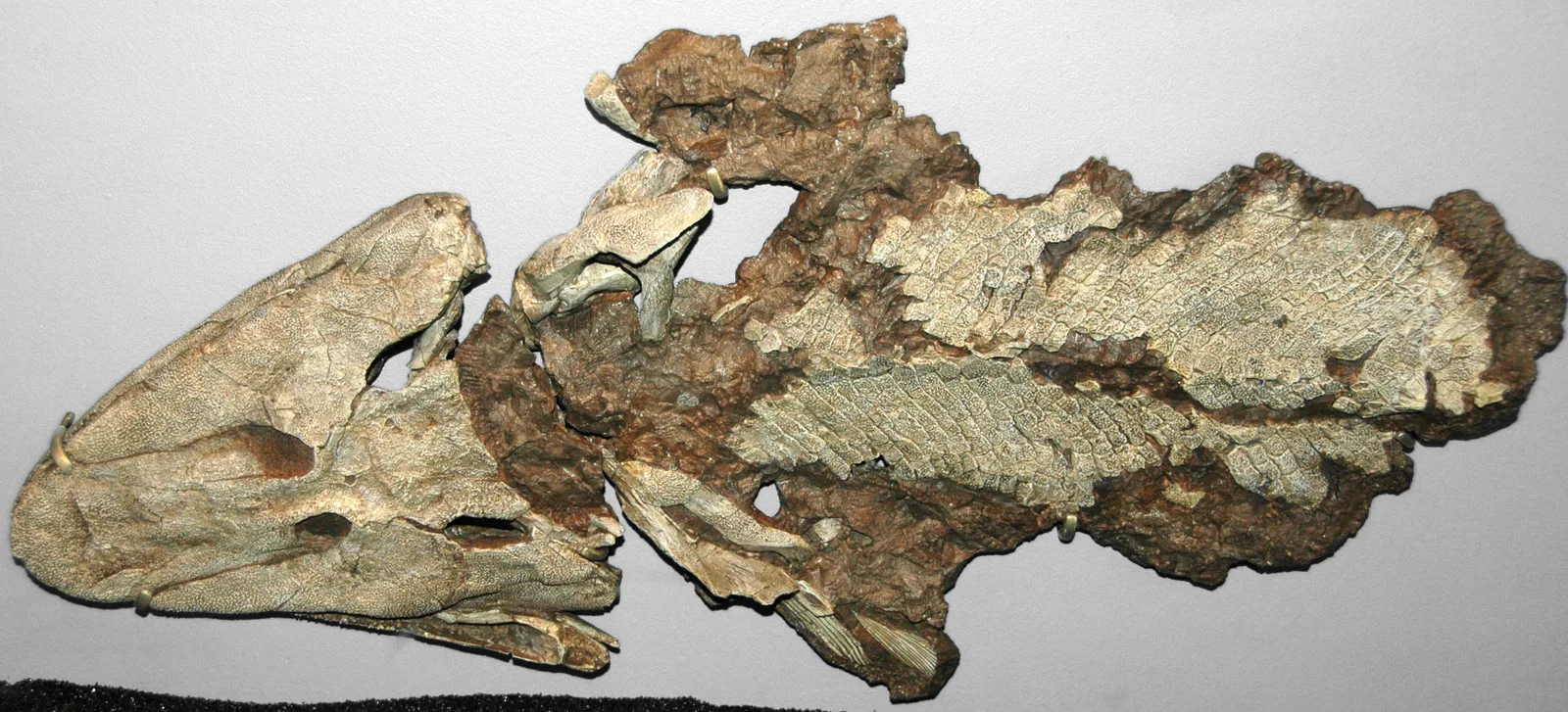
Tiktaalik roseae: A Fish With a Neck and a Wrist Joint
- Kind
- Specimen entry
- Added
Picture credit
"Tiktaalik roseae (fish to amphibian transitional fossil) (Fram Formation, Upper Devonian; Ellesmere Island, Arctic Canada) 1" by James St. John — https://commons.wikimedia.org/wiki/File:Tiktaalik_roseae_(fish_to_amphibian_transitional_fossil)_(Fram_Formation,_Upper_Devonian;_Ellesmere_Island,_Arctic_Canada)_1_(49755118288).jpg — CC BY 2.0 (https://creativecommons.org/licenses/by/2.0/)
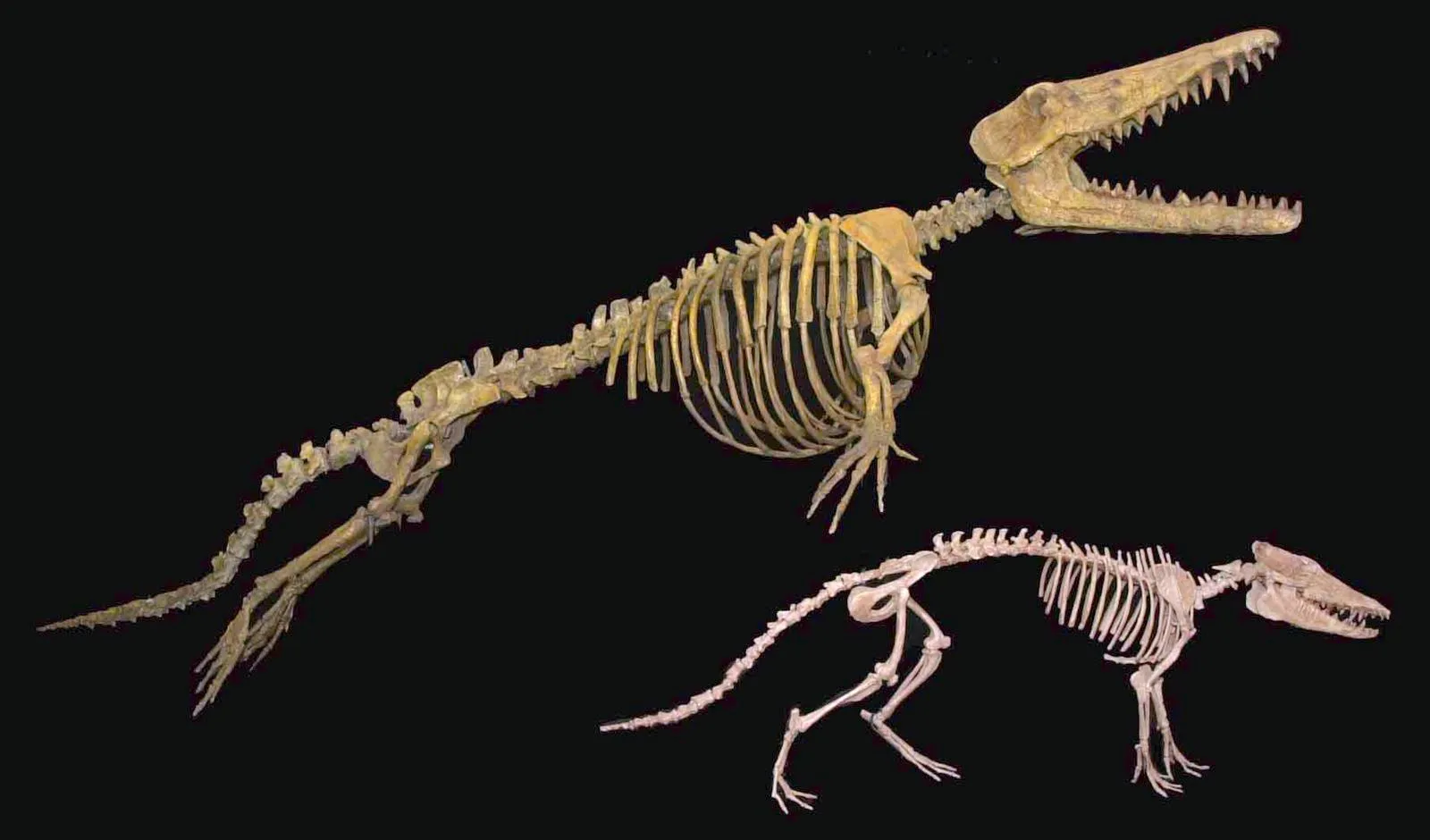
Whale Evolution: Ankles Tied Whales to Even-Toed Mammals
- Kind
- In-depth explainer
- Added
Picture credit
"Pakicetus and Ambulocetus skeletons, comparison" by Hans Thewissen — https://commons.wikimedia.org/wiki/File:Pakicetus_Ambulocetus_Skeletons_comparison.jpg — CC BY 2.0 (https://creativecommons.org/licenses/by/2.0/)