Did Humans Evolve From Monkeys? Not From Any Living Species
Short answer
No: humans did not evolve from any monkey alive today, nor from chimpanzees or any other living ape. On the Open Tree of Life synthetic tree, humans sit inside the apes; their nearest branch point, shared with chimpanzees and bonobos, stands for an ancestral population that no longer exists. A 2008 genome study by Jennifer Caswell and colleagues places the separation of human and chimpanzee ancestors 5 to 7 million years ago.
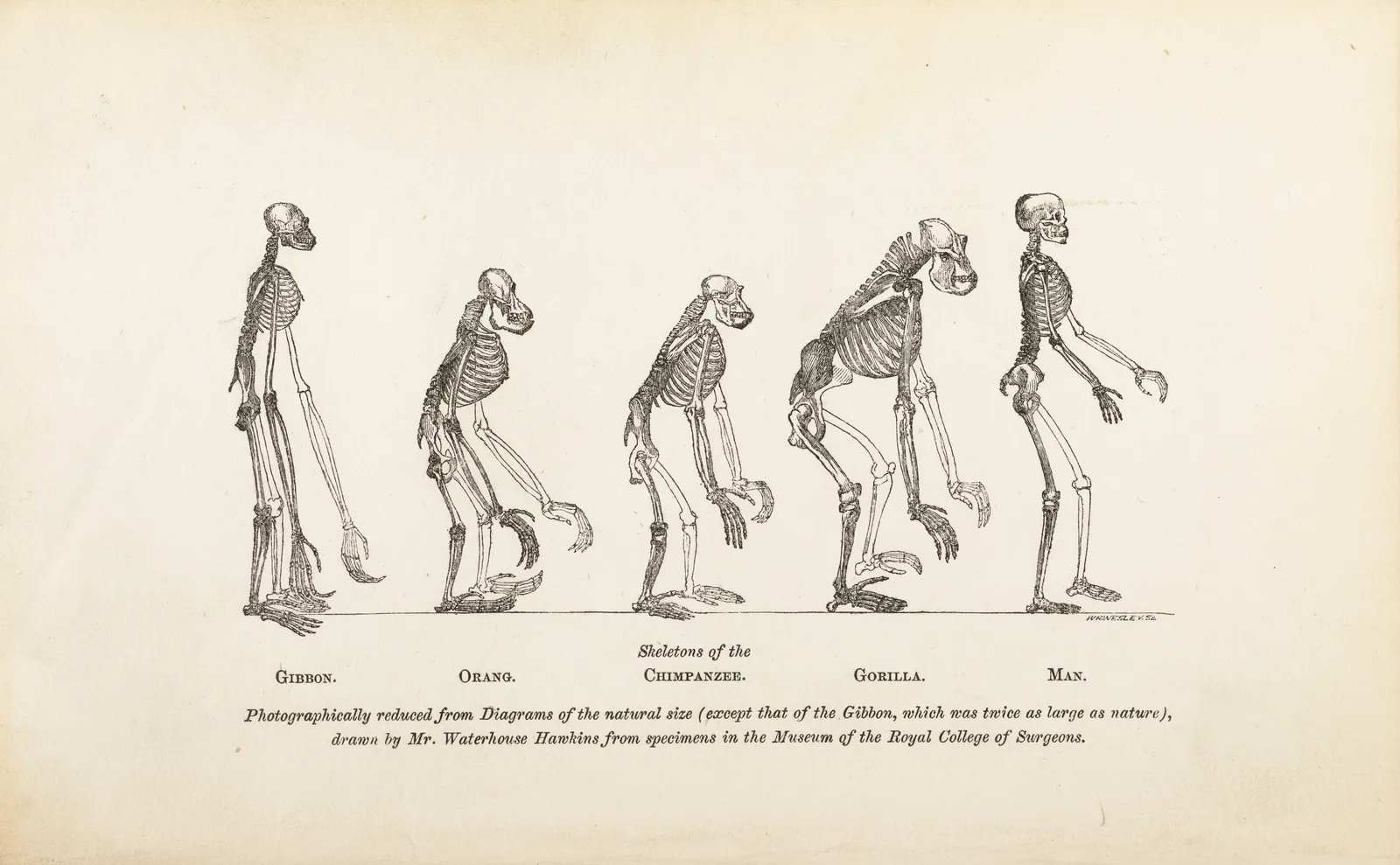
The frontispiece of Thomas Henry Huxley’s 1863 book Evidence as to Man’s Place in Nature: skeletons of a gibbon, an orang, a chimpanzee, a gorilla and a man, drawn by Waterhouse Hawkins from museum specimens. Read left to right, the row is easily mistaken for one line of descent; the tree further down orders the five differently.
"Skeletons of the gibbon, orang, chimpanzee, gorilla and man (frontispiece), from Evidence as to Man's Place in Nature" by Wellcome Library, London. Wellcome Images — https://commons.wikimedia.org/wiki/File:Frontispiece_to_Huxley_%27Evidence_as_to_man%27s_place...%27_Wellcome_L0063032.jpg — CC BY 4.0 (https://creativecommons.org/licenses/by/4.0/)
Five skeletons stand in a row at the front of Huxley’s book, and the row misleads. The caption under the plate says only what the drawings are: they were “Photographically reduced from Diagrams of the natural size (except that of the Gibbon, which was twice as large as nature), drawn by Mr. Waterhouse Hawkins from specimens in the Museum of the Royal College of Surgeons.”
The plate, then, compares five animals of Huxley’s day, each drawn from a museum skeleton. It is not a family line. Even the sizes are not comparable, because the gibbon’s diagram was twice natural size before the reduction. Laid side by side, the skeletons invite a bone-by-bone comparison; how many bones in a giraffe neck? runs one such count across mammals.
Read from left to right, the row looks like a march towards the man at the end. The order does not follow kinship either: on the tree below, the nearest relatives of humans are the chimpanzee and the bonobo, not the gorilla that stands beside the man in Huxley’s row. A tree has no top. None of the five species is drawn there as the ancestor of another.
Did humans evolve from monkeys?
Not from any monkey, or any ape, that is alive today. The tree below is redrawn from the Open Tree of Life synthetic tree, version 16.1, for eight living species: the human, the chimpanzee, the bonobo, the western gorilla, the Bornean orangutan, the lar gibbon, the rhesus macaque and the white-faced capuchin.
Tree Open Tree of Life synthetic tree v16.1, retrieved 2026-11-16; no branch lengths or dates.
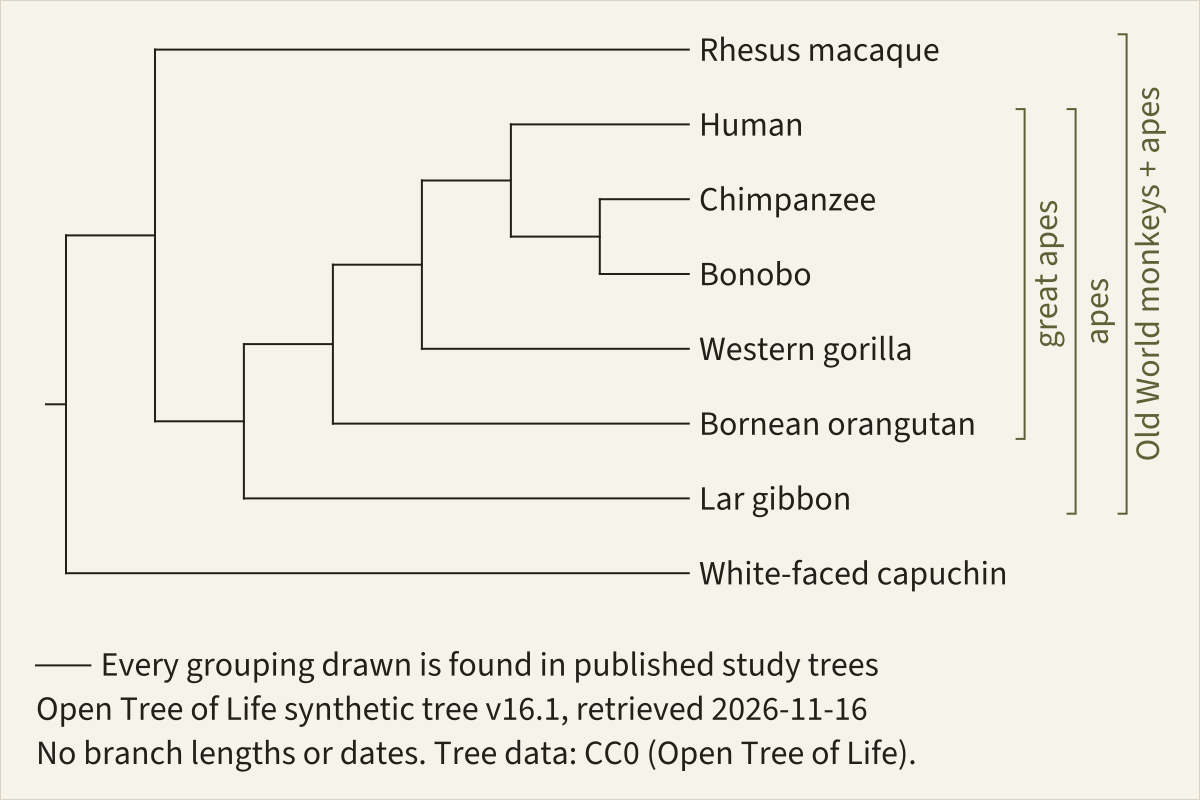
Eight living primates on a family tree. Branch order shows which species share a more recent common ancestor; the brackets on the right mark the great apes, the apes, and the Old World monkeys with the apes.
Basis Tree data from the Open Tree of Life synthetic tree.
"Humans among the apes and monkeys" by Feathers, Skeletons & Nests, https://feathersskeletonsandnests.com/lineages/humans-and-apes/ , licensed under CC BY 4.0, https://creativecommons.org/licenses/by/4.0/
Data: Open Tree of Life synthetic tree opentree16.1, https://tree.opentreeoflife.org/ , retrieved 2026-11-16, CC0 where not limited by pre-existing terms
Start at the human tip and follow its line to the left. The first branch point it meets is shared with the chimpanzee and the bonobo, and the next one adds the western gorilla. The rhesus macaque, an Old World monkey, joins only after the orangutan and the gibbon. The white-faced capuchin, a New World monkey, joins last.
Every branch point on this rooted tree stands for a common ancestor, not for a living animal. Reading a tree by its tips alone, so that a chimpanzee drawn beside a human looks like the human’s parent, is the habit Feathers, Skeletons & Nests calls node blindness: missing that each branch point is a shared ancestor.
The answer has two parts. Humans did not evolve from the macaque, the capuchin or any other monkey alive today; humans and monkeys share older common ancestors, at branch points 1 and 2 in the table below. Whether those older ancestors looked like monkeys is a separate question. This tree cannot answer it, because it holds living species only and no fossils.
The Open Tree record also lists the published study trees that contain each grouping. For the three brackets and for Homininae, that record holds a single study tree. The pairing of humans with chimpanzees and bonobos appears in five.
| Branch point | Group | Species below it | Study trees in the Open Tree record |
|---|---|---|---|
| 1 | monkeys and apes (Simiiformes), root of this tree | all eight | not judged (root) |
| 2 | Old World monkeys + apes | rhesus macaque and the six apes | 1 |
| 3 | apes | lar gibbon, Bornean orangutan, western gorilla, chimpanzee, bonobo, human | 1 |
| 4 | great apes | Bornean orangutan, western gorilla, chimpanzee, bonobo, human | 1 |
| 5 | Homininae | western gorilla, chimpanzee, bonobo, human | 1 |
| 6 | humans with chimpanzees and bonobos | chimpanzee, bonobo, human | 5 |
| 7 | chimpanzees and bonobos (Pan) | chimpanzee, bonobo | 4 |
Download the branch points (CSV) (what this file records) Data: Open Tree of Life synthetic tree opentree16.1, https://tree.opentreeoflife.org/ , retrieved 2026-11-16, CC0 where not limited by pre-existing terms
Are humans apes?
On this tree, yes. The bracket labelled apes holds the gibbon, the orangutan, the gorilla, the chimpanzee, the bonobo and the human, and the human tip falls inside it. The narrower great-ape bracket also includes the human, along with the orangutan, the gorilla, the chimpanzee and the bonobo.
The nesting does not stop at the apes. Humans are mammals too, and middle ear evolution follows two ear bones that came from the jaw in the line leading to mammals. The same nesting places birds inside the dinosaurs, a case set out in are birds dinosaurs?. Body shape can mislead in the other direction: a crab-like body evolved more than once, as carcinization shows, so looks are a poor guide to kinship.
How long ago did humans and chimps split?
A 2008 study of genome sequence alignments by Jennifer Caswell and colleagues names “the period of time 5–7 million years ago when the ancestors of humans separated from those of the chimpanzees”. The same paper gives an older range for a different measure. The genetic divergence of the two genomes “could be anywhere between 6–8 Mya”, it states, citing a 2006 analysis by Patterson and colleagues, “as the calibration to the fossil record is uncertain”.
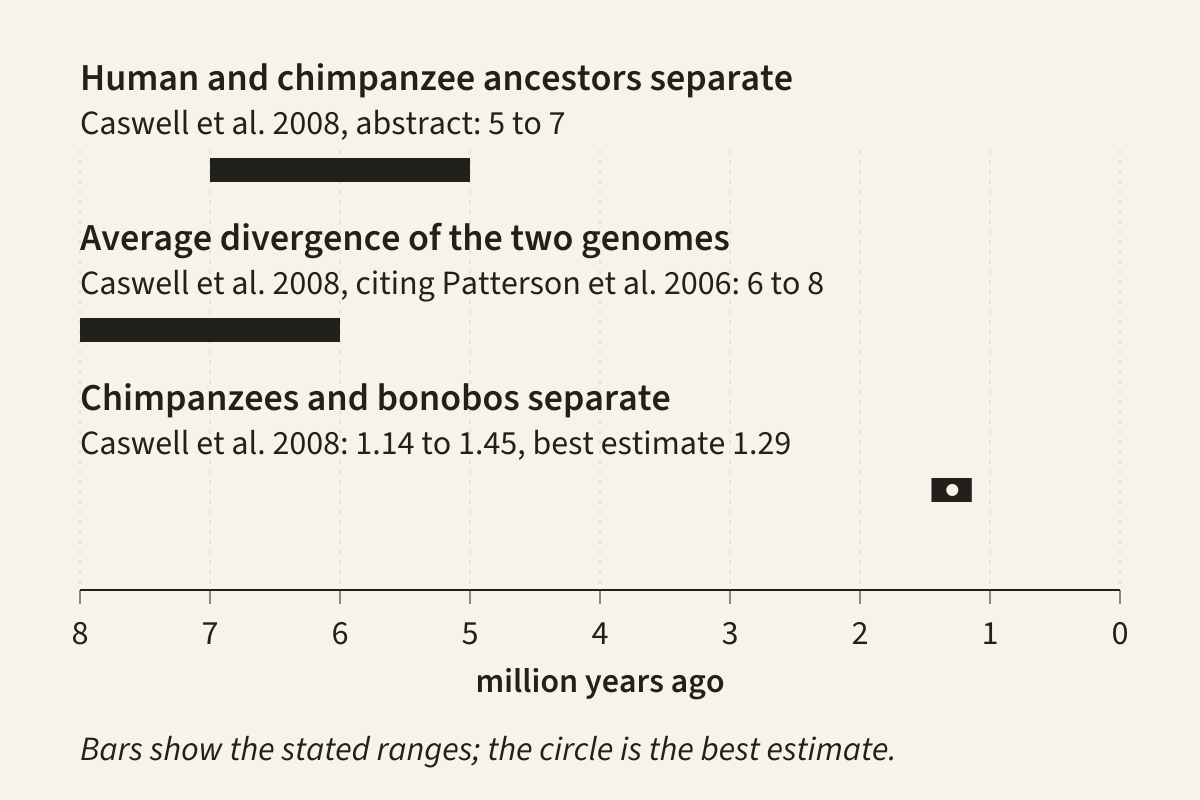
Three time ranges from one 2008 genome study, on an axis running from 8 million years ago to today. The upper two bars measure different things for the same pair of species; the lower bar is the 90% credible interval for the split between chimpanzees and bonobos, with the best estimate as a circle.
Basis Ranges as stated in Caswell et al. 2008; time axis to scale.
"Stated time ranges for the human-chimpanzee and chimpanzee-bonobo splits" by Feathers, Skeletons & Nests, https://feathersskeletonsandnests.com/lineages/humans-and-apes/ , licensed under CC BY 4.0, https://creativecommons.org/licenses/by/4.0/
Data: Caswell J. L., Mallick S., Richter D. J., Neubauer J., Schirmer C., Gnerre S. and Reich D. (2008) Analysis of chimpanzee history based on genome sequence alignments. PLoS Genetics 4(4): e1000057, https://doi.org/10.1371/journal.pgen.1000057, CC BY (version not stated)
One split gets two ranges because the differences between two genomes can be older than the split between two populations. A 2006 commentary by Todd Disotell in Genome Biology sets out the reason: full speciation comes when the daughter populations stop interbreeding, but separate stretches of the genome can trace back to common ancestors from before that point.
All of these dates depend on how the molecular clock is set. Caswell’s team assumed that human and chimpanzee DNA diverged on average 7 million years ago, with 20 years per generation, and the paper notes that the fossil calibration behind such numbers is uncertain.
The same study dates a younger split, estimating that chimpanzees and bonobos separated about 1.29 million years ago. The 90% credible interval is 1.14 to 1.45 million years in the paper’s Table 2, though one sentence in its Results prints the upper end as 1.46. That is about a fifth as long ago as the middle of the human and chimpanzee window. Branch point 7 on the tree is that split.
| Pair | Range (million years ago) | What is measured | Source |
|---|---|---|---|
| Human and chimpanzee | 5–7 | separation of ancestral populations | Caswell et al. 2008, abstract |
| Human and chimpanzee | 6–8 | average genetic divergence of the genomes | Caswell et al. 2008, citing Patterson et al. 2006 |
| Chimpanzee and bonobo | 1.14–1.45 (90% credible interval; best estimate 1.29) | separation of ancestral populations, assuming 7 million years of average genome divergence and 20 years per generation | Caswell et al. 2008, Table 2 |
Download the split ranges (CSV) (what this file records) Data: Caswell J. L., Mallick S., Richter D. J., Neubauer J., Schirmer C., Gnerre S. and Reich D. (2008) Analysis of chimpanzee history based on genome sequence alignments. PLoS Genetics 4(4): e1000057, https://doi.org/10.1371/journal.pgen.1000057, CC BY (version not stated)
If humans evolved from apes, why are there still apes?
Because no living ape turned into a human. The question mixes three levels: the animals alive today, the species they belong to, and the ancestral population those species came from. Living chimpanzees are not the ancestors of humans; chimpanzees and humans both descend from a shared ancestral population that no longer exists.
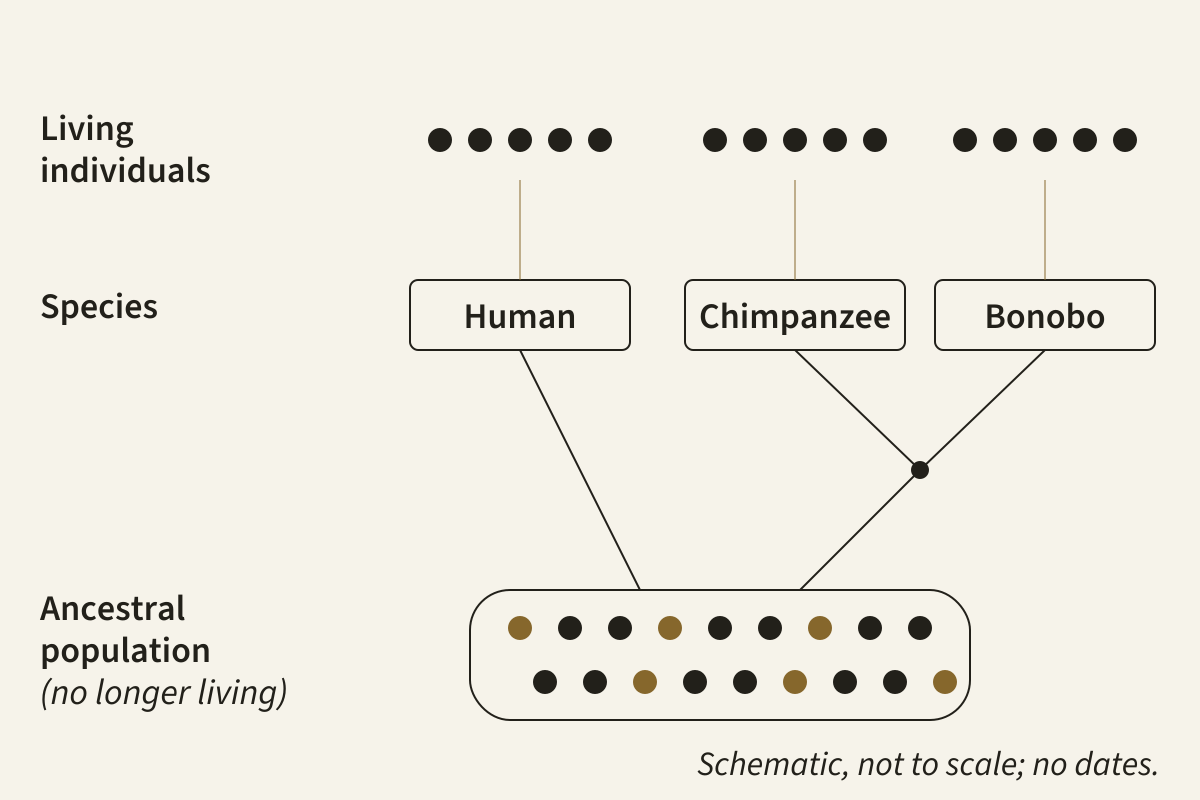
Three levels in one picture: an ancestral population at the bottom, the species that descend from it, and the individuals alive today at the top. The chimpanzee line splits again into chimpanzee and bonobo.
Basis Branching order from the Open Tree of Life synthetic tree; schematic, not to scale.
"Living individuals, species and an ancestral population" by Feathers, Skeletons & Nests, https://feathersskeletonsandnests.com/lineages/humans-and-apes/ , licensed under CC BY 4.0, https://creativecommons.org/licenses/by/4.0/
Data: Open Tree of Life synthetic tree opentree16.1, https://tree.opentreeoflife.org/ , retrieved 2026-11-16, CC0 where not limited by pre-existing terms; Caswell J. L. et al. (2008) PLoS Genetics 4(4): e1000057, https://doi.org/10.1371/journal.pgen.1000057, CC BY (version not stated)
Measured from that shared ancestor, the chimpanzee line is just as old as the human line. Both kept changing after the split. The chimpanzee line later divided into chimpanzees and bonobos. Gorillas, orangutans and gibbons branch from older points on the tree, so they are more distant cousins, not earlier stages of humans.
Genome data treat that ancestor as a population, not as one animal. Caswell and colleagues found that in about one percent of the genome, the relationships among humans, chimpanzees and bonobos appear to differ from the species relationships. In those stretches, chimpanzees and bonobos trace their ancestry separately back to before the split from humans.
The authors call this incomplete lineage sorting, where the family tree of a stretch of DNA does not match the family tree of the species. Their model of chimpanzee history includes the sizes of the ancestral populations involved.
Saying that humans evolved from chimpanzees gets the whole shape of the claim wrong, not a detail. The claim that matches the tree is that humans and chimpanzees descend from a common ancestor, and that the ancestor was a population.
Same bones, elsewhere:
- How many bones in a giraffe neck?: seven neck bones you share with a giraffe.
- Are birds dinosaurs?: another family tree where one group sits inside another, birds among the dinosaurs.
Sources
- Open Tree of Life, synthetic tree opentree16.1 with Open Tree Taxonomy 3.7draft3. tree.opentreeoflife.orgRead: full text of the subtree for eight living primate species (27-0012) and of the subtree for seven anomuran and brachyuran species (27-0008), with the study-tree records for each branch point (topology retrieved 2026-11-16, node records 2026-11-17)Text licence: CC0 where not limited by pre-existing terms of use (terms)
- Thomas Henry Huxley, Evidence as to Man's Place in Nature (1863), frontispiece and caption. gutenberg.pglaf.org/cache/epub/2931/pg2931.txtRead: full text of the frontispiece caption, checked against the printed plate
- Jennifer L. Caswell, Swapan Mallick, Daniel J. Richter, Julie Neubauer, Christine Schirmer, Sante Gnerre and David Reich, "Analysis of Chimpanzee History Based on Genome Sequence Alignments", PLoS Genetics 4, no. 4 (2008): e1000057. doi.org/10.1371/journal.pgen.1000057Read: full textText licence: CC BY (version not stated in the article) (terms)
- Todd R. Disotell, "'Chumanzee' evolution: the urge to diverge and merge", Genome Biology 7, no. 11 (2006): 240. doi.org/10.1186/gb-2006-7-11-240Read: full text
Cite this page
Feathers, Skeletons & Nests. “Did Humans Evolve From Monkeys? Not From Any Living Species.” first published 17 November 2026. https://feathersskeletonsandnests.com/lineages/humans-and-apes/ (accessed on the date you read it).
How facts are sourcedAll correctionsReport an error on this page (contact@feathersskeletonsandnests.com)
More from the Lineages drawer
Are Birds Dinosaurs? On the Family Tree, Birds Sit Inside
- Kind
- Comparison and reading
- Added
Picture credit
"Plate XX, Hesperornis regalis, from Odontornithes: a monograph on the extinct toothed birds of North America" by Marsh, Othniel Charles (1880), via Biodiversity Heritage Library — https://commons.wikimedia.org/wiki/File:Odontornithes-_a_monograph_on_the_extinct_toothed_birds_of_North_America_(Plate_XX)_BHL40333948.jpg — Public domain (US: published 1880, before 1931; EU: author O. C. Marsh d. 1899; plate credits F. Berger (drawing) and E. Crisand (lithography), death years not checked, but both were working on the plate in 1880, 76 years before 1956, so a death after 1955 is not credible)
Carcinization: King Crabs Evolved From Hermit Crab Kin
- Kind
- Comparison and reading
- Added
Picture credit
"Decapoda, plate 86, from Kunstformen der Natur" by Ernst Haeckel, Kunstformen der Natur (1904), plate 86 — https://commons.wikimedia.org/wiki/File:Haeckel_Decapoda.jpg — Public domain (US: published 1904, before 1931; EU: artist Ernst Haeckel d. 1919, lithographer Adolf Giltsch d. 1911)