Mary Anning’s Ichthyosaur: The Skull Came Before the Ribs
Short answer
Mary Anning's first ichthyosaur was found in two parts: her brother Joseph found the skull, and Mary, then 13, found part of the backbone and ribs about a year later, in 1811–1812 (accounts differ). Everard Home's 1814 paper on the fossil dates the skull to 1812 and the rest to “the following year”, and it names neither Anning.
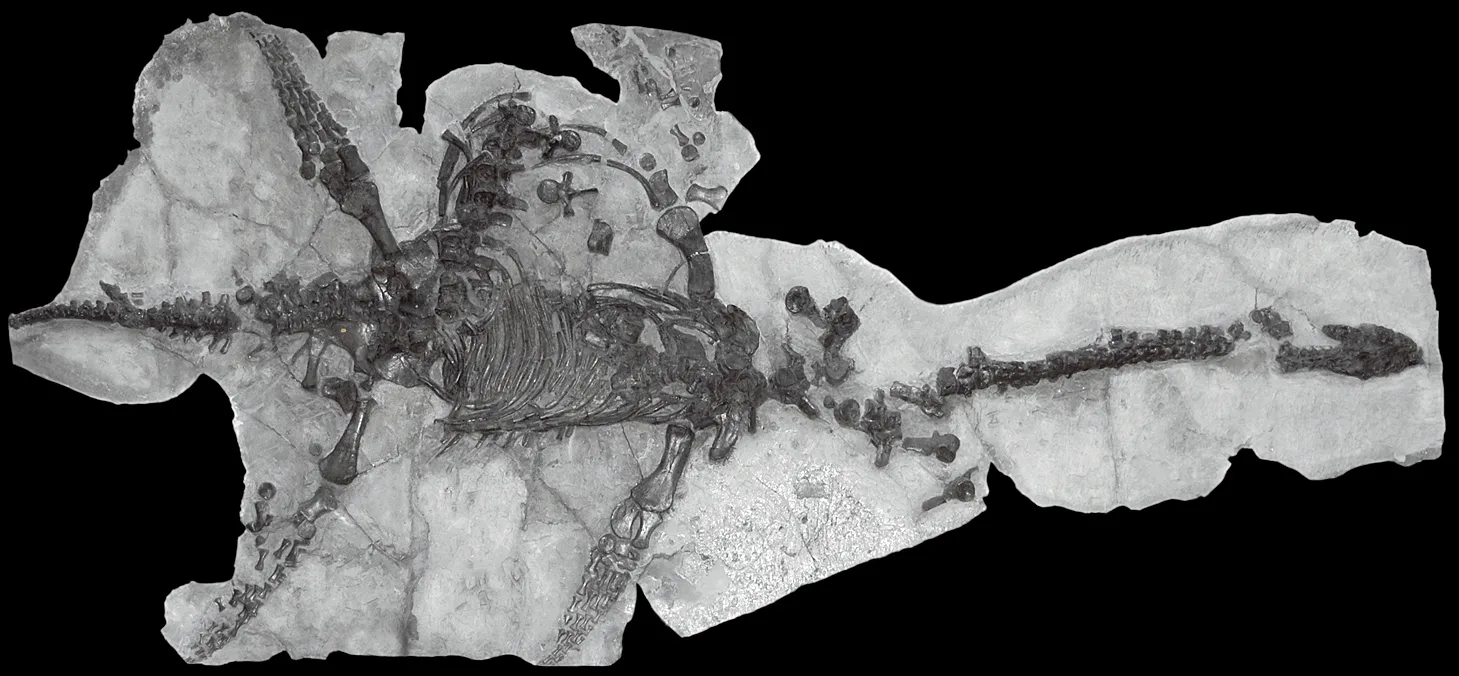
Mary Anning's plesiosaur from Lyme Regis, Plesiosaurus dolichodeirus, as named on its file page, photographed in 2017 and shown in greyscale on black as uploaded. The long neck runs to the small skull at the right, and a paddle spreads from each corner of the ribcage.
"Plesiosaurus dolichodeirus NHM.jpg, Mary Anning's plesiosaur from Lyme Regis" by the paleobear — https://commons.wikimedia.org/wiki/File:Plesiosaurus_dolichodeirus_NHM.jpg — CC BY 2.0 (https://creativecommons.org/licenses/by/2.0/)
The skull of the Anning family's first major fossil was found by Joseph Anning, not by his sister Mary. That order comes from two kinds of record: the scientific paper of 1814 that described the animal, and the Geological Society of London's exhibition on Mary Anning, which sets out who found what.
The skeleton in the photo is a later find. The same exhibition credits Mary Anning with the first articulated plesiosaur, a skeleton with its bones still joined, found on 10 December 1823. Neither Home's 1814 paper on the ichthyosaur nor the opening page of Conybeare's 1824 paper on the plesiosaur names the finder.
Who found the ichthyosaur skull?
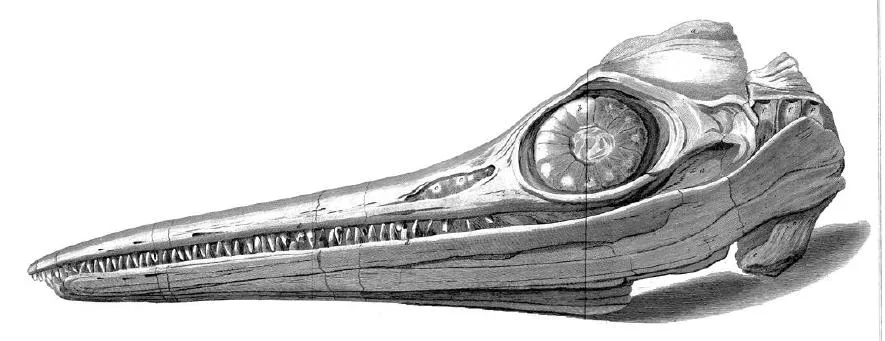
The skull as engraved for Everard Home's 1814 paper, from Plate XVII, drawn by William Clift and engraved by James Basire. The large circle is the ring of bony plates in the eye; both jaws carry rows of conical teeth.
“Plate XVII (skull), from Home, Some Account of the fossil Remains of an Animal more nearly allied to Fishes (Philosophical Transactions 104)”, W. Clift (drawing) and J. Basire (engraving), in Everard Home, Philosophical Transactions of the Royal Society (1814); Public Domain Mark.
Full credit
"Plate XVII (skull), from Home, Some Account of the fossil Remains of an Animal more nearly allied to Fishes (Philosophical Transactions 104)" by W. Clift (drawing) and J. Basire (engraving), in Everard Home, Philosophical Transactions of the Royal Society (1814) — https://commons.wikimedia.org/wiki/File:AnningIchthyosaurSkull.jpg — Public domain (US: published 1814; EU: author Everard Home d. 1832; draughtsman William Clift d. 1849 (Commons category); engraver J. Basire, a later James Basire (James Basire I d. 1802 per Commons category), death year not verified, but an engraver working in 1814 cannot have died after 1955; Public Domain Mark on the file page)
The Geological Society of London's exhibition dates Joseph's find of the skull, about four feet long, to the autumn of 1811. Mary, then 13 years old, found part of the backbone and ribs in November of the next year. The exhibition identifies the animal as Temnodontosaurus platyodon and notes that it is now in the Natural History Museum, London.
Home's paper, read to the Royal Society on 23 June 1814, gives the same order without the names: “The skull was dug out in 1812, the other parts in the following year, at a distance of some feet” (p. 572). It places the bones in blue lias, a clay-rich limestone, in a cliff between Lyme and Charmouth in Dorset.
The head alone was “four feet long” (p. 573), about 1.2 metres. The paper gives 60 vertebrae, and laid in a line they measured “about seventeen feet” (p. 574), about 5.2 metres.
Home could not decide what the animal was. The lower jaw and the small teeth inside the large ones first led him to think of a crocodile, but the joints between the vertebrae looked like a fish's.
One tooth was split, and its hollow held “calcareous spar” (p. 575), a mineral, rather than a young tooth growing inside the old one. Minerals filling the spaces in bone are the subject of how fossils form. In the end Home placed it with the fishes, yet wrote: “I by no means consider it as wholly a fish” (p. 576).
Why do the dates disagree?
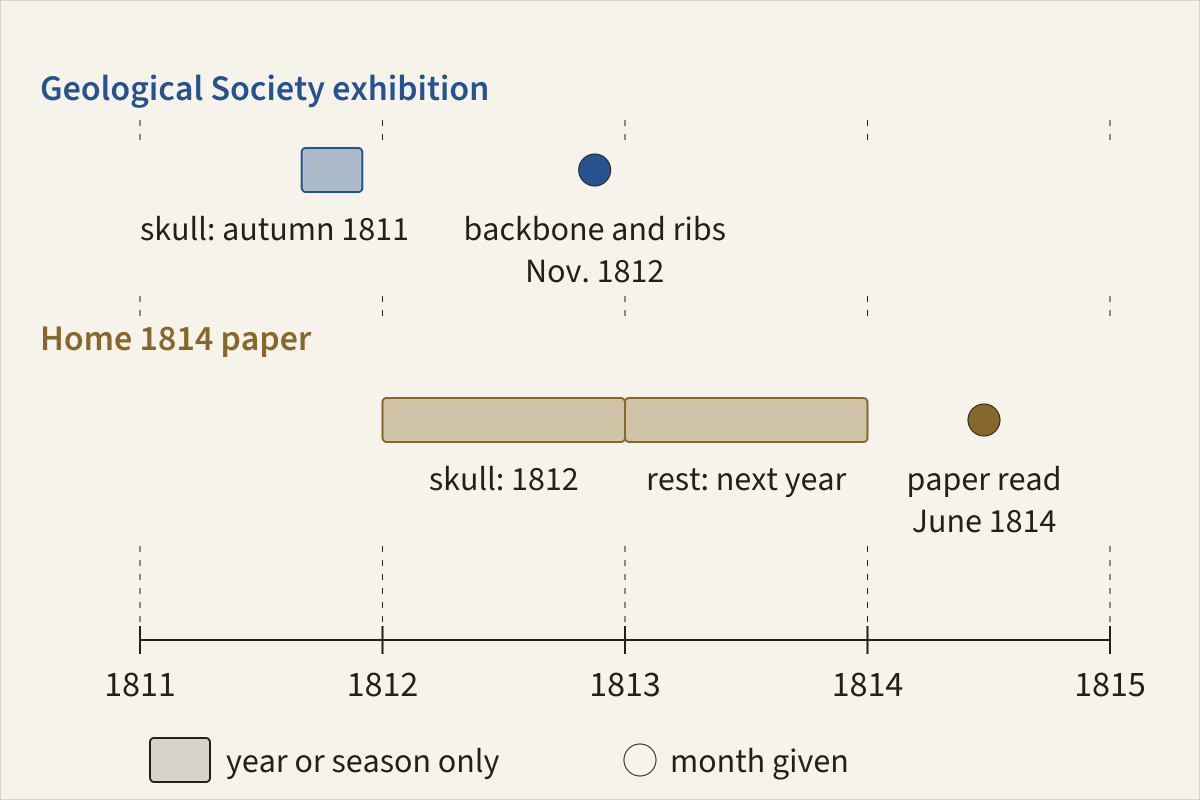
Two accounts of the same two finds. Bands mark dates given only as a year or a season; dots mark dates given to the month. Both accounts put the skull first and the other bones about a year later.
Basis Dates from Home 1814, p. 572, and the Geological Society of London's online exhibition (summarised); not to scale within each year.
"Two accounts of the Anning ichthyosaur finds, 1811 to 1814" by Feathers, Skeletons & Nests, https://feathersskeletonsandnests.com/fossils/mary-anning-ichthyosaur/ , licensed under CC BY 4.0, https://creativecommons.org/licenses/by/4.0/
Data: Everard Home (1814) Some Account of the fossil Remains of an Animal more nearly allied to Fishes than any of the other Classes of Animals. Philosophical Transactions of the Royal Society of London 104: 571-577, public domain; Geological Society of London, Mary Anning and the Geological Society (online exhibition), dates summarised
The two accounts agree on the order and differ by one year. Home's paper puts the skull in 1812 and the other parts in 1813. The Geological Society exhibition puts them in 1811 and 1812, and when it quotes Home it marks his “1812” with [sic]. This page keeps both sets of years and writes the dates as 1811–1812 (accounts differ).
Home was describing a specimen that was already in a museum. His paper says the stone was cleared away “under the superintendance of Mr. Bullock, in whose Museum of Natural History the specimen is preserved” (p. 572). The exhibition adds that the local landowner Henry Hoste Henley bought the fossil and sent it on to William Bullock's museum in London.
| Event | Date as given | Source | Qualifier |
|---|---|---|---|
| Skull found by Joseph Anning | autumn 1811 | Geological Society exhibition (summarised) | accounts differ |
| Backbone and ribs found by Mary Anning, aged 13 | November 1812 | Geological Society exhibition (summarised) | accounts differ |
| Skull of the ichthyosaur dug out | 1812 | Home 1814, p. 572 | accounts differ on the year; the paper does not name who found it |
| Other parts of the same skeleton dug out, some feet away | in the following year | Home 1814, p. 572 | the year after the skull was dug out (1812 in this paper), so 1813; accounts differ on the year; the paper does not name who found it |
| Home's account of the specimen read to the Royal Society | June 23, 1814 | Home 1814, p. 571 | date the paper was read |
| Genus name Ichthyosaurus retained, credited to Mr. König of the British Museum | read April 6, 1821 | De la Beche and Conybeare 1821, pp. 559, 563 | date the paper was read; the date of König's own naming is not given |
| Genus Plesiosaurus named from a headless skeleton in Col. Birch's collection | read April 6, 1821 | De la Beche and Conybeare 1821, pp. 559–560 | date the paper was read; finder not named |
| Ichthyosaurus specimen with 104 vertebrae lately discovered at Lyme | after the paper went to press | De la Beche and Conybeare 1821, p. 594 | finder not named |
| Plesiosaurus dolichodeirus skeleton discovered in the lias at Lyme Regis | 1823 | Conybeare 1824, plate XLVIII | year printed on the lithographed plate; finder not named on the plate or on p. 381 |
| Conybeare's paper on the almost perfect Plesiosaurus skeleton read | February 20, 1824 | Conybeare 1824, p. 381 | date the paper was read; the specimen's possessor, the Duke of Buckingham, is named |
Download the dated records from the three papers (CSV) (what this file records) Data: Everard Home (1814) Philosophical Transactions of the Royal Society of London 104: 571-577, public domain; H. T. De la Beche and W. D. Conybeare (1821) Transactions of the Geological Society of London 5: 559-594, public domain; W. D. Conybeare (1824) Transactions of the Geological Society of London, 2nd series, 1: 381-389, public domain
The download holds the eight rows taken from the three public-domain papers. The two exhibition rows appear only in the table above.
Why didn't the 1814 paper name her?
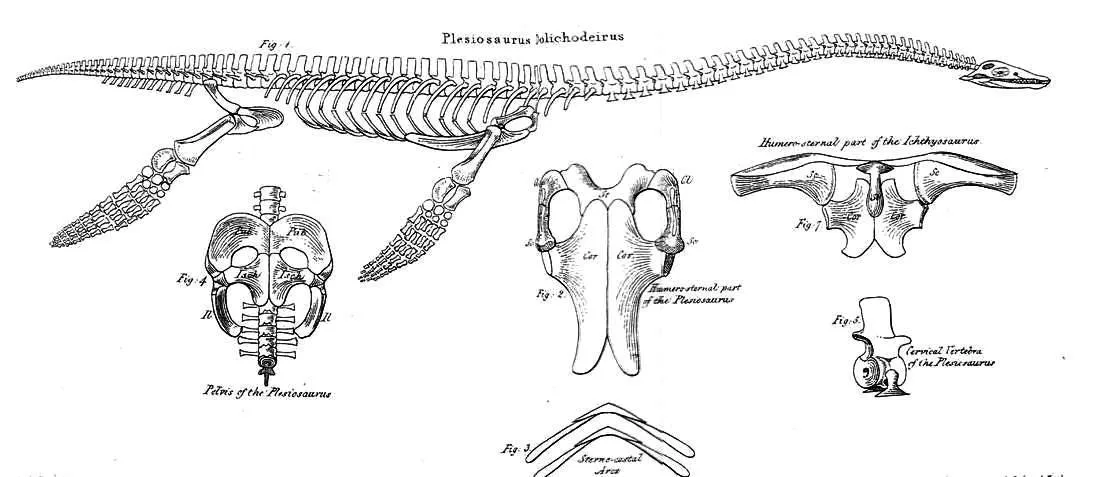
Skeletal plate from Conybeare's 1824 paper, which the Geological Society exhibition describes as his full skeleton of the plesiosaur found by Mary Anning. Bones only; no outline of the body is drawn.
“Plesiosaurus dolichodeirus skeletal plate, from Conybeare, On the Discovery of an almost perfect Skeleton of the Plesiosaurus (Transactions of the Geological Society, 1824)”, William Conybeare; Public Domain Mark.
Full credit
"Plesiosaurus dolichodeirus skeletal plate, from Conybeare, On the Discovery of an almost perfect Skeleton of the Plesiosaurus (Transactions of the Geological Society, 1824)" by William Conybeare — https://commons.wikimedia.org/wiki/File:Conybeare_Plesiosaur_1824.jpg — Public domain (US: published 1824; EU: drawn by William Conybeare d. 1857, lithographed by George Johann Scharf d. 1860 (plate credits read on IA page image n600; Commons categories), printed by C. Hullmandel (printer, not an author); Public Domain Mark on the file page)
Home's paper names the landowner and the museum owner. It does not name the finders. It says the specimen “was found upon an estate of Henry Host Henley, Esq.” (p. 572), and it credits the cleaning to Bullock. The Geological Society exhibition comments that leaving the Annings out was not uncommon at the time, and that Home gave only the previous owner as the fossil's provenance.
The papers that followed did the same where they introduced new specimens. In 1821 Henry De la Beche and William Conybeare thanked the owners of the collections they used, among them Colonel Birch, and named seven more people in a footnote (p. 560). Their closing note reports an ichthyosaur “lately discovered at Lyme” (p. 594) without saying who found it. In 1824 Conybeare thanked the plesiosaur's possessor, the Duke of Buckingham, and called it “the magnificent specimen recently discovered at Lyme” (p. 381); the finder again goes unnamed.
The 1821 paper also took a side on the name. De la Beche and Conybeare kept “the name Ichthyosaurus, originally applied to this animal by Mr. König of the British Museum” (p. 563), and turned down a later proposal to rename it Proteosaurus (p. 564). The entry on Archaeopteryx follows a later fossil name, given in 1861 to a single feather according to Owen's 1863 account.
What did she find next?
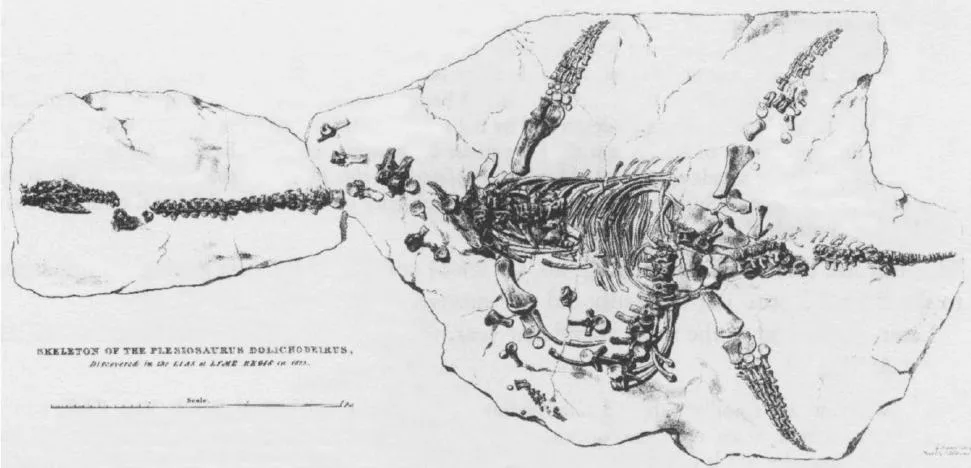
Plate XLVIII of Conybeare's 1824 paper, drawn by Thomas Webster: the plesiosaur skeleton as it lay in its slab. The printed title gives the lias at Lyme Regis and the year 1823.
“Plate XLVIII, Skeleton of the Plesiosaurus dolichodeirus, from Conybeare, On the Discovery of an almost perfect Skeleton of the Plesiosaurus (Transactions of the Geological Society, 1824)”, Thomas Webster; Public Domain Mark.
Full credit
"Plate XLVIII, Skeleton of the Plesiosaurus dolichodeirus, from Conybeare, On the Discovery of an almost perfect Skeleton of the Plesiosaurus (Transactions of the Geological Society, 1824)" by Thomas Webster — https://commons.wikimedia.org/wiki/File:Anning_plesiosaur_1823.jpg — Public domain (US: published 1824; EU: drawn by Thomas Webster d. 1844 (file page author field), lithographed by George Johann Scharf d. 1860 (plate credit 'G. Scharf Lithog.' read on IA page images n598-n599; Commons category), printed by C. Hullmandel (printer, not an author); Public Domain Mark on the file page)
The plesiosaur in the plate is the one the Geological Society exhibition credits to Mary Anning, found on 10 December 1823. The exhibition says the slab, about three metres by two, was brought to the Society's meeting on 20 February 1824, but it could not be carried up the stairs and was shown in the hallway.
Conybeare recalled proposing the genus Plesiosaurus in 1821 from “several fragments found only in a disjointed state” (p. 381). He admitted that readers might have suspected he had, “like the painter in Horace,” put together “a fictitious animal from the juxtaposition of incongruous members” (p. 381). The Lyme skeleton, he wrote, confirmed his conclusions “in every essential point”. For the species he chose the Homeric epithet dolichodeirus, for its long neck (p. 389).
The ichthyosaur swam with paddles built on an arm. In 1821 De la Beche and Conybeare described the ichthyosaur's front limb as a humerus, the single bone of the upper arm, “immediately supporting a very numerous series of small polygonal bones, forming a very flexible paddle” (p. 563). The same upper-arm bone sits at the base of very different limbs in homologous structures.
Same bones, elsewhere:
- Whale evolution: mammals that went back to sea much later
- How do fossils form?: what happens to a skeleton between death and discovery
Sources
- Everard Home, "Some Account of the fossil Remains of an Animal more nearly allied to Fishes than any of the other Classes of Animals", Philosophical Transactions of the Royal Society of London 104 (1814): 571–577, plates XVII–XX. archive.org/details/philosophicaltra1041royaRead: full text; pages 571–577 and plates XVII–XX checked against the page images
- Geological Society of London, "Temnodontosaurus platyodon, found 1811-1812", Mary Anning and the Geological Society (online exhibition). www.geolsoc.org.uk/the-library/online-exhibitions/ma…Read: full text (summarised here, not quoted)
- H. T. De la Beche and W. D. Conybeare, "Notice of the discovery of a new Fossil Animal, forming a link between the Ichthyosaurus and Crocodile, together with general remarks on the Osteology of the Ichthyosaurus", Transactions of the Geological Society of London 5 (1821): 559–594. archive.org/details/per_geological-society-lo…Read: pages 559, 560, 563, 564 and 594 checked against the page images
- W. D. Conybeare, "On the Discovery of an almost perfect Skeleton of the Plesiosaurus", Transactions of the Geological Society of London, 2nd series, 1 (1824): 381–389, plates XLVIII–XLIX. archive.org/details/per_geological-society-lo…Read: pages 381 and 389 checked against the page images; plate XLVIII title read on the plate
- Geological Society of London, "Plesiosaurus dolichodeirus, found 1823", Mary Anning and the Geological Society (online exhibition). www.geolsoc.org.uk/the-library/online-exhibitions/ma…Read: full text (summarised here, not quoted)
Cite this page
Feathers, Skeletons & Nests. “Mary Anning’s Ichthyosaur: The Skull Came Before the Ribs.” first published 17 November 2026. https://feathersskeletonsandnests.com/fossils/mary-anning-ichthyosaur/ (accessed on the date you read it).
How facts are sourcedAll correctionsReport an error on this page (contact@feathersskeletonsandnests.com)
More from the Fossils drawer
How Do Fossils Form? Often, Minerals Fill the Pores in Bone
- Kind
- In-depth explainer
- Added
Picture credit
"Plate 37, Various Forms of Ammonites, from Geology and Mineralogy Considered with Reference to Natural Theology" by William Buckland — https://commons.wikimedia.org/wiki/File:Geology_and_Mineralogy_considered_with_reference_to_Natural_Theology,_plate_37.png — Public domain (US: published 1837; EU: author William Buckland d. 1856 (plate engraver not individually traced; Public Domain Mark on the file page); anyone working on the plate in 1837, 119 years before 1956, could not credibly have died after 1955)
Archaeopteryx: A Lone Feather Was Its First Type Specimen
- Kind
- Specimen entry
- Added
Picture credit
"London Archaeopteryx" by Allan Henderson — https://commons.wikimedia.org/wiki/File:London_Archaeopteryx.jpg — CC BY 2.0 (https://creativecommons.org/licenses/by/2.0/)
Tiktaalik roseae: A Fish With a Neck and a Wrist Joint
- Kind
- Specimen entry
- Added
Picture credit
"Tiktaalik roseae (fish to amphibian transitional fossil) (Fram Formation, Upper Devonian; Ellesmere Island, Arctic Canada) 1" by James St. John — https://commons.wikimedia.org/wiki/File:Tiktaalik_roseae_(fish_to_amphibian_transitional_fossil)_(Fram_Formation,_Upper_Devonian;_Ellesmere_Island,_Arctic_Canada)_1_(49755118288).jpg — CC BY 2.0 (https://creativecommons.org/licenses/by/2.0/)