Tiktaalik roseae: A Fish With a Neck and a Wrist Joint
Short answer
Tiktaalik roseae was a Late Devonian lobe-finned fish from Arctic Canada with a mobile neck and a working wrist joint, features its describers linked to limbed animals. It still had fins and scales. Polish tracks attributed to limbed animals, reported in 2010, are older than any known fish of its group, so it was probably not the first four-limbed animal.
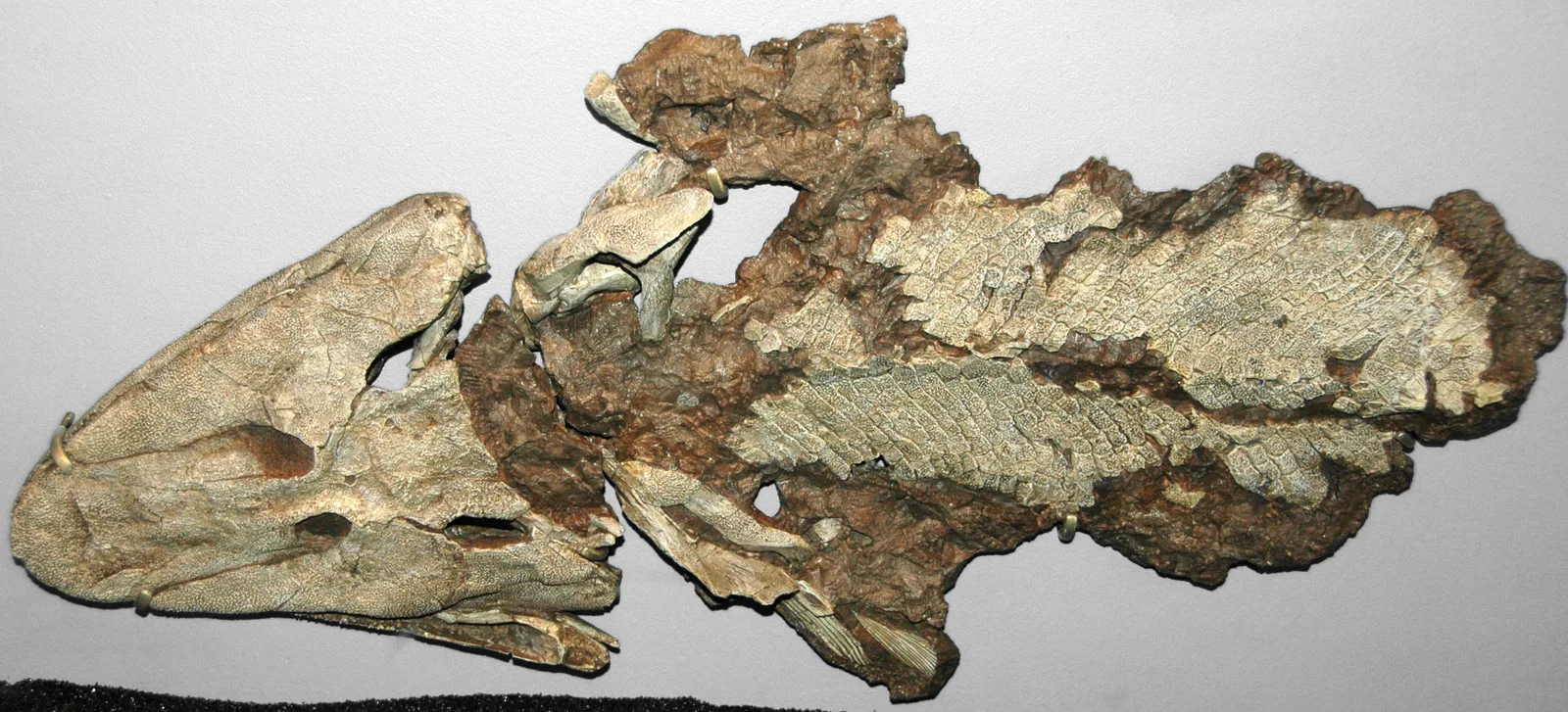
A cast of Tiktaalik roseae at the Field Museum, Chicago. The broad, flat head is on the left, and overlapping scales cover the body to the right.
"Tiktaalik roseae (fish to amphibian transitional fossil) (Fram Formation, Upper Devonian; Ellesmere Island, Arctic Canada) 1" by James St. John — https://commons.wikimedia.org/wiki/File:Tiktaalik_roseae_(fish_to_amphibian_transitional_fossil)_(Fram_Formation,_Upper_Devonian;_Ellesmere_Island,_Arctic_Canada)_1_(49755118288).jpg — CC BY 2.0 (https://creativecommons.org/licenses/by/2.0/)
Tiktaalik roseae was a fish, and it had a mobile neck and a working wrist joint. The type specimen, catalogued as NUFV108, was recovered in 2004 and described in 2006, according to a 2014 paper by Neil Shubin, Edward Daeschler and Farish Jenkins. It came from southern Ellesmere Island in Nunavut, Canada. A 2022 study by Stewart and colleagues reports that every known specimen comes from one site in the Fram Formation, in rocks dated to the early to middle Frasnian stage of the Late Devonian.
According to the 2014 paper, work at the site in 2004, 2006, 2008 and 2013 turned up the type specimen and later pieces, among them the hip bones of five individuals. Those hip bones vary in size by about a factor of two.
What made Tiktaalik roseae unusual for a fish?
The head is the first clue. The 2006 description lists a shortened skull roof, a changed ear region and a neck that could move. A neck, in this sense, is a separate region between the head and the shoulders, as a 2012 study by Swartz defines it. The 2006 description reads both the body and the rocks it came from as signs of life in shallow water and at the water’s edge, sometimes exposed to the air.
Shubin and colleagues added more detail in 2014. Tiktaalik had a flattened head and had lost the extrascapular bones at the back of the skull roof and the opercular bones, the bony gill covers. It also had widened ribs. They suggested that it lived across channels, shallow water and mudflats, where turning the head and propping on the fins would have helped.
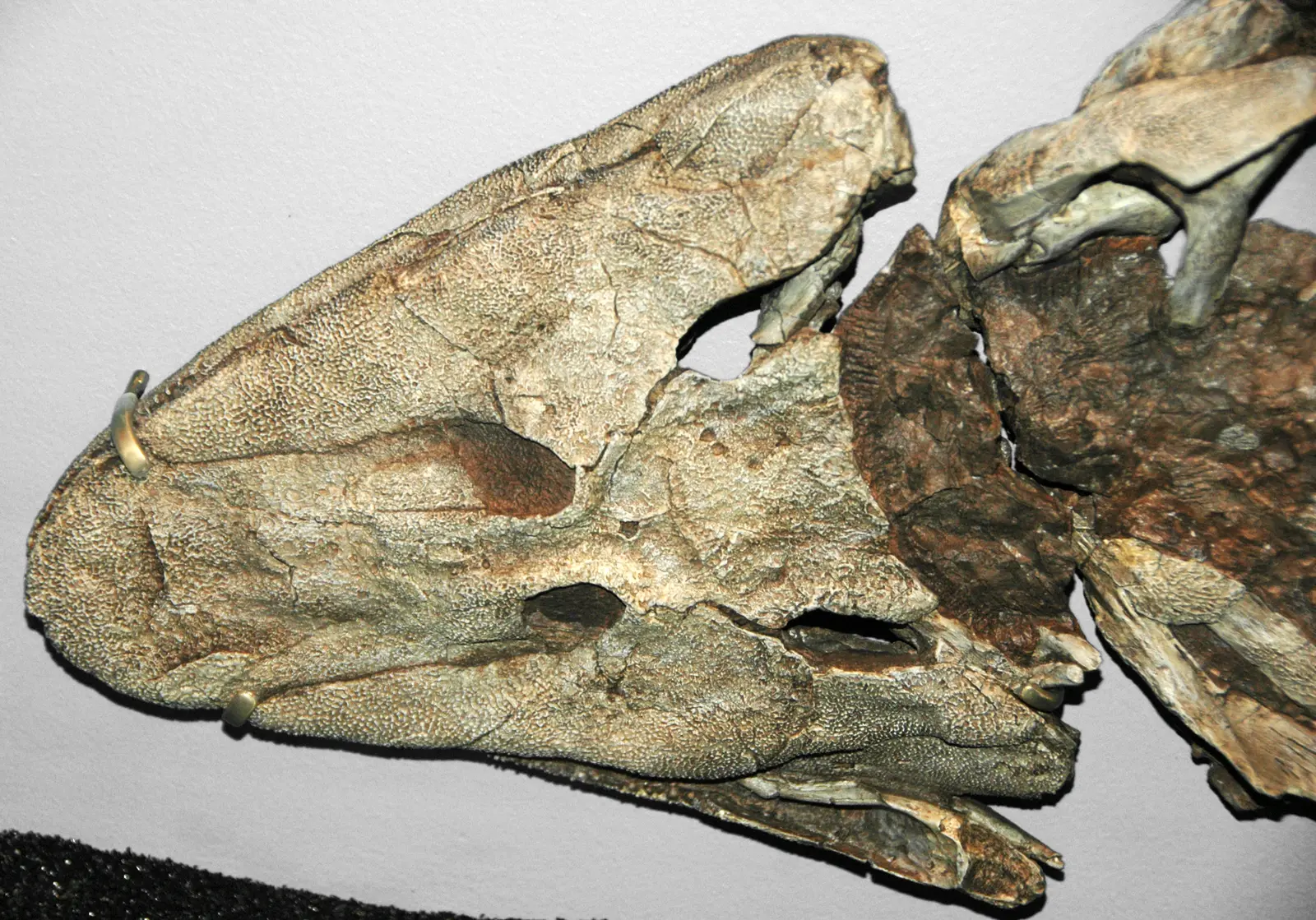
The head of the same cast. The skull is wide and flat, and a gap separates it from the bones behind it on the right.
"Tiktaalik roseae (fish to amphibian transitional fossil) (Fram Formation, Upper Devonian; Ellesmere Island, Arctic Canada) 2" by James St. John — https://commons.wikimedia.org/wiki/File:Tiktaalik_roseae_(fish_to_amphibian_transitional_fossil)_(Fram_Formation,_Upper_Devonian;_Ellesmere_Island,_Arctic_Canada)_2_(49755646886).jpg — CC BY 2.0 (https://creativecommons.org/licenses/by/2.0/)
Which bones were in its fins?
Inside each front fin, Tiktaalik roseae had a humerus, the single long bone of the upper arm in a human, and a radius and ulna, the two bones of the forearm. A 2022 study by Stewart and colleagues compares the humerus of a newer fossil with the humeri of Tiktaalik, whose known sizes differ twofold. In Tiktaalik, the ulna is about half as long as the radius, according to a 2012 study by Swartz.
Further out, the 2006 study of the fin found more bones, with movable joints between them. Among the postures it describes is a stance with the shoulder and elbow bent and the outer part of the fin held straight, so the fin could support the body against the bottom. The names humerus, radius and ulna are those of the human upper arm and forearm, and homologous structures follows those bones across other animals.
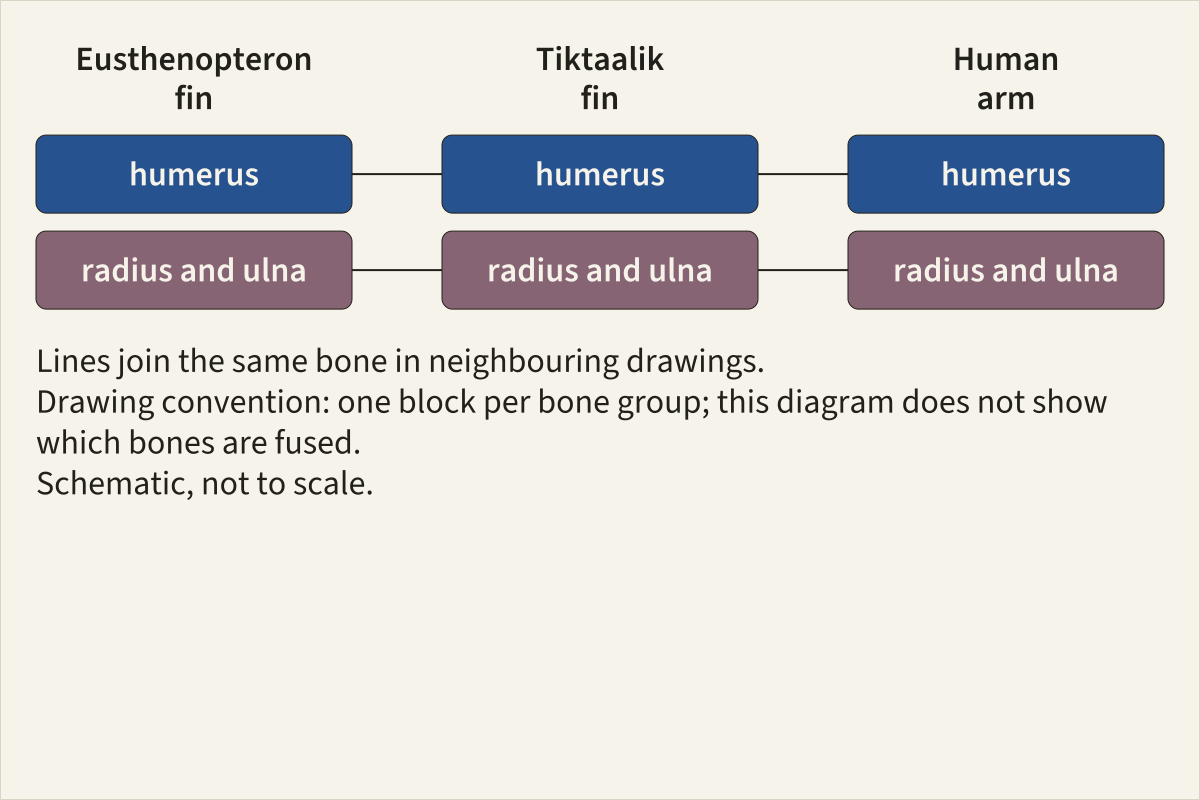
Each column is one fin or arm, read from the shoulder down, with one block per bone group, so the radius and ulna share a block. Lines join the same bones across the three columns; only the first two segments of each limb are drawn.
Basis Bones in each fin or arm from Stewart et al. 2022, Swartz 2012 and Solounias et al. 2018; colours fixed site-wide.
"Humerus, radius and ulna in Eusthenopteron, Tiktaalik and a human" by Feathers, Skeletons & Nests, https://feathersskeletonsandnests.com/fossils/tiktaalik/ , licensed under CC BY 4.0, https://creativecommons.org/licenses/by/4.0/
Data: Stewart T. A., Lemberg J. B., Daly A., Daeschler E. B. and Shubin N. H. (2022) A new elpistostegalian from the Late Devonian of the Canadian Arctic. Nature 608: 563-568, https://doi.org/10.1038/s41586-022-04990-w, CC BY 4.0; Swartz B. (2012) A marine stem-tetrapod from the Devonian of western North America. PLoS ONE 7(3): e33683, https://doi.org/10.1371/journal.pone.0033683, CC BY (version not stated); Solounias N. et al. (2018) R. Soc. Open Sci. 5: 171782, https://doi.org/10.1098/rsos.171782, CC BY 4.0
The fins still had rays, the thin bony struts that stiffen a fish fin. Even the hind fins had changed. In the type specimen, the pelvis, or hip girdle, is 65 mm long, close to the 70 mm of the shoulder girdle, according to the 2014 paper. The paper calls that ratio tetrapod-like: in Acanthostega, an early limbed animal, the two girdles are also about equal.
The hip joint was probably more mobile than the shoulder. The 2014 paper describes the hip socket as deep and round and infers from it a wider swing than in early limbed animals, with stability at the shoulder and mobility at the hip. Judging from the length of its rays, the hind fin was at least as long as the front fin. The authors suggest that paddling, holding position and walking on the bottom may all have been part of what the fins did.
Is Tiktaalik a fish or an amphibian?
It was a fish. The 2006 description calls it a sarcopterygian, or lobe-finned fish, that sits between fish with fins and tetrapods with limbs. Its body scales, fin rays, lower jaw and palate are comparable to those of earlier lobe-finned fish. Its shortened skull roof, modified ear region, mobile neck and wrist joint point towards the condition of limbed animals.
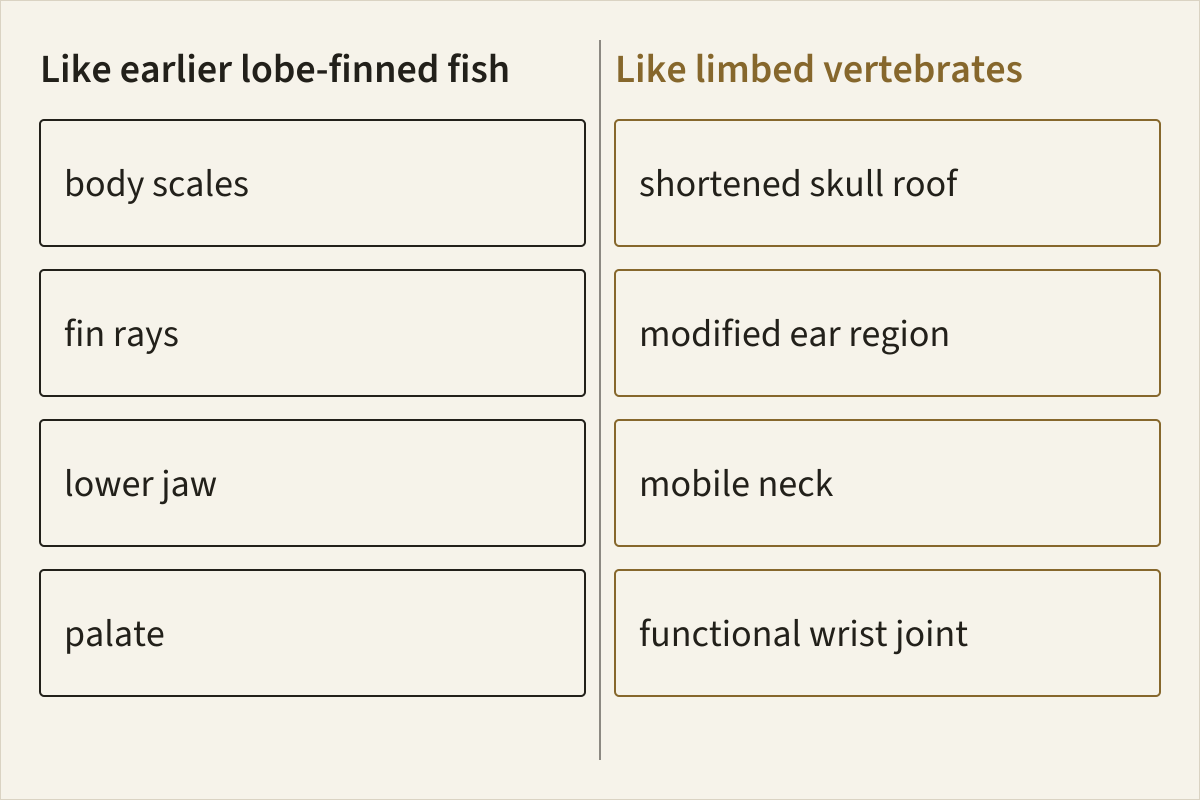
The features named in the 2006 description, split into two groups. Read down each column; the order within a column has no meaning.
Basis Features as listed in the abstract of Daeschler et al. 2006; schematic.
"Fish-like and tetrapod-like features of Tiktaalik roseae" by Feathers, Skeletons & Nests, https://feathersskeletonsandnests.com/fossils/tiktaalik/ , licensed under CC BY 4.0, https://creativecommons.org/licenses/by/4.0/
| Like earlier lobe-finned fish | Like limbed vertebrates |
|---|---|
| Body scales | Shortened skull roof |
| Fin rays | Modified ear region |
| Lower jaw | Mobile neck |
| Palate | Functional wrist joint |
The 2022 study counts as limbed only animals with digits and no fin rays, and Tiktaalik had fin rays. The same study calls it an elpistostegalian, one of the finned relatives closest to limbed vertebrates.
That group was more varied than one fossil suggests. The 2022 study describes Qikiqtania wakei, a close relative found 1.5 km away in slightly lower rocks of the same formation. Its front fin lacks the bony processes, joint angles and muscle scars linked to propping on a hard bottom. The authors read it as a fin specialized for swimming, a return to open water.
Where such a fossil sits among its relatives is a tree question, covered in are birds dinosaurs?, and Archaeopteryx is another fossil read as in-between.
Was Tiktaalik the first animal on land?
Probably not the first four-limbed animal, going by older tracks attributed to limbed animals. In 2010, Niedźwiedzki and colleagues reported tetrapod tracks from Poland, left in tidal flat sediments of the Eifelian stage of the Middle Devonian. According to their 2010 abstract, the tracks are about 10 million years older than the oldest elpistostegids, the group that includes Tiktaalik, and about 18 million years older than the earliest known tetrapod body fossils.
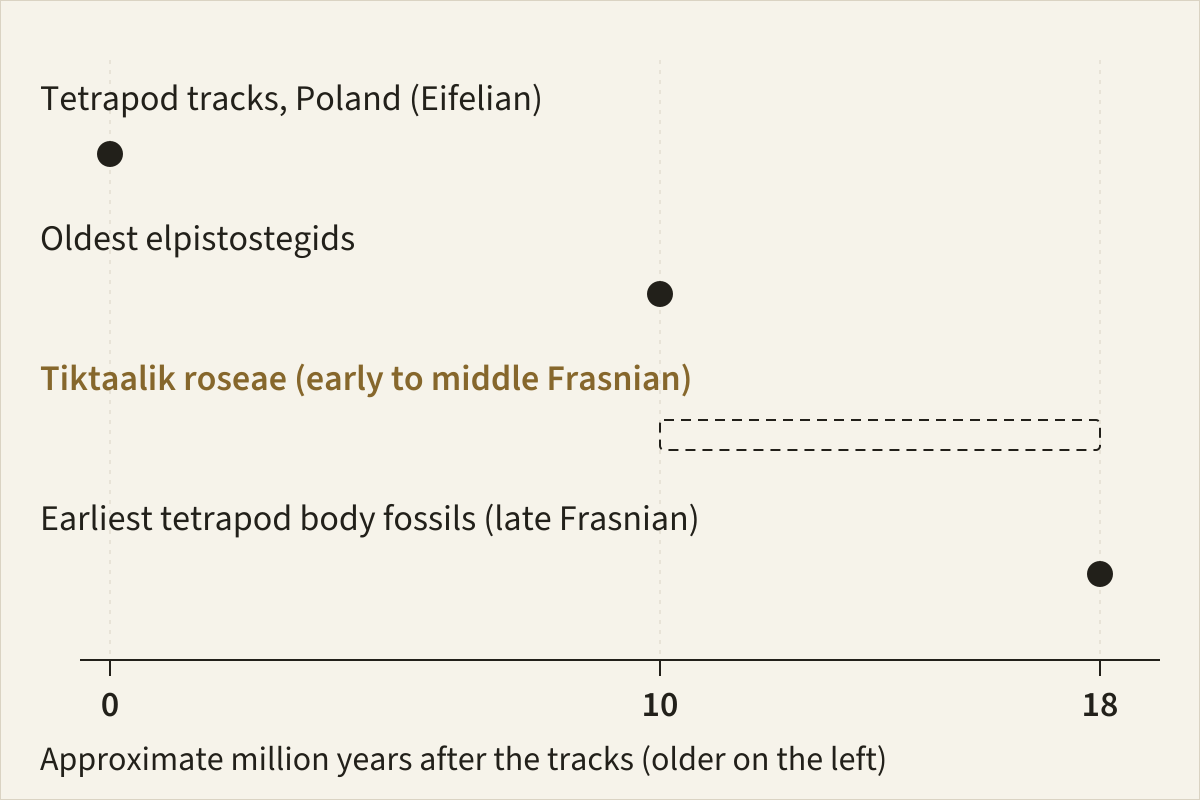
Four events in order, older on the left. The dashed span marks only the place of Tiktaalik in that order, between the dots above and below it; its ends are not dates for Tiktaalik itself.
Basis Gaps of about 10 and 18 million years from the abstract of Niedźwiedzki et al. 2010; the Tiktaalik span shows order only, with its stage from Stewart et al. 2022.
"Order of the Polish tracks, the oldest elpistostegids, Tiktaalik and the first tetrapod bodies" by Feathers, Skeletons & Nests, https://feathersskeletonsandnests.com/fossils/tiktaalik/ , licensed under CC BY 4.0, https://creativecommons.org/licenses/by/4.0/
| Event | When | Source |
|---|---|---|
| Tetrapod tracks, Poland | Eifelian, Middle Devonian | Niedźwiedzki et al. 2010 |
| Oldest elpistostegids | About 10 million years after the tracks | Niedźwiedzki et al. 2010 |
| Tiktaalik roseae | Early to middle Frasnian, Late Devonian | Stewart et al. 2022 |
| Earliest tetrapod body fossils | Late Frasnian, about 18 million years after the tracks | Niedźwiedzki et al. 2010 |
According to the same 2010 abstract, the earliest tetrapod bodies came after fish such as Panderichthys and Tiktaalik, which still had paired fins. Read with the tracks, the order puts footprints attributed to limbed animals before Tiktaalik lived. The authors wrote that this calls for a fresh look at when and where the fish-to-tetrapod change happened. Animals that later went the other way, back into water, are the subject of whale evolution.
How does it compare with Eusthenopteron?
Eusthenopteron is a finned relative that sits further from limbed animals on the family tree than Tiktaalik, as the 2014 paper places it. The 2022 study notes that Eusthenopteron humeri keep a ridge, a bony process and joint faces for the radius and ulna across a wide range of body sizes. Tiktaalik humeri, it adds, keep the same features across their twofold size range.
The hips differ more. In Eusthenopteron, the pelvis is about 1/20 of body length, according to the 2014 paper; in Tiktaalik it is about 1/12 of estimated body length, roughly 1.7 times the share. Yet the Tiktaalik pelvis is still built like a fish’s: it has no ischium, the rear hip bone of limbed animals, and no attachment for a rib that would tie it to the backbone.
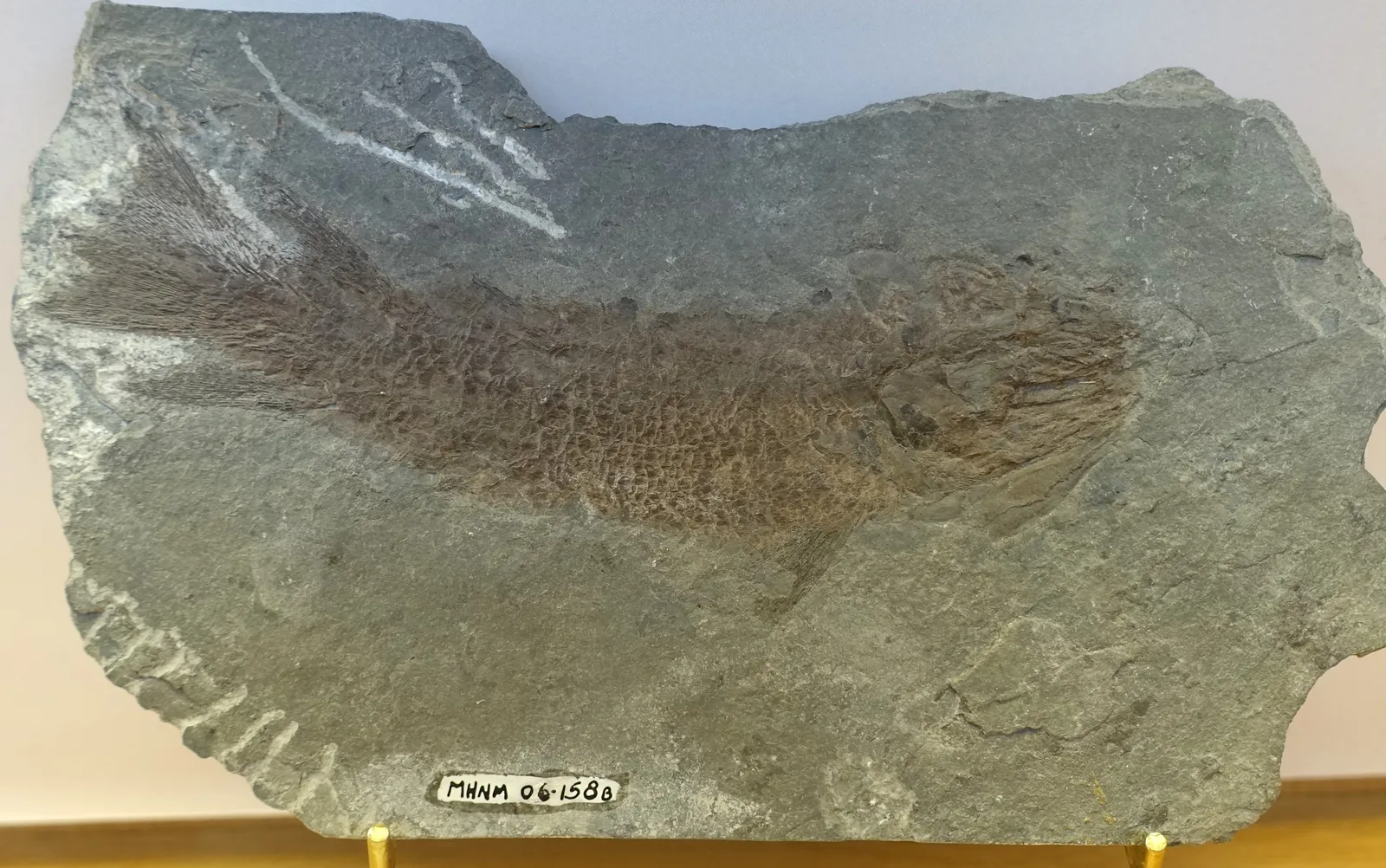
A young Eusthenopteron from Miguasha, on display at the Redpath Museum, Montreal. The overlapping scales and the rays of the tail fin show clearly in the dark film of the body.
"Eusthenopteron, complete specimen of juvenile individual, Miguasha - Redpath Museum - McGill University - Montreal, Canada" by Daderot — https://commons.wikimedia.org/wiki/File:Eusthenopteron,_complete_specimen_of_juvenile_individual,_Miguasha_-_Redpath_Museum_-_McGill_University_-_Montreal,_Canada_-_DSC07998.jpg — CC0 1.0 (https://creativecommons.org/publicdomain/zero/1.0/); modified: cropped to the fossil slab, leaving out the exhibit panel text behind it
Same bones, elsewhere:
- Homologous structures: the arm bones a fish fin can share with a human arm.
- Whale evolution: the reverse trip, from land back to water.
Sources
- Edward B. Daeschler, Neil H. Shubin and Farish A. Jenkins Jr, "A Devonian tetrapod-like fish and the evolution of the tetrapod body plan", Nature 440 (2006): 757–763. doi.org/10.1038/nature04639Read: abstract only
- Neil H. Shubin, Edward B. Daeschler and Farish A. Jenkins Jr, "The pectoral fin of Tiktaalik roseae and the origin of the tetrapod limb", Nature 440 (2006): 764–771. doi.org/10.1038/nature04637Read: abstract only
- Neil H. Shubin, Edward B. Daeschler and Farish A. Jenkins Jr, "Pelvic girdle and fin of Tiktaalik roseae", Proceedings of the National Academy of Sciences 111 (2014): 893–899. doi.org/10.1073/pnas.1322559111Read: full text
- Thomas A. Stewart, Justin B. Lemberg, Ailis Daly, Edward B. Daeschler and Neil H. Shubin, "A new elpistostegalian from the Late Devonian of the Canadian Arctic", Nature 608 (2022): 563–568. doi.org/10.1038/s41586-022-04990-wRead: full textText licence: CC BY 4.0 (terms)
- Brian Swartz, "A marine stem-tetrapod from the Devonian of western North America", PLoS ONE 7, no. 3 (2012): e33683. doi.org/10.1371/journal.pone.0033683Read: full textText licence: CC BY (version not stated in the article) (terms)
- Nikos Solounias, Melinda Danowitz, Elizabeth Stachtiaris, Abhilasha Khurana, Marwan Araim, Marc Sayegh and Jessica Natale, "The evolution and anatomy of the horse manus with an emphasis on digit reduction", Royal Society Open Science 5, no. 1 (2018): 171782. doi.org/10.1098/rsos.171782Read: full textText licence: CC BY 4.0 (terms)
- Grzegorz Niedźwiedzki, Piotr Szrek, Katarzyna Narkiewicz, Marek Narkiewicz and Per E. Ahlberg, "Tetrapod trackways from the early Middle Devonian period of Poland", Nature 463 (2010): 43–48. doi.org/10.1038/nature08623Read: abstract only
Cite this page
Feathers, Skeletons & Nests. “Tiktaalik roseae: A Fish With a Neck and a Wrist Joint.” first published 17 November 2026. https://feathersskeletonsandnests.com/fossils/tiktaalik/ (accessed on the date you read it).
How facts are sourcedAll correctionsReport an error on this page (contact@feathersskeletonsandnests.com)
More from the Fossils drawer
How Do Fossils Form? Often, Minerals Fill the Pores in Bone
- Kind
- In-depth explainer
- Added
Picture credit
"Plate 37, Various Forms of Ammonites, from Geology and Mineralogy Considered with Reference to Natural Theology" by William Buckland — https://commons.wikimedia.org/wiki/File:Geology_and_Mineralogy_considered_with_reference_to_Natural_Theology,_plate_37.png — Public domain (US: published 1837; EU: author William Buckland d. 1856 (plate engraver not individually traced; Public Domain Mark on the file page); anyone working on the plate in 1837, 119 years before 1956, could not credibly have died after 1955)
Archaeopteryx: A Lone Feather Was Its First Type Specimen
- Kind
- Specimen entry
- Added
Picture credit
"London Archaeopteryx" by Allan Henderson — https://commons.wikimedia.org/wiki/File:London_Archaeopteryx.jpg — CC BY 2.0 (https://creativecommons.org/licenses/by/2.0/)
Whale Evolution: Ankles Tied Whales to Even-Toed Mammals
- Kind
- In-depth explainer
- Added
Picture credit
"Pakicetus and Ambulocetus skeletons, comparison" by Hans Thewissen — https://commons.wikimedia.org/wiki/File:Pakicetus_Ambulocetus_Skeletons_comparison.jpg — CC BY 2.0 (https://creativecommons.org/licenses/by/2.0/)