Archaeopteryx: A Lone Feather Was Its First Type Specimen
Short answer
The name Archaeopteryx lithographica was first given to a single fossil feather from the Solnhofen limestone of southern Germany, not to a skeleton, according to Richard Owen’s 1863 account of the 1861 naming. The London skeleton later replaced the feather as the name-bearing specimen, and as of 2019, Kaye and colleagues counted 11 or 12 known skeletons.
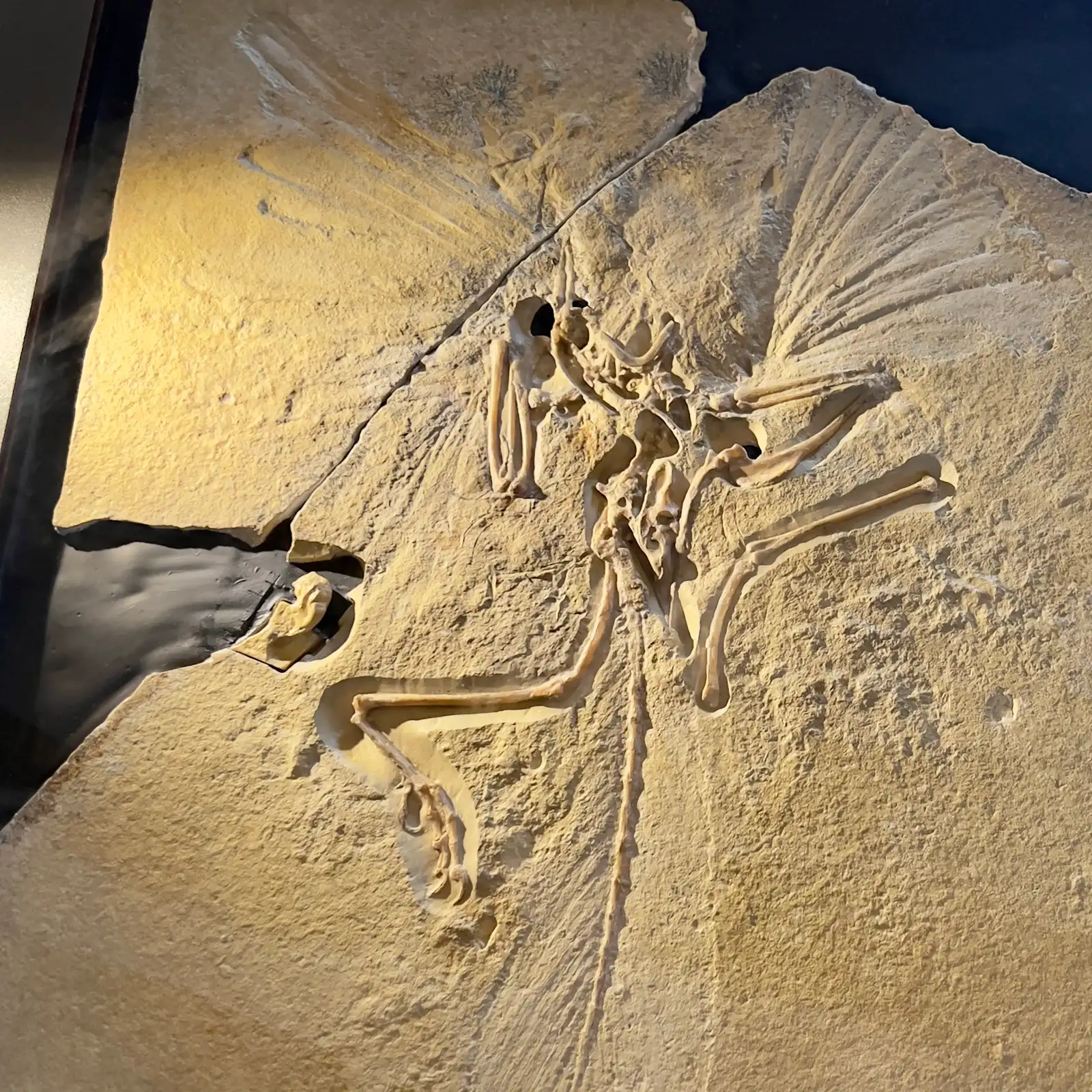
The London specimen, the skeleton that now carries the name. The fanned grooves at the top are wing-feather impressions, and the thin line of small bones running down to the lower edge is the bony tail.
"London Archaeopteryx" by Allan Henderson — https://commons.wikimedia.org/wiki/File:London_Archaeopteryx.jpg — CC BY 2.0 (https://creativecommons.org/licenses/by/2.0/)
In a slab of fine limestone, a single feather can lie on its own, with no bird around it. That is how Archaeopteryx entered science: as a dark film split across two slabs, one now in Berlin and one in Munich, according to a 2019 study by Kaye and colleagues. That study and a 2020 reply still disagree on whether the feather came from Archaeopteryx at all. How such fine detail survives in stone is the subject of how fossils form.
Why was the name first given to a feather?
Owen’s 1863 paper in the Philosophical Transactions of the Royal Society opens with the feather. “The first evidence of a Bird in strata of the Oxfordian or Corallian stage of the Oolitic series”, he wrote, “was afforded by the impression of a single feather, in a slab of the lithographic calcareous laminated stone, or slate, of Solenhofen” (page 33). Of the German describer of that feather, Owen added: “He applies to this fossil impression the term Archeopteryx lithographica.”
A footnote dates that first notice to 1861, page 561 of the Jahrbuch für Mineralogie. In the same year, Andreas Wagner told the Munich academy of a skeleton with feathers that he knew only from a report. Wagner proposed the name Griphosaurus, “conceiving it to be a long-tailed Pterodactyle with feathers” (Owen 1863, page 34). Owen described that skeleton in 1863 and kept the genus name first given to the feather.
Owen was uneasy about defining a species by one feather. In a footnote he warned that “the impression of a second feather differing greatly in its shape and proportions, as in Plate IV. fig. 8, would represent a distinct species” if a single feather set the rules. Figure 8 shows tail plumes from the skeleton, which carried a pair of feathers on each tail bone (Owen 1863, page 36). So Owen kept the genus but gave the London species its own name, Archeopteryx macrura.
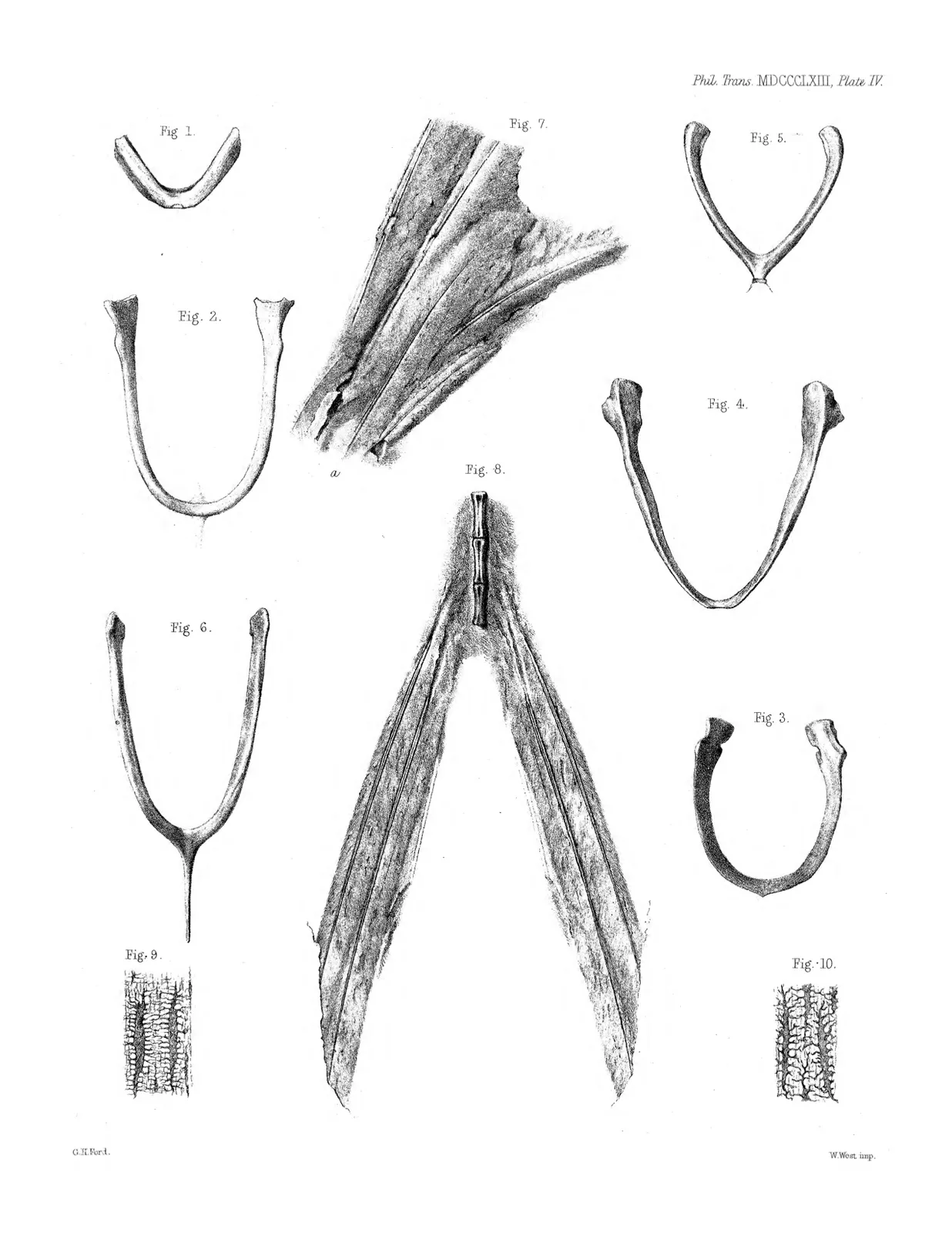
Plate IV from Owen’s 1863 paper. Figure 8, the large V in the centre, is the pair of tail plumes Owen set against the lone feather of 1861. Figure 1, top left, is part of the fossil’s wishbone, drawn beside the wishbones of a raven, a falcon, an owl, a stork and a curassow.
“Plate IV, from Owen, On the Archeopteryx of von Meyer (Philosophical Transactions 153)”, G. H. Ford (drawing), in Richard Owen, Philosophical Transactions of the Royal Society (1863); public domain.
Full credit
"Plate IV, from Owen, On the Archeopteryx of von Meyer (Philosophical Transactions 153)" by G. H. Ford (drawing), in Richard Owen, Philosophical Transactions of the Royal Society (1863) — https://commons.wikimedia.org/wiki/File:R._Owen_London_Archaeopteryx_(1862)_-_Plate_IV.png — Public domain (US: published 1863, before 1931; EU: artist G. H. Ford d. 1876 and author Richard Owen d. 1892, more than 70 years ago (printer W. West: death year not verified))
The feather kept its status for a long time. Carney and colleagues (2020) write that this “Urfeder” (first feather) “was the holotype of Archaeopteryx lithographica, the archetypal Urvogel (first bird), until the feather was replaced by the more diagnostic London specimen.” A holotype is the single specimen that a species name is tied to. Kaye and colleagues (2019) note that the London skeleton was “eventually designated as a neotype”, a replacement name-bearer, by Opinion 2283 of the International Commission on Zoological Nomenclature.
How many Archaeopteryx skeletons are known?
Kaye and colleagues put the number at 11 or 12 known skeletons as of 2019. The range comes from one specimen whose identity was in doubt: as they report, a 2017 study had recently removed the Haarlem specimen from Archaeopteryx. A 2020 paper by Carney and colleagues gives a higher total, referring to “the 13 described Archaeopteryx specimens”.
The methods section of the 2019 paper names each specimen that Kaye’s team studied, with a museum number where one was available. That list starts with the lone feather and names ten skeletons, fewer than the 2019 total of 11 or 12, since it records the specimens studied rather than a full count. The figure and table below copy it. Totals like this change as new finds are described, so the list is dated to 2019.
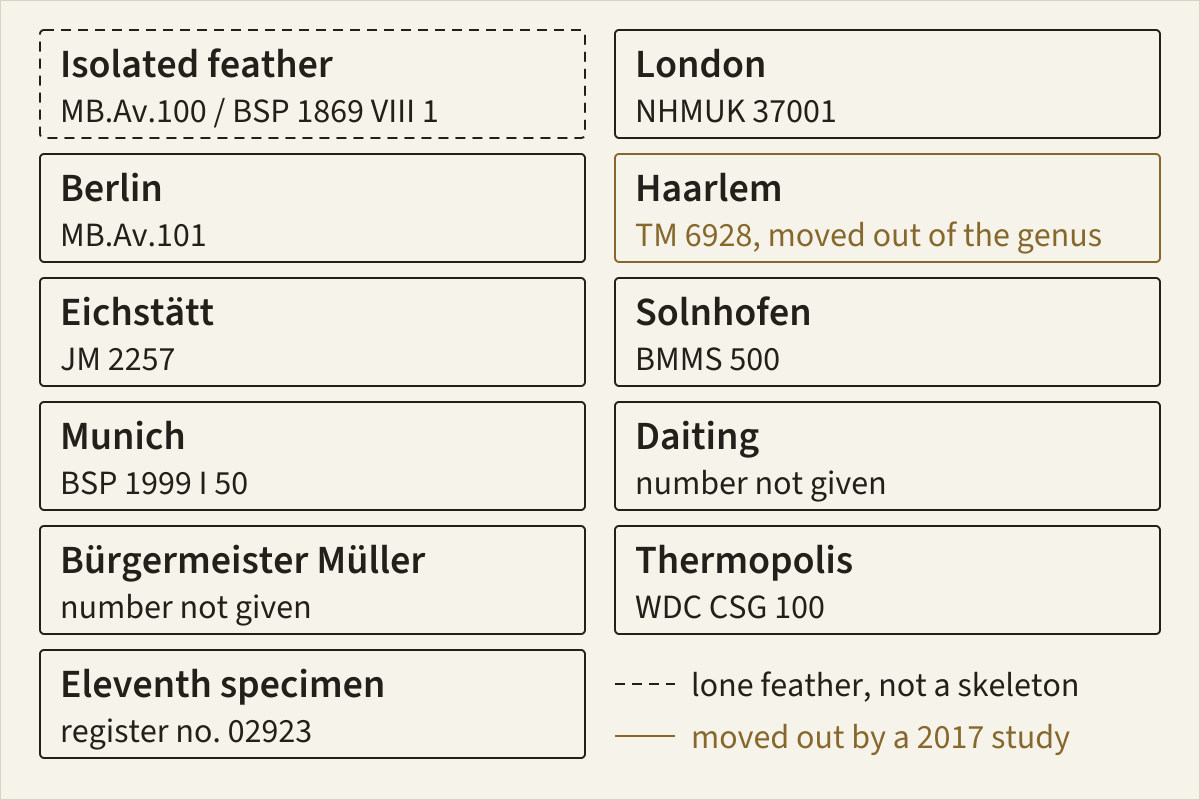
Each tag is one specimen named in Kaye et al. 2019, with its specimen number where the paper gives one. The dashed tag is the lone feather; the amber tag is the Haarlem specimen, which the paper reports was moved out of Archaeopteryx.
Basis Specimen names and numbers from the Methods of Kaye et al. 2019 (CC BY 4.0), as of 2019; schematic, not to scale.
"Archaeopteryx specimens named in Kaye et al. 2019" by Feathers, Skeletons & Nests, https://feathersskeletonsandnests.com/fossils/archaeopteryx/ , licensed under CC BY 4.0, https://creativecommons.org/licenses/by/4.0/
Data: Kaye T. G., Pittman M., Mayr G., Schwarz D. and Xu X. (2019) Detection of lost calamus challenges identity of isolated Archaeopteryx feather. Scientific Reports 9: 1182, https://doi.org/10.1038/s41598-018-37343-7, CC BY 4.0
| Specimen | Number in Kaye et al. 2019 | Held at (2019) | Note |
|---|---|---|---|
| Isolated feather | BSP 1869 VIII 1; MB.Av.100 | Bavarian State Collection of Paleontology and Geology, Munich; Museum für Naturkunde, Berlin | A feather, not a skeleton; attribution disputed |
| London specimen | NHMUK 37001 | Natural History Museum, London | Later designated the neotype |
| Berlin specimen | MB.Av.101 | Museum für Naturkunde, Berlin | Skeleton |
| Haarlem specimen | TM 6928; TM 6929 | Teylers Museum, Haarlem | Reported as removed from Archaeopteryx |
| Eichstätt specimen | JM 2257 | Jura Museum, Willibaldsburg | Skeleton |
| Solnhofen specimen | BMMS 500 | Bürgermeister Müller Museum, Solnhofen | Skeleton |
| Munich specimen | BSP 1999 I 50 | Bavarian State Collection of Paleontology and Geology, Munich | Skeleton |
| Daiting specimen | Not given | Not given | Skeleton |
| Bürgermeister Müller specimen | Not given | Bürgermeister Müller Museum | Skeleton |
| Thermopolis specimen | WDC CSG 100 | Wyoming Dinosaur Center, Thermopolis | Skeleton |
| Eleventh specimen | 02923 (German national register) | Bürgermeister Müller Museum | Skeleton |
Download the specimen list (CSV) (what this file records) Data: Kaye T. G., Pittman M., Mayr G., Schwarz D. and Xu X. (2019) Detection of lost calamus challenges identity of isolated Archaeopteryx feather. Scientific Reports 9: 1182, https://doi.org/10.1038/s41598-018-37343-7, CC BY 4.0; Carney R. M., Tischlinger H. and Shawkey M. D. (2020) Evidence corroborates identity of isolated fossil feather as a wing covert of Archaeopteryx. Scientific Reports 10: 15593, https://doi.org/10.1038/s41598-020-65336-y, CC BY 4.0
Does the first feather belong to Archaeopteryx?
Two studies read the same feather in opposite ways, and neither has closed the question. Kaye and colleagues (2019) used laser-stimulated fluorescence, a method that makes faint chemical traces glow, to recover the outline of the feather’s lost quill. They compared the whole feather with the wing and tail feathers of known skeletons. Their conclusion: “the isolated feather is not conformal to known Archaeopteryx specimens as a primary, secondary or tail feather.”
The 2019 team found that the feather is a third shorter than it would need to be to match the secondary wing feathers of the Berlin skeleton. Its shaft also curves the other way from the primary coverts of 24 modern birds; a covert is one of the smaller feathers that overlap the base of the flight feathers. They wrote that “the possibility remains that it stems from a different feathered dinosaur that lived in the Solnhofen Archipelago.”
Carney, Tischlinger and Shawkey (2020) replied that the feather is “most likely an upper major primary covert”, pointing to its long quill, 23.3% of the feather’s total length, and eight other features. The feather also came from the same fossil site and layer as four Archaeopteryx skeletons, and it matches the primary coverts on the eleventh skeleton. Even so, they wrote that “we can never know the exact follicle or species from which the Urfeder originated with complete certainty.”
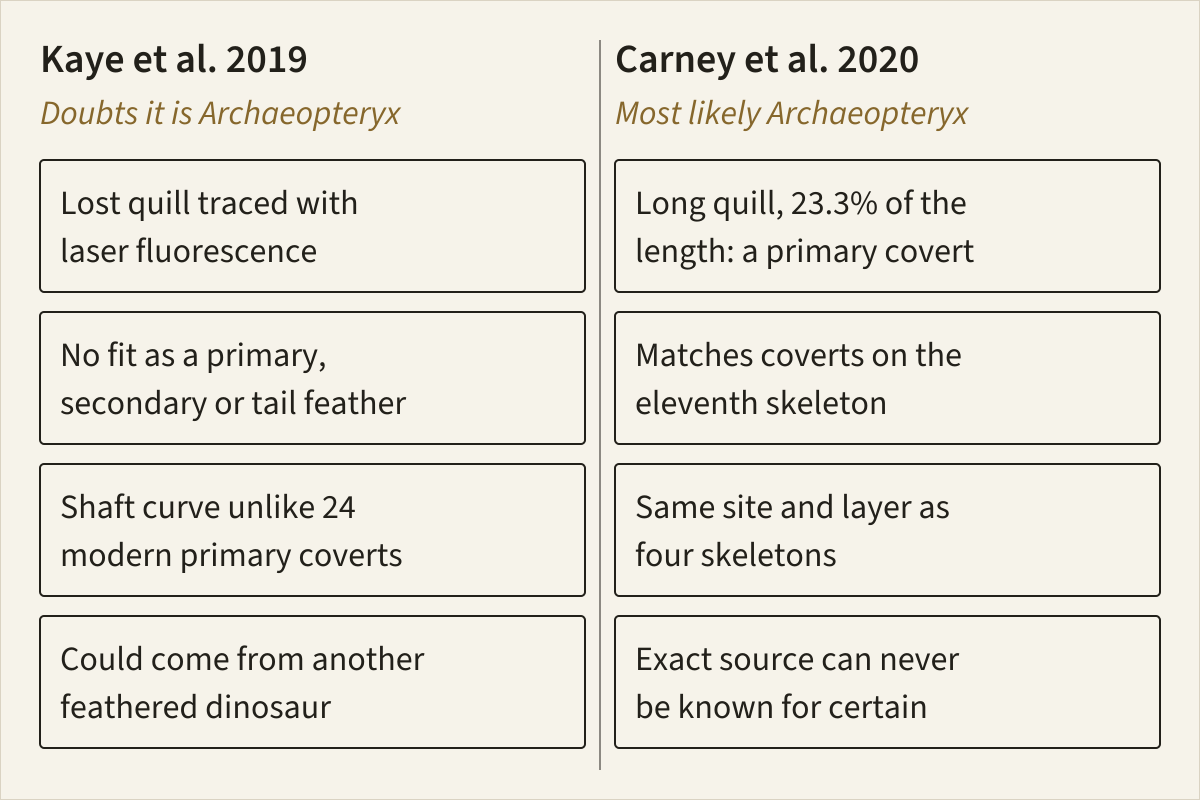
The main points of each study, set side by side. Read down each column; the boxes are summaries in no ranked order.
Basis Points summarised from Kaye et al. 2019 and Carney et al. 2020 (both CC BY 4.0); schematic, not to scale.
"Two readings of the isolated Archaeopteryx feather" by Feathers, Skeletons & Nests, https://feathersskeletonsandnests.com/fossils/archaeopteryx/ , licensed under CC BY 4.0, https://creativecommons.org/licenses/by/4.0/
Data: Kaye T. G., Pittman M., Mayr G., Schwarz D. and Xu X. (2019) Detection of lost calamus challenges identity of isolated Archaeopteryx feather. Scientific Reports 9: 1182, https://doi.org/10.1038/s41598-018-37343-7, CC BY 4.0; Carney R. M., Tischlinger H. and Shawkey M. D. (2020) Evidence corroborates identity of isolated fossil feather as a wing covert of Archaeopteryx. Scientific Reports 10: 15593, https://doi.org/10.1038/s41598-020-65336-y, CC BY 4.0
| Point | Kaye et al. 2019 | Carney et al. 2020 |
|---|---|---|
| Verdict | Doubts the feather is from Archaeopteryx | Most likely an Archaeopteryx upper major primary covert |
| Quill | Lost quill traced with laser fluorescence | Quill is 23.3% of the feather’s length, as in primary coverts |
| Fit to skeletons | No fit as a primary, secondary or tail feather | Matches primary coverts on the eleventh skeleton |
| Shaft curve | Unlike 24 modern primary coverts | Says that comparison used too narrow a set of modern feathers |
| Other sources | Could come from another feathered dinosaur | Same site and layer as four skeletons; exact source never certain |
The 2020 paper also predicts the feather’s colour from melanosomes, the pigment granules whose imprints survive in the fossil. Carney and colleagues’ 2020 reanalysis put the colour at matte black, with 90% probability, based on a statistical comparison with the melanosomes of living birds. The colour of Sinosauropteryx, another feathered fossil, is likewise an inference rather than something seen in the stone.
Was Archaeopteryx a bird?
Owen called it a bird. Yet the skeleton he described mixed parts that look like a bird’s with parts that do not. He counted “twenty caudal vertebrae”, tail bones in one unbroken row, and wrote that the tail resembled a squirrel’s more than a modern bird’s (Owen 1863, pages 34 and 36). Against that, the fossil had a wishbone, which Owen called “connate clavicles”, two collarbones joined in one arch, a bone that he noted no pterodactyl skeleton had shown.
The hand carried the wing’s quill feathers, but in Owen’s words it “also supported two moderately long and slender free digits, each terminated by a strong, curved, sharp-pointed claw” (page 38). The Berlin specimen shows the same plan from a second skeleton, with feather impressions around both arms and along the tail.
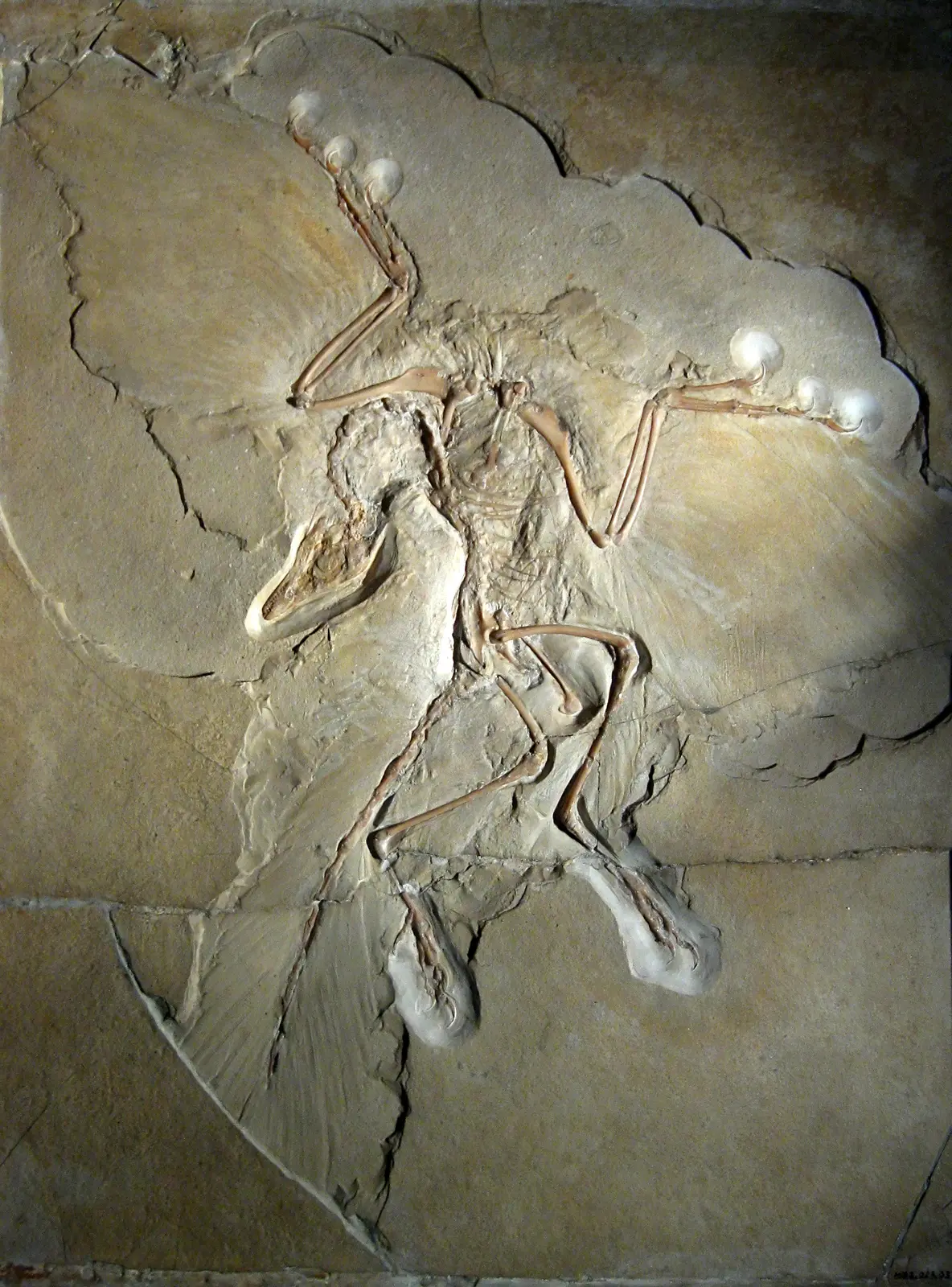
The Berlin specimen. Feather impressions fan out from both arms and along the bony tail, and the bones of each hand run out towards the upper corners of the slab.
"Archaeopteryx lithographica (Berlin specimen)" by H. Raab (User: Vesta) — https://commons.wikimedia.org/wiki/File:Archaeopteryx_lithographica_(Berlin_specimen).jpg — CC BY-SA 3.0 (https://creativecommons.org/licenses/by-sa/3.0/)
Both the 2019 and the 2020 papers place Archaeopteryx at the base of the bird lineage. Carney and colleagues call it “the archetypal Urvogel (first bird)”. Kaye and colleagues raise the chance that the lone feather came from “another basal avialan”, a term for early members of the bird lineage. For a fossil from another big change, fish to four legs, see Tiktaalik.
Same bones, elsewhere:
- Bird wing bones: clawed wing fingers on a living chick.
- Are birds dinosaurs?: where Archaeopteryx sits among dinosaurs and birds.
Sources
- Richard Owen, "On the Archeopteryx of von Meyer, with a description of the fossil remains of a long-tailed species, from the lithographic stone of Solenhofen", Philosophical Transactions of the Royal Society of London 153 (1863): 33–47, plates I–IV. archive.org/details/per_abstracts-of-the-pape…Read: pages 33, 34, 36, 37, 38 and 39 checked against the page images; plate IV explanation
- Thomas G. Kaye, Michael Pittman, Gerald Mayr, Daniela Schwarz and Xing Xu, "Detection of lost calamus challenges identity of isolated Archaeopteryx feather", Scientific Reports 9 (2019): 1182. doi.org/10.1038/s41598-018-37343-7Read: full textText licence: CC BY 4.0 (terms)
- Ryan M. Carney, Helmut Tischlinger and Matthew D. Shawkey, "Evidence corroborates identity of isolated fossil feather as a wing covert of Archaeopteryx", Scientific Reports 10 (2020): 15593. doi.org/10.1038/s41598-020-65336-yRead: full textText licence: CC BY 4.0 (terms)
Cite this page
Feathers, Skeletons & Nests. “Archaeopteryx: A Lone Feather Was Its First Type Specimen.” first published 17 November 2026. https://feathersskeletonsandnests.com/fossils/archaeopteryx/ (accessed on the date you read it).
How facts are sourcedAll correctionsReport an error on this page (contact@feathersskeletonsandnests.com)
More from the Fossils drawer
How Do Fossils Form? Often, Minerals Fill the Pores in Bone
- Kind
- In-depth explainer
- Added
Picture credit
"Plate 37, Various Forms of Ammonites, from Geology and Mineralogy Considered with Reference to Natural Theology" by William Buckland — https://commons.wikimedia.org/wiki/File:Geology_and_Mineralogy_considered_with_reference_to_Natural_Theology,_plate_37.png — Public domain (US: published 1837; EU: author William Buckland d. 1856 (plate engraver not individually traced; Public Domain Mark on the file page); anyone working on the plate in 1837, 119 years before 1956, could not credibly have died after 1955)
Tiktaalik roseae: A Fish With a Neck and a Wrist Joint
- Kind
- Specimen entry
- Added
Picture credit
"Tiktaalik roseae (fish to amphibian transitional fossil) (Fram Formation, Upper Devonian; Ellesmere Island, Arctic Canada) 1" by James St. John — https://commons.wikimedia.org/wiki/File:Tiktaalik_roseae_(fish_to_amphibian_transitional_fossil)_(Fram_Formation,_Upper_Devonian;_Ellesmere_Island,_Arctic_Canada)_1_(49755118288).jpg — CC BY 2.0 (https://creativecommons.org/licenses/by/2.0/)
Whale Evolution: Ankles Tied Whales to Even-Toed Mammals
- Kind
- In-depth explainer
- Added
Picture credit
"Pakicetus and Ambulocetus skeletons, comparison" by Hans Thewissen — https://commons.wikimedia.org/wiki/File:Pakicetus_Ambulocetus_Skeletons_comparison.jpg — CC BY 2.0 (https://creativecommons.org/licenses/by/2.0/)