Petrified Wood: Mostly Silica Filled the Cells, Copying Wood
Short answer
Petrified wood is fossil wood whose pores were filled by minerals carried in groundwater, mostly silica (quartz, chalcedony, opal). At Petrified Forest National Park in Arizona, the US National Park Service describes the wood as largely permineralized. Some specimens also had wood material replaced by silica, and in others a small percentage of the original cell walls survives.
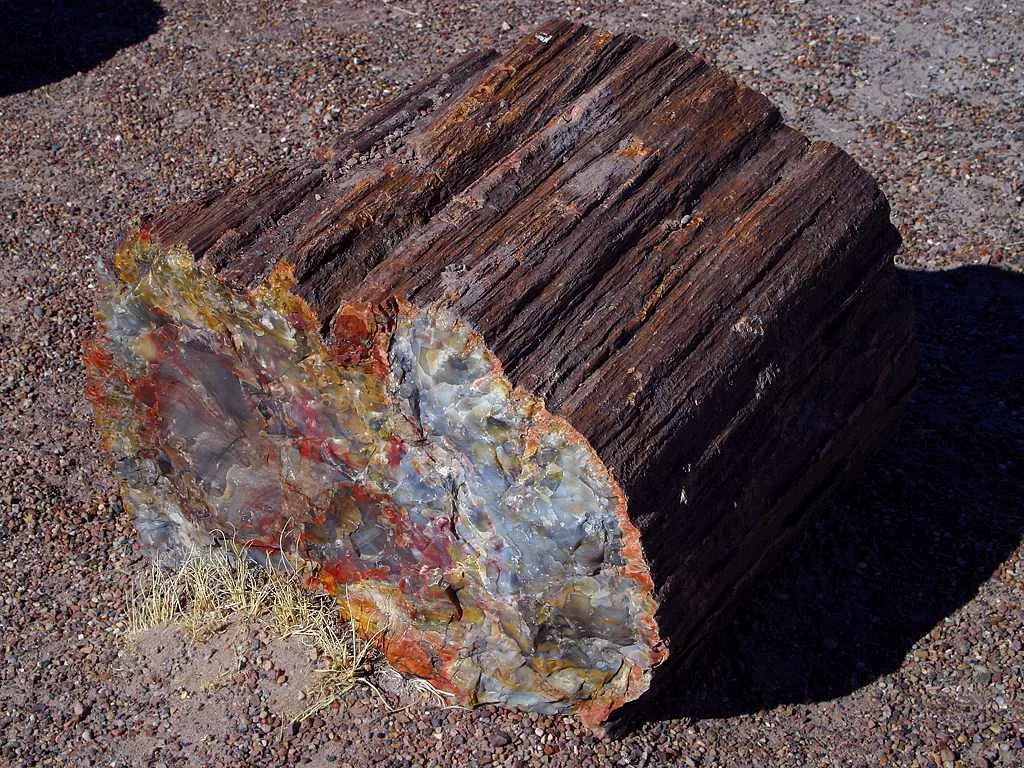
One of the petrified logs at Petrified Forest National Park, Arizona, photographed in 2004. The broken end is grey, red and yellow stone; the side of the log still shows the lengthwise grain of the trunk.
"PetrifiedWood.jpg, a petrified log at Petrified Forest National Park, Arizona" by Jon Sullivan (PD Photo.org) — https://commons.wikimedia.org/wiki/File:PetrifiedWood.jpg — Public domain (US and EU: released into the public domain worldwide by the photographer Jon Sullivan (PD-author on the file page; CC0 for non-US use per the photo page as quoted on the file page))
Under a microscope, a slice of petrified wood can still show the shape of its cells. The NPS notes that permineralization sometimes preserves “details at the microscopic or cellular level.” The geologist Gideon Mantell said much the same in 1838: wood “so commonly petrified by flint or chalcedony, may be cut so thin, that with a powerful lens the ramifications of the vessels and the structure of their tissues may be seen” (The Wonders of Geology, vol. 1, p. 51).
Petrified wood is a fossil, but not all fossil wood is petrified. The NPS points out that some fossil wood went through carbonization instead. For that reason palaeontologists usually prefer the words permineralization and replacement, which name the process, to petrification, which only names the stony result.
How does wood turn to stone?
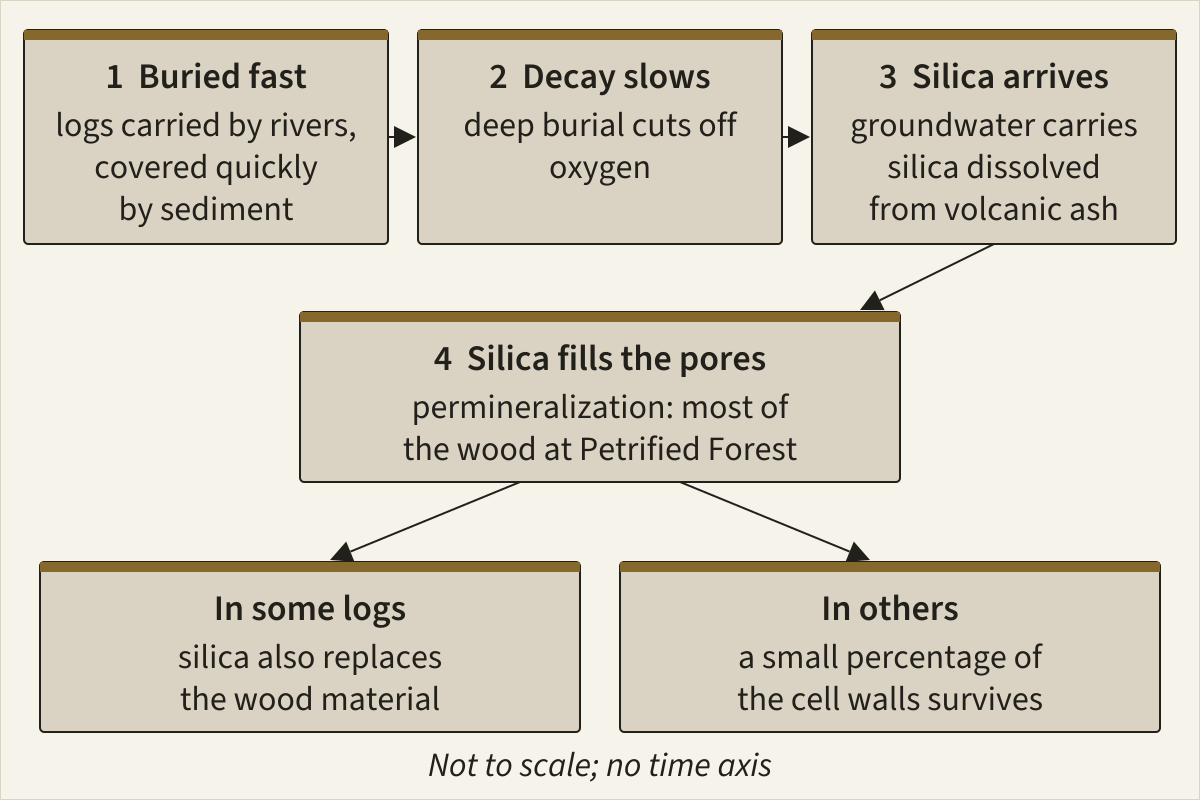
From log to stone at Petrified Forest National Park. Silica fills the pores; some logs also have wood replaced by silica, and in others a small share of the cell walls survives.
Basis Steps from the NPS article Permineralization and Replacement and the Petrified Forest National Park pages; schematic, not to scale.
"How a log becomes petrified wood at Petrified Forest National Park" by Feathers, Skeletons & Nests, https://feathersskeletonsandnests.com/fossils/petrified-wood/ , licensed under CC BY 4.0, https://creativecommons.org/licenses/by/4.0/
Data: National Park Service, Permineralization and Replacement and Petrified Forest National Park, Petrified Wood (U.S. Government works), https://www.nps.gov/articles/000/permineralization-and-replacement.htm, retrieved 2026-11-17
The NPS places the park's petrified logs in the Upper Triassic Chinle Formation. When that sediment was laid down, the area was part of a large river system. Logs were carried by streams and quickly buried by river sediment. The park's own page adds that the burial was fast and deep enough to cut off oxygen, so decay slowed to a crawl.
Then the minerals came in. In the park page's words, minerals, “including silica dissolved from volcanic ash, absorbed into the porous wood over hundreds and thousands of years.” The table lists each step with its source; each row stands as one claim.
| Step | What happens | Qualifier | Source |
|---|---|---|---|
| 1 | Logs were carried by streams and quickly buried by river sediment | Petrified Forest National Park, Upper Triassic Chinle Formation | NPS, Permineralization and Replacement |
| 2 | Burial quick and deep enough cut off oxygen, and decay slowed | Park page wording, last updated 2018-03-16 | NPS, Petrified Forest: Petrified Wood |
| 3 | Groundwater picked up silica from volcanic ash and carried it into the pores of the wood | General NPS account; the Chinle Formation contains abundant volcanic ash | NPS, Permineralization and Replacement |
| 4 | Silica filled the pores of the wood (permineralization) | The park's silicified wood is largely permineralized | NPS, Permineralization and Replacement |
| 5, path A | Silica also replaced wood material (replacement) | Some specimens only; parallel to path B, not before or after it | NPS, Permineralization and Replacement |
| 5, path B | A small percentage of the woody cell walls was preserved | Other specimens only; parallel to path A, not before or after it | NPS, Permineralization and Replacement |
| 6 | Small amounts of iron and manganese minerals give the wood its reddish colours | Most of the petrified wood in the park | NPS, Permineralization and Replacement |
Download the petrified wood steps table (CSV) (what this file records) Data: National Park Service, Permineralization and Replacement and Petrified Forest National Park, Petrified Wood (U.S. Government works), retrieved 2026-11-17
Two NPS pages describe step 4 a little differently. The park's visitor page says the minerals crystallized within the cell structure, “replacing the organic material as it broke down over time.” The NPS geology article is more exact: the wood is “largely permineralized, but some specimens have also undergone replacement of wood material with silica.” This page follows the geology article, because it keeps the two processes apart.
Bone goes through the same pore-filling. The NPS uses the same terms for both, and the bone version has its own entry: how fossils form.
Why can cell walls still show?
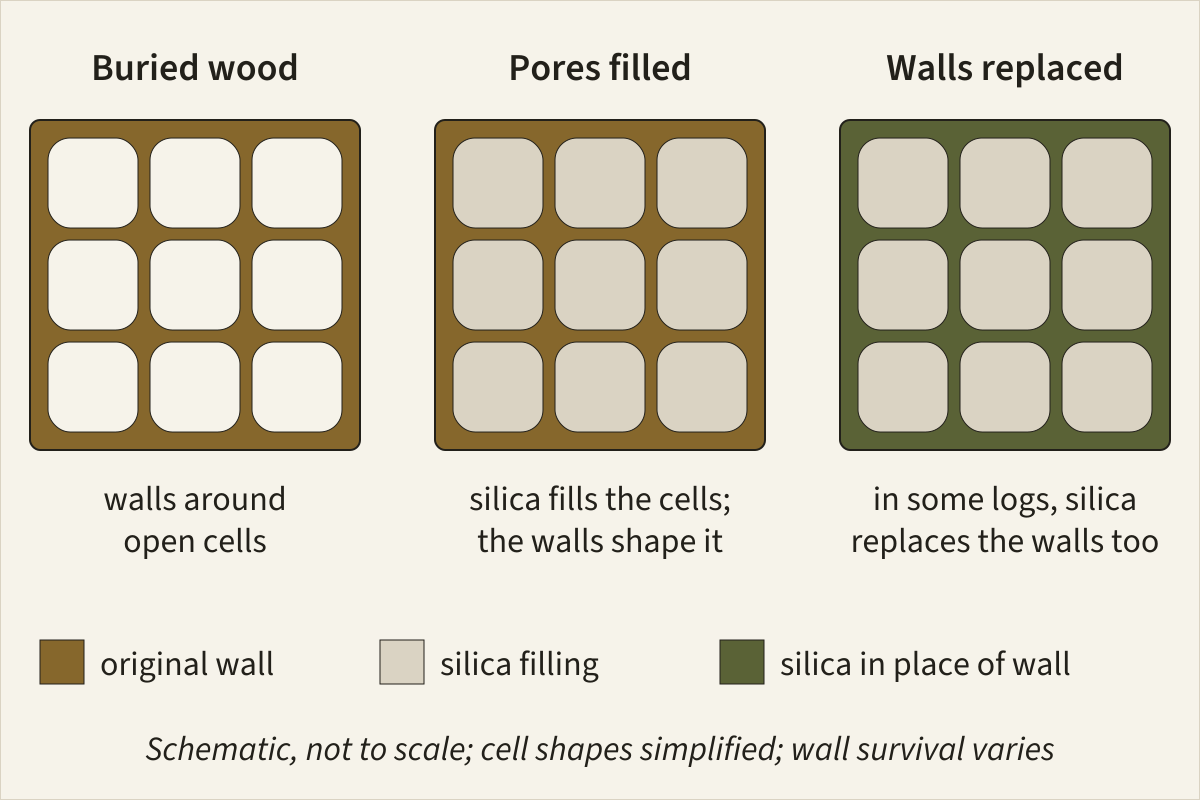
Three blocks drawn side by side. Filling copies the layout of the cells because the silica sets inside the walls while they are still there; in the third block, as in some logs, silica has taken the place of the walls as well.
Basis NPS descriptions of permineralization and of the wood at Petrified Forest; Mantell 1838; schematic, not to scale.
"Wood cells in petrified wood: walls shape the silica filling, and in some logs are replaced" by Feathers, Skeletons & Nests, https://feathersskeletonsandnests.com/fossils/petrified-wood/ , licensed under CC BY 4.0, https://creativecommons.org/licenses/by/4.0/
Data: National Park Service, Permineralization and Replacement (U.S. Government work), https://www.nps.gov/articles/000/permineralization-and-replacement.htm, retrieved 2026-11-17; Gideon Mantell, The Wonders of Geology, vol. 1 (1838), p. 51, public domain
Buried wood is full of pores, some of them microscopic. Permineralization fills those spaces rather than crushing them, so the result, in the NPS's words, is “a three-dimensional internal mold of the original organic tissue.” The silica takes the shape of the room it fills, and the walls set the pattern.
That is why a slice can be read like the original wood. Mantell wrote that the form and arrangement of the vessels in such a slice can show what kind of tree the specimen came from (vol. 1, p. 51). At Petrified Forest, the NPS says most of the petrified trees have been given the scientific name Araucarioxylon arizonicum.
In some logs the copy keeps more than a shape. The NPS writes that in some specimens “a small percentage of the woody cell walls have been preserved.” In those logs a little of the tree itself is still there, held inside the stone that filled it.
Cracks tell a different story. Where crushing or decay split a log, the park page says, there was room for large crystals to grow: clear quartz, purple amethyst, yellow citrine and smoky quartz. These crystals fill open gaps rather than cells, so they do not copy the wood's structure.
Where did the silica come from?
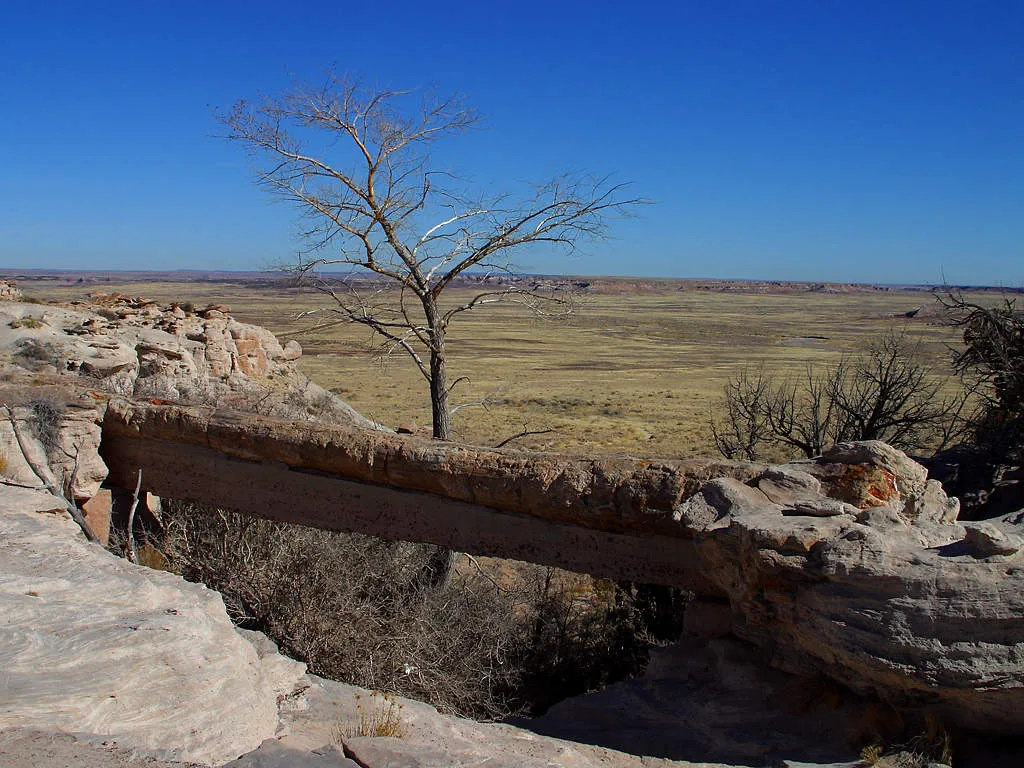
Agate Bridge, a petrified log lying across a small wash in Petrified Forest National Park, Arizona. The park's petrified logs come from the Upper Triassic Chinle Formation.
"Agate_bridge.jpg, Agate Bridge in Petrified Forest National Park, Arizona" by Jon Sullivan (PD Photo.org) — https://commons.wikimedia.org/wiki/File:Agate_bridge.jpg — Public domain (US and EU: released into the public domain worldwide by the photographer Jon Sullivan (PD-author on the file page; CC0 for non-US use per the photo page as quoted on the file page))
The short answer is volcanic ash. The NPS calls volcanic ash “a ready source of silica.” The silica in its tiny glass fragments is not locked inside a crystal like quartz or feldspar, so circulating groundwater picks it up easily and can leave it in the pores of wood or bone.
The Chinle Formation, the NPS adds, “contains abundant volcanic ash and also significant occurrences of petrified wood,” in Petrified Forest, Capitol Reef and Zion national parks and elsewhere on the Colorado Plateau. The park's questions page traces the ash to 200-million-year-old volcanoes to the west, in what is now California, southern Nevada and western Arizona. Wind carried the ash hundreds of miles, and “the ash supplied the silica.”
Silica can harden in several forms. The NPS lists among them quartz, which is crystalline silica; chalcedony, with crystals too small to see under a microscope; and opal, a hydrated silica with no crystal structure. The park page describes its own wood as “almost solid quartz.” Not every fossil ends up in silica, though: Archaeopteryx was kept in fine limestone.
Taking petrified wood from a national park is against the law, according to the National Park Service. Petrified Forest National Park states that “it is against the law to remove any of the natural (petrified wood, other rocks, plants, animals) or cultural resources.” The park explains that with more than half a million visitors a year, it could be picked clean within a few years if collecting were allowed. NPS regulations, set out on its fossil laws and policies page, prohibit removing or disturbing fossilized specimens in parks.
The park says hunter-gatherers found this wood more than 13,000 years ago and chipped it into stone tools for thousands of years, and that the first published account of it came from the Whipple Expedition of 1853. Written records of a fossil can start late and leave gaps, as the differing accounts of Mary Anning's ichthyosaur show.
Same bones, elsewhere:
- How do fossils form?: the same pore-filling, in bone
- Beaver dam: wood that stays wood, the sticks in a beaver dam
Sources
- National Park Service, "Permineralization and Replacement", Fossils and Paleontology (last updated August 16, 2024). www.nps.gov/articles/000/permineralization-an…Read: full textText licence: U.S. Government work. No protection is claimed in original U.S. Government works (terms)
- National Park Service, Petrified Forest National Park, "Petrified Wood" (last updated March 16, 2018). www.nps.gov/pefo/learn/nature/petrified-wood.…Read: full textText licence: U.S. Government work. No protection is claimed in original U.S. Government works (terms)
- National Park Service, Petrified Forest National Park, "Frequently Asked Questions" (last updated April 26, 2025). www.nps.gov/pefo/faqs.htmRead: full textText licence: U.S. Government work. No protection is claimed in original U.S. Government works (terms)
- National Park Service, "Laws, Regulations, & Policies", Fossils and Paleontology (last updated October 11, 2024). www.nps.gov/subjects/fossils/fossil-protectio…Read: full textText licence: U.S. Government work. No protection is claimed in original U.S. Government works (terms)
- Gideon Mantell, The Wonders of Geology; or, A Familiar Exposition of Geological Phenomena, vol. 1 (London: Relfe and Fletcher, 1838). archive.org/details/wondersofgeology01mantRead: pages 49–51, checked against the page images
Cite this page
Feathers, Skeletons & Nests. “Petrified Wood: Mostly Silica Filled the Cells, Copying Wood.” first published 17 November 2026. https://feathersskeletonsandnests.com/fossils/petrified-wood/ (accessed on the date you read it).
How facts are sourcedAll correctionsReport an error on this page (contact@feathersskeletonsandnests.com)
More from the Fossils drawer
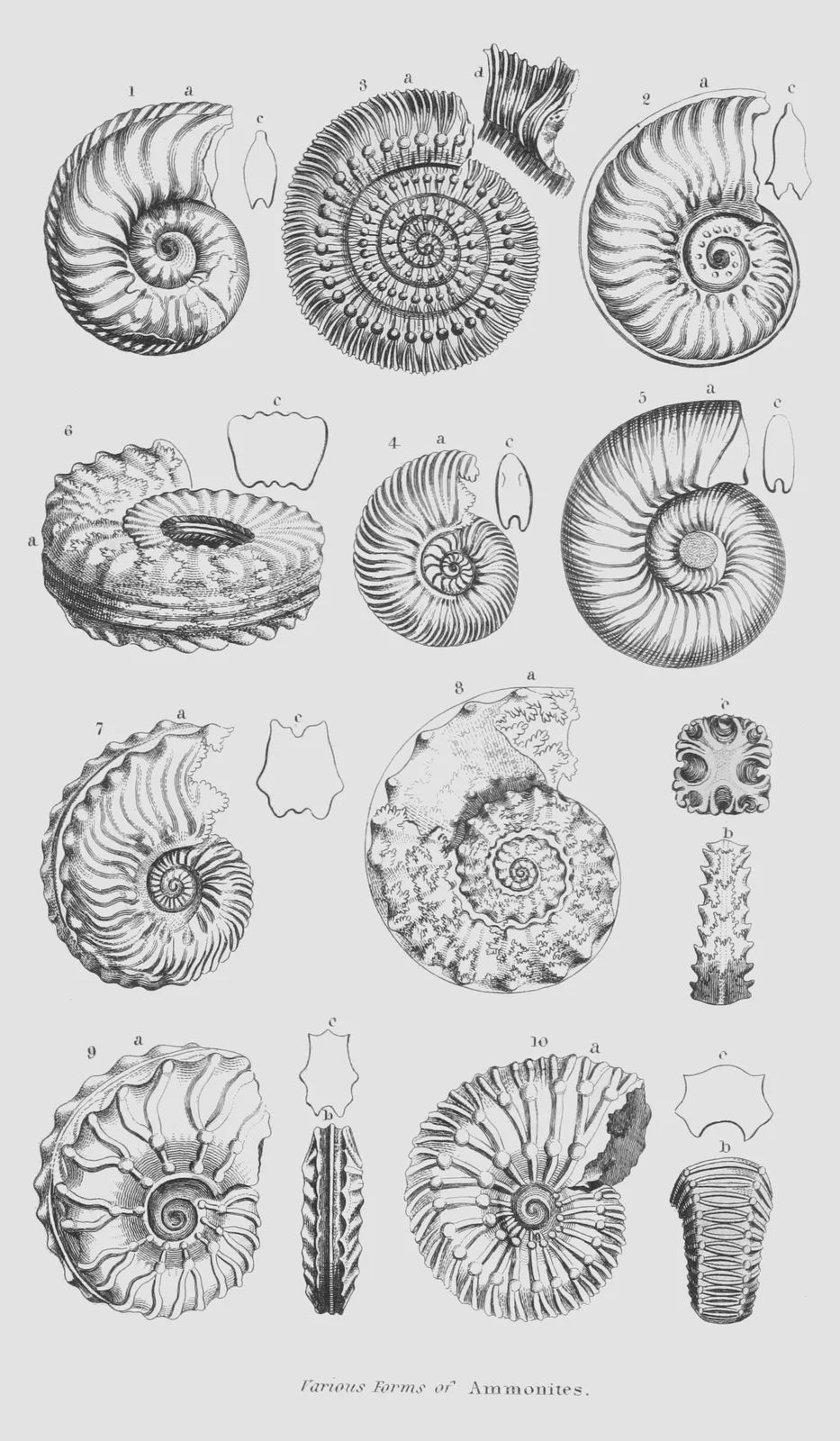
How Do Fossils Form? Often, Minerals Fill the Pores in Bone
- Kind
- In-depth explainer
- Added
Picture credit
"Plate 37, Various Forms of Ammonites, from Geology and Mineralogy Considered with Reference to Natural Theology" by William Buckland — https://commons.wikimedia.org/wiki/File:Geology_and_Mineralogy_considered_with_reference_to_Natural_Theology,_plate_37.png — Public domain (US: published 1837; EU: author William Buckland d. 1856 (plate engraver not individually traced; Public Domain Mark on the file page); anyone working on the plate in 1837, 119 years before 1956, could not credibly have died after 1955)
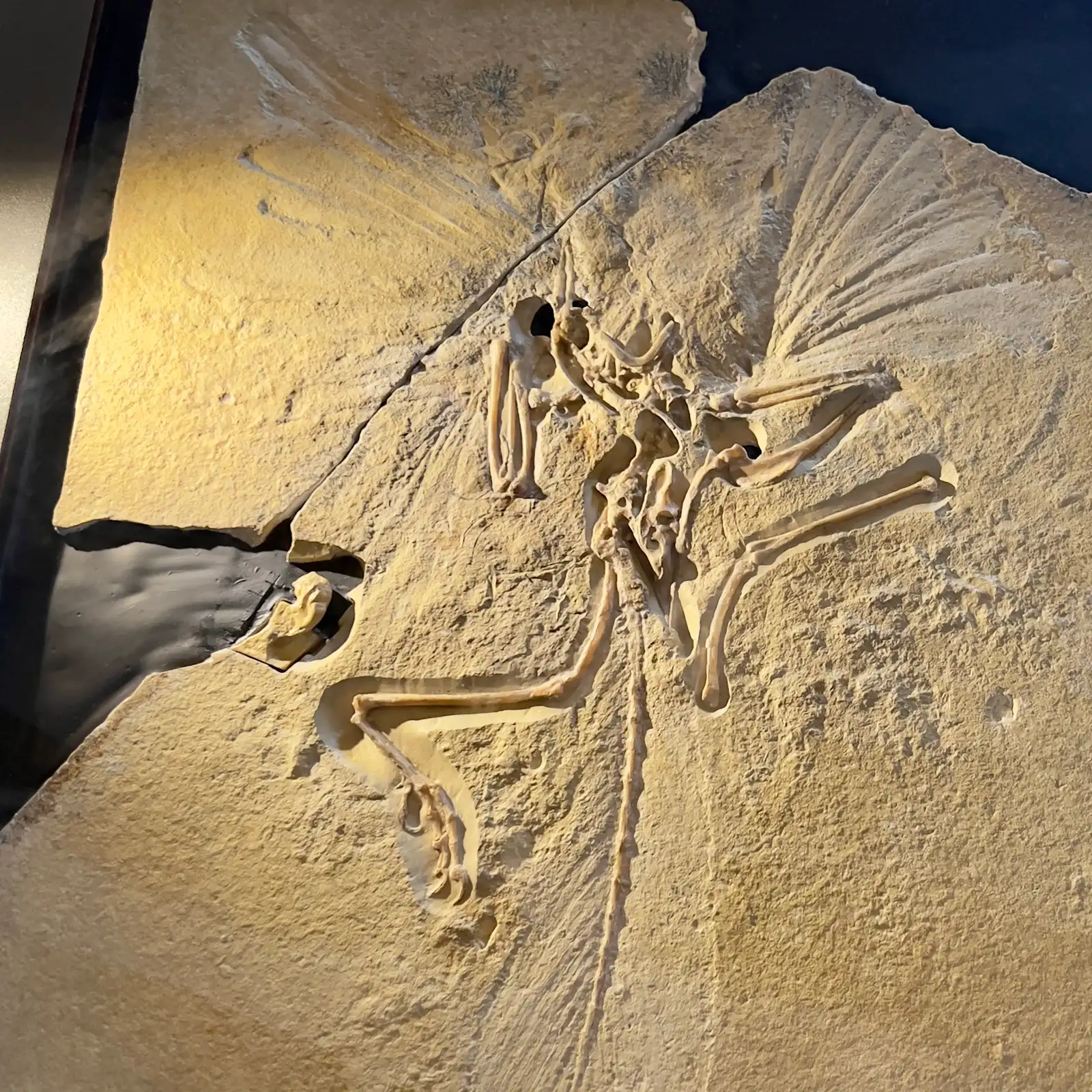
Archaeopteryx: A Lone Feather Was Its First Type Specimen
- Kind
- Specimen entry
- Added
Picture credit
"London Archaeopteryx" by Allan Henderson — https://commons.wikimedia.org/wiki/File:London_Archaeopteryx.jpg — CC BY 2.0 (https://creativecommons.org/licenses/by/2.0/)
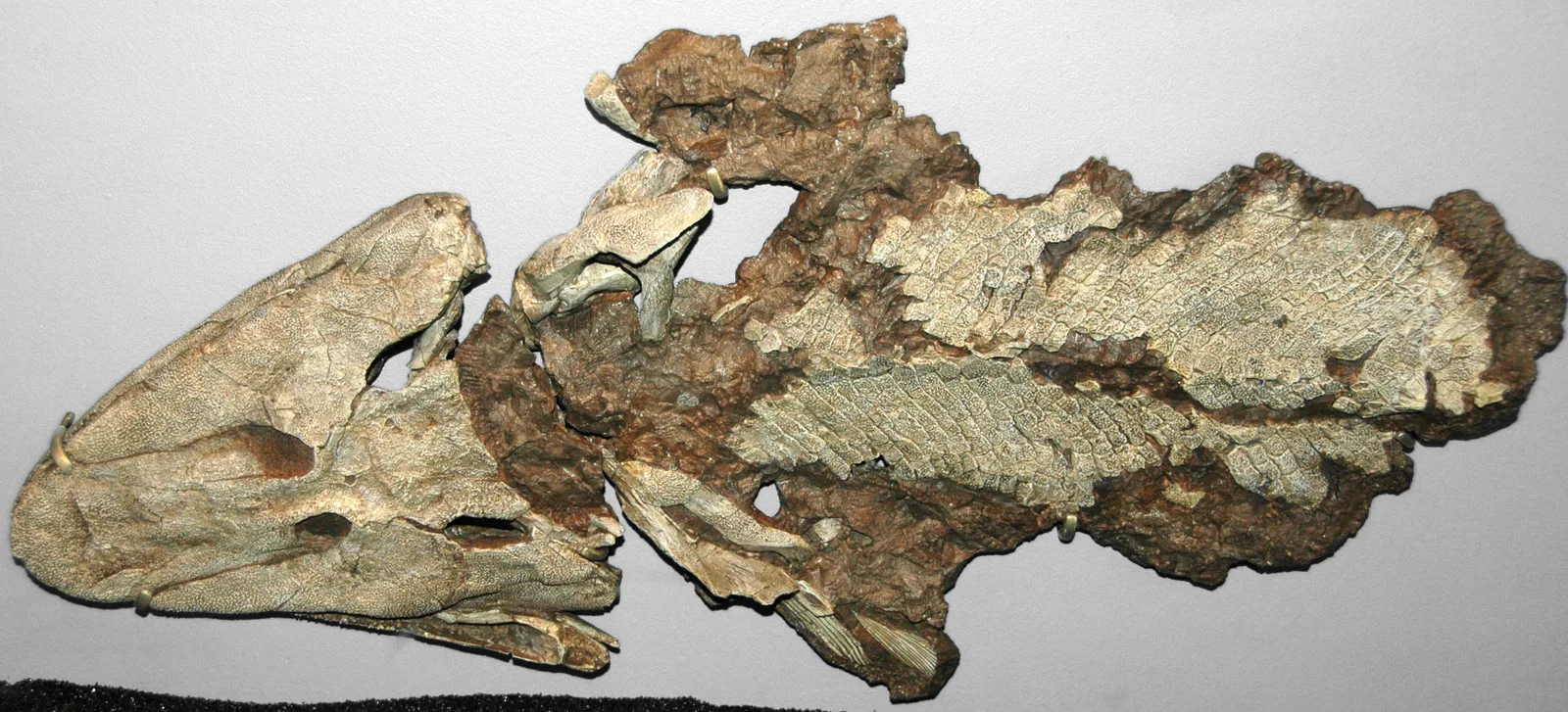
Tiktaalik roseae: A Fish With a Neck and a Wrist Joint
- Kind
- Specimen entry
- Added
Picture credit
"Tiktaalik roseae (fish to amphibian transitional fossil) (Fram Formation, Upper Devonian; Ellesmere Island, Arctic Canada) 1" by James St. John — https://commons.wikimedia.org/wiki/File:Tiktaalik_roseae_(fish_to_amphibian_transitional_fossil)_(Fram_Formation,_Upper_Devonian;_Ellesmere_Island,_Arctic_Canada)_1_(49755118288).jpg — CC BY 2.0 (https://creativecommons.org/licenses/by/2.0/)