Sinosauropteryx: A 2010 Study Inferred Its Stripes’ Colour
Short answer
The dark stripes on the tail of Sinosauropteryx were probably chestnut to reddish-brown, a colour Zhang and colleagues inferred in 2010 from fossil melanosomes, tiny colour-bearing structures. The stripes are dark bands in the fossil; only their colour is inferred. A 2017 study by Smithwick and colleagues described countershading on the same dinosaur: a darker back, lighter belly.
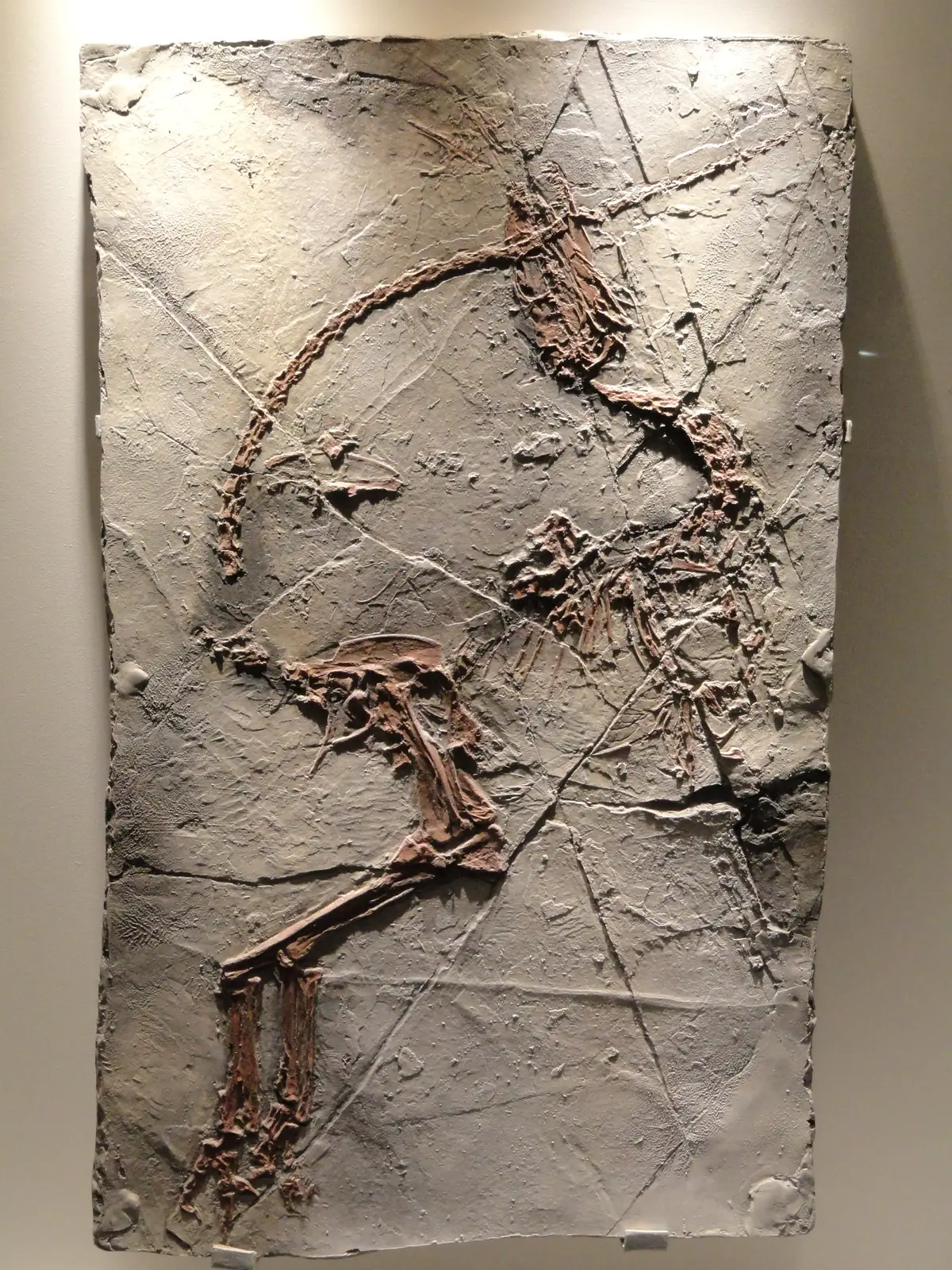
A plate displayed as Sinosauropteryx prima at the Houston Museum of Natural Science. The skeleton lies in relief on the slab; the filaments and tail stripes discussed below do not show at this scale. The reddish tone is that of the bones on the plate, not the colour inferred for the tail.
"Sinosauropteryx prima, feathered dinosaur plate, Houston Museum of Natural Science" by Daderot — https://commons.wikimedia.org/wiki/File:Sinosauropteryx_prima,_feathered_dinosaur_plate,_Early_Cretaceous,_Yixian_Formation,_Liaoning,_China_-_Houston_Museum_of_Natural_Science_-_DSC01872.JPG — CC0 1.0 (https://creativecommons.org/publicdomain/zero/1.0/)
The species, Sinosauropteryx prima, is a small theropod dinosaur from the Early Cretaceous Jehol Biota of Liaoning, in northeastern China.
The holotype, the specimen the name rests on, is small and possibly a juvenile, according to a 2007 study by Lingham-Soliar and colleagues. Fine filaments edge its neck, its back and the tip of its tail. Studies from 2007 and 2010 disagree on what those filaments were. Rock that keeps detail this fine is part of the story of how fossils form.
What colour was its tail?
Zhang and colleagues (2010) looked for melanosomes, which their abstract calls colour-bearing organelles, in fossils from the Jehol Group. They reported them in the vaned feathers of early birds and, kept in the same way, in the filaments of dinosaurs that were not birds. They found two kinds, eumelanosomes and phaeomelanosomes, often still in their life position.
From those data, the 2010 study by Zhang and colleagues concluded that the dark tail stripes of Sinosauropteryx can reasonably be inferred to have been chestnut to reddish-brown. That wording matters. The abstract does not present the stripes as a new find; it starts from them. What it added was a likely colour for bands that were already dark in the rock.
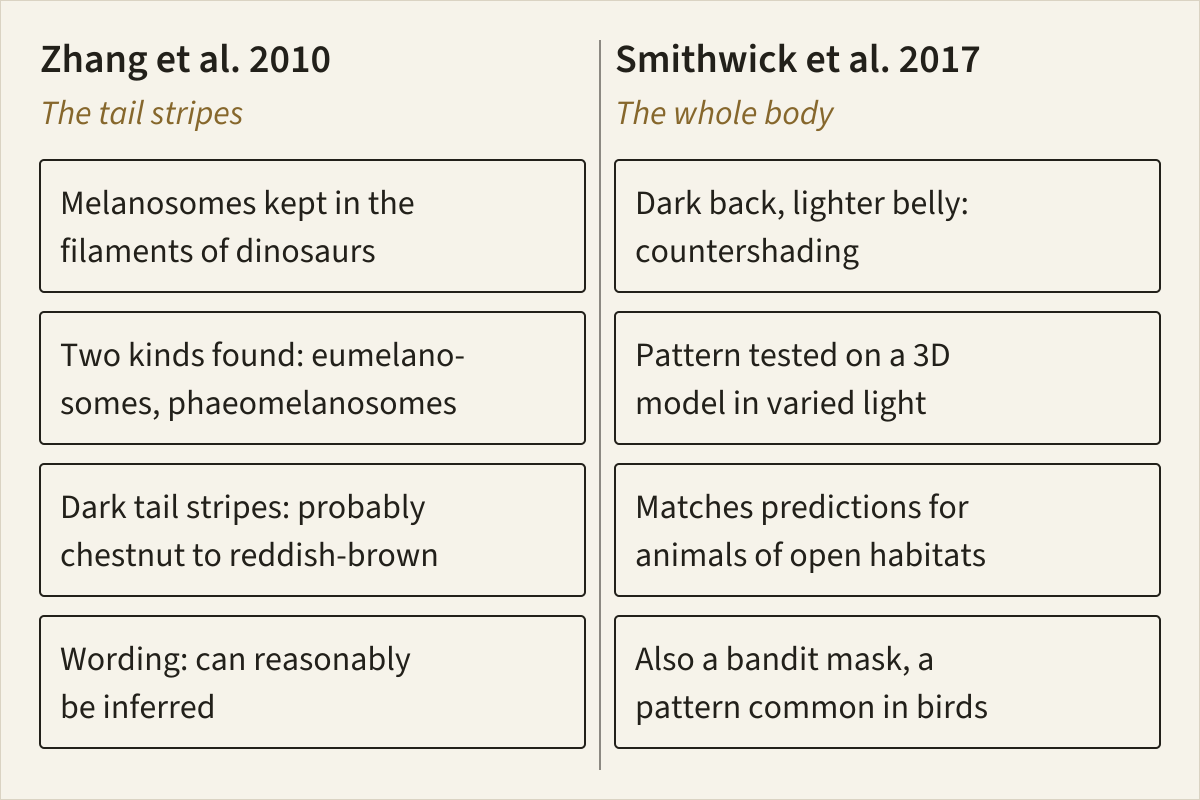
Claims about the colour of Sinosauropteryx from Zhang et al. 2010 and Smithwick et al. 2017, as stated in their abstracts. Read down each column; the boxes are in no ranked order.
Basis Points summarised from the abstracts of Zhang et al. 2010 and Smithwick et al. 2017; schematic, not to scale.
"What two studies claim about the colour of Sinosauropteryx" by Feathers, Skeletons & Nests, https://feathersskeletonsandnests.com/fossils/sinosauropteryx/ , licensed under CC BY 4.0, https://creativecommons.org/licenses/by/4.0/
| Study | Part of the animal | Claim | How it is worded |
|---|---|---|---|
| Zhang et al. 2010 | Tail stripes | Chestnut to reddish-brown in Zhang et al. 2010 | Can reasonably be inferred |
| Zhang et al. 2010 | Body filaments | Melanosomes kept as in early bird feathers | Reported |
| Smithwick et al. 2017 | Whole body | Smithwick et al. 2017: countershading, dark back over lighter belly | Inferred from fossil colour patterns |
| Smithwick et al. 2017 | Habitat | Pattern fits an animal of open habitats | Matched against a model |
| Smithwick et al. 2017 | Head | A bandit mask pattern | Reported |
How can a fossil keep a hint of colour?
A fossil can keep a hint of colour when the tiny bodies that held pigment survive in it. The 2017 study by Smithwick and colleagues notes that the discovery of fossil melanin made it possible to infer original colour patterns from fossils.
The 2010 abstract sets out the evidence in four steps. Filaments are preserved, melanosomes survive inside them, and two kinds are told apart. Only then does the abstract propose a tone. In the same abstract, the melanosomes in dinosaur filaments were often still in life position, inside partly broken-down filaments.
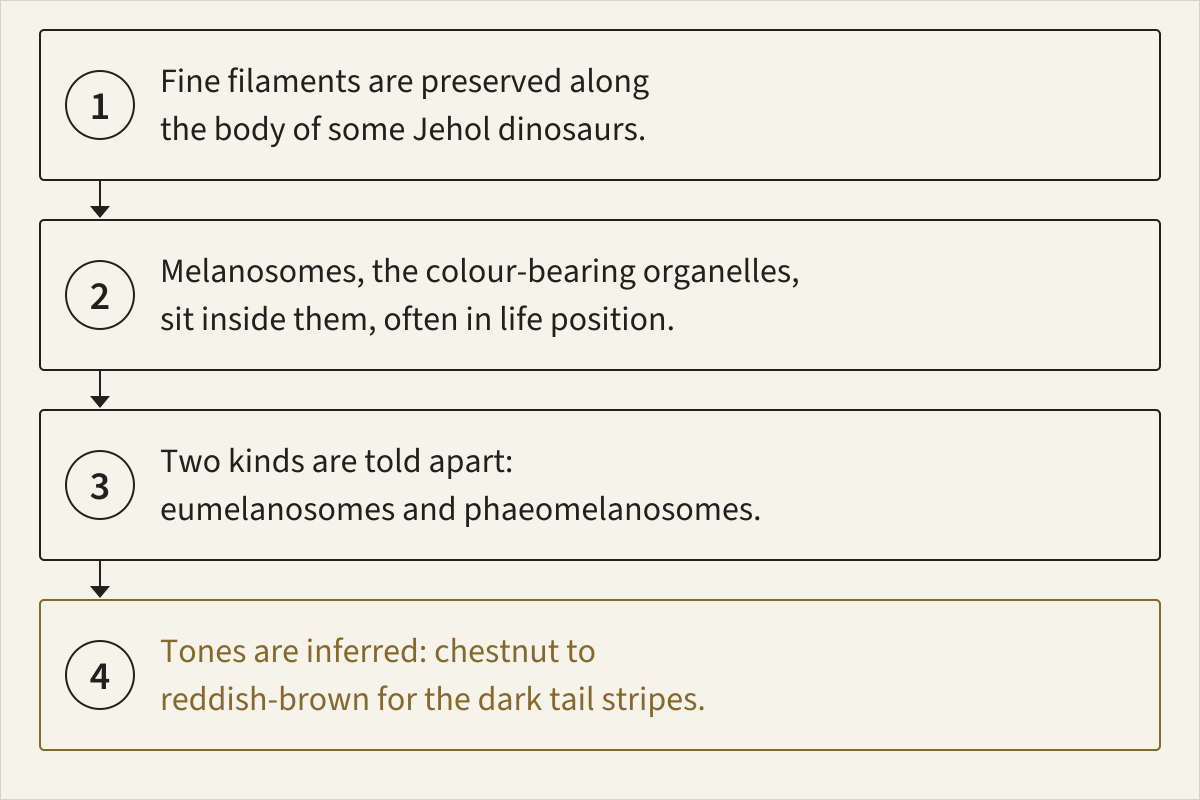
The steps behind the colour claim, in the order given in the 2010 abstract by Zhang and colleagues. The last box, outlined in amber, is the inference; the first three are what was reported in the fossils.
Basis Steps as described in the abstract of Zhang et al. 2010; schematic, not to scale.
"From fossil filaments to an inferred colour" by Feathers, Skeletons & Nests, https://feathersskeletonsandnests.com/fossils/sinosauropteryx/ , licensed under CC BY 4.0, https://creativecommons.org/licenses/by/4.0/
The final step is the one the 2010 authors hedged. Their abstract says the data give evidence for working out the colours and colour patterns of extinct dinosaurs and birds. So in Zhang and colleagues' 2010 account, chestnut to reddish-brown is a likely colour for the stripes, not a known one.
What is countershading?
Countershading, as Smithwick and colleagues (2017) use the term, is a pattern of light and dark across the whole body: a dark back over a lighter belly, which their 2017 study described in Sinosauropteryx. As the 2017 Smithwick study explains it, countershading reduces self-shadowing, so the body's rounded shape is harder for predators and prey to see. The dark fringe along the top of the neck and back on the slab below is a separate matter. The filament debate later on this page is about that fringe.
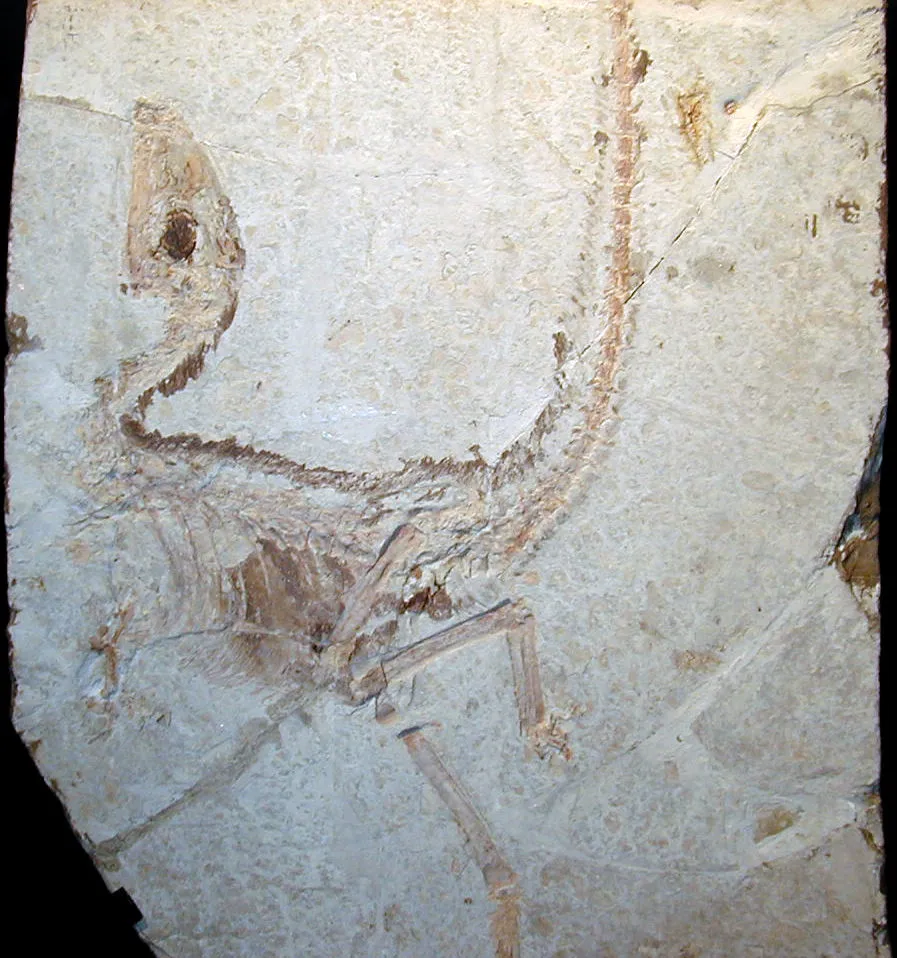
One of the two slabs of the Sinosauropteryx prima holotype, the specimen the name rests on. A dark fringe runs along the top of the curved neck and back; the skull, with its round eye socket, is at upper left.
"Sinosauropteryx prima slab" by James St. John — https://commons.wikimedia.org/wiki/File:Sinosauropteryx_prima_slab.jpg — CC BY 2.0 (https://creativecommons.org/licenses/by/2.0/)
The best countershading pattern depends on the light, and the light depends on the habitat, according to Smithwick and colleagues (2017). They built 3D models of the animal's belly region and lit them as if in different settings; the fossil pattern matched the one predicted for animals living in open country.
That result cut against expectation. The Jehol Biota is presumed to have been mostly closed forest, so they read the match as a sign of a more mixed range of habitats. The same study also reported a “bandit mask”, a pattern found in many living animals with backbones, especially birds, where it serves several purposes, including camouflage.
Were the filaments feathers?
Two studies read the filaments in opposite ways. Lingham-Soliar, Feduccia and Wang (2007) described a new specimen, IVPP V12415, from Liaoning and compared it with the holotype and with a second specimen, NIGP 127587.
The 2007 team read the filaments as the remains of tough fibres in the skin, close in build to dermal collagen, the protein fibres that, in their account, give skin its toughness. The fringe from the head to the tail tip they took for a stiffened frill.
Under the microscope, isolated strands from the new specimen measured mostly 80 to 120 µm thick, with a mean of 88 µm, just under a tenth of a millimetre. The 2007 authors added that changes in the rock can distort shape and thickness, so they treat these measurements as approximate.
Their abstract closes with a flat verdict: “The proposal that these fibres are protofeathers is dismissed.” Protofeathers here means the proposed simple forerunners of true feathers, the reading that two earlier studies of Sinosauropteryx had given the filaments, as the 2007 paper summarises them.
Zhang and colleagues (2010) came at the question from the pigment side. They reported melanosomes in the filaments of non-avian dinosaurs, kept in the same way as in the feathers of early birds; in their abstract, that finding refutes the claim that the filaments are decayed collagen fibres.
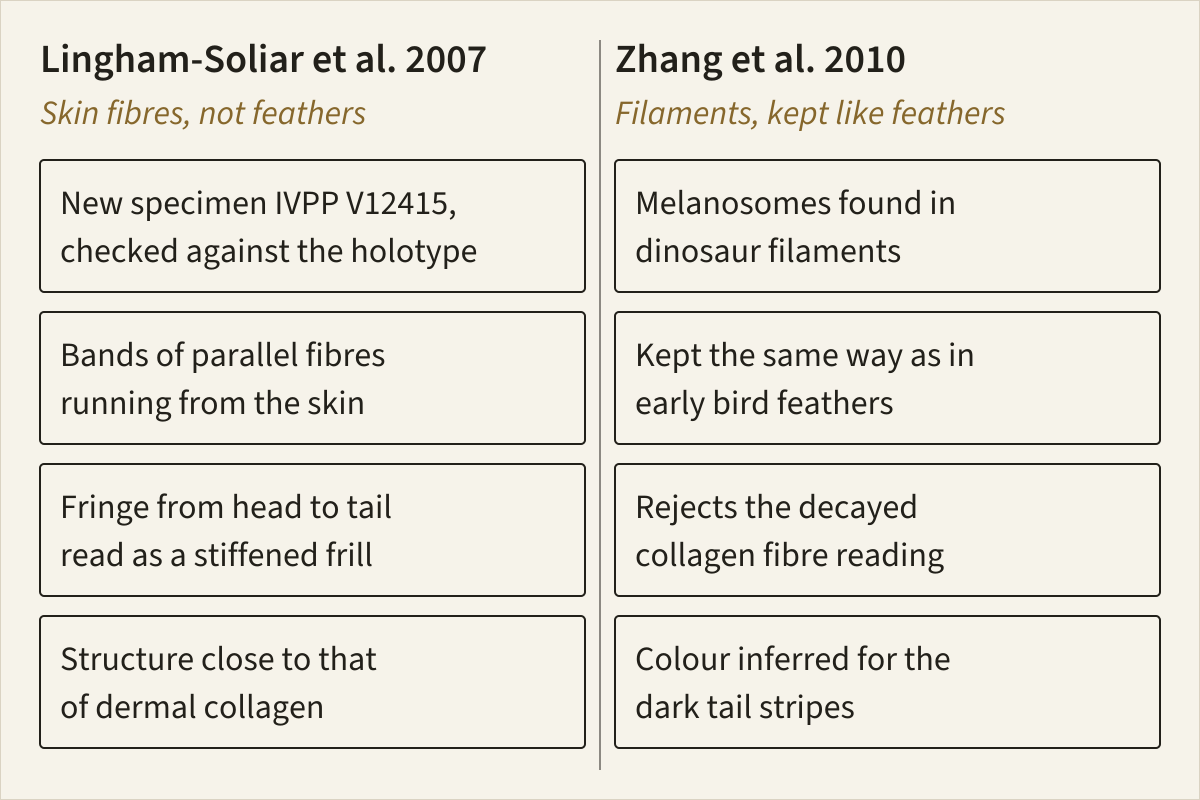
The main points of the 2007 and 2010 studies, older study first. Read down each column; the boxes are summaries in no ranked order, and neither column is marked as right.
Basis Points summarised from Lingham-Soliar et al. 2007 (full text) and the abstract of Zhang et al. 2010; schematic, not to scale.
"Two readings of the filaments of Sinosauropteryx" by Feathers, Skeletons & Nests, https://feathersskeletonsandnests.com/fossils/sinosauropteryx/ , licensed under CC BY 4.0, https://creativecommons.org/licenses/by/4.0/
| Point | Lingham-Soliar et al. 2007 | Zhang et al. 2010 |
|---|---|---|
| What the filaments are | Fibres in the skin, close to dermal collagen | Filaments that keep melanosomes as bird feathers do |
| Fringe along the body | A stiffened frill from head to tail tip | Not addressed in the abstract |
| Evidence used | Fibre patterns under the microscope | Preserved melanosomes |
| Verdict on protofeathers | Dismissed | Rejects the decayed collagen reading |
The 2007 authors also wrote that the wider question of whether birds come from dinosaurs was not what their study addressed. That question is taken up in Are birds dinosaurs?. For the hand bones inside a living bird's wing, see bird wing bones.
Same bones, elsewhere:
- Archaeopteryx: a single fossil feather and the argument over it.
- Are birds dinosaurs?: feathered dinosaurs on the family tree.
Sources
- Fucheng Zhang, Stuart L. Kearns, Patrick J. Orr, Michael J. Benton, Zhonghe Zhou, Diane Johnson, Xing Xu and Xiaolin Wang, "Fossilized melanosomes and the colour of Cretaceous dinosaurs and birds", Nature 463, no. 7284 (2010): 1075–1078. doi.org/10.1038/nature08740Read: abstract only
- Fiann M. Smithwick, Robert Nicholls, Innes C. Cuthill and Jakob Vinther, "Countershading and stripes in the theropod dinosaur Sinosauropteryx reveal heterogeneous habitats in the Early Cretaceous Jehol Biota", Current Biology 27, no. 21 (2017): 3337–3343.e2. doi.org/10.1016/j.cub.2017.09.032Read: abstract only
- Theagarten Lingham-Soliar, Alan Feduccia and Xiaolin Wang, "A new Chinese specimen indicates that 'protofeathers' in the Early Cretaceous theropod dinosaur Sinosauropteryx are degraded collagen fibres", Proceedings of the Royal Society B 274, no. 1620 (2007): 1823–1829. pmc.ncbi.nlm.nih.gov/articles/PMC2270928/Read: full text
Cite this page
Feathers, Skeletons & Nests. “Sinosauropteryx: A 2010 Study Inferred Its Stripes’ Colour.” first published 17 November 2026. https://feathersskeletonsandnests.com/fossils/sinosauropteryx/ (accessed on the date you read it).
How facts are sourcedAll correctionsReport an error on this page (contact@feathersskeletonsandnests.com)
More from the Fossils drawer
How Do Fossils Form? Often, Minerals Fill the Pores in Bone
- Kind
- In-depth explainer
- Added
Picture credit
"Plate 37, Various Forms of Ammonites, from Geology and Mineralogy Considered with Reference to Natural Theology" by William Buckland — https://commons.wikimedia.org/wiki/File:Geology_and_Mineralogy_considered_with_reference_to_Natural_Theology,_plate_37.png — Public domain (US: published 1837; EU: author William Buckland d. 1856 (plate engraver not individually traced; Public Domain Mark on the file page); anyone working on the plate in 1837, 119 years before 1956, could not credibly have died after 1955)
Archaeopteryx: A Lone Feather Was Its First Type Specimen
- Kind
- Specimen entry
- Added
Picture credit
"London Archaeopteryx" by Allan Henderson — https://commons.wikimedia.org/wiki/File:London_Archaeopteryx.jpg — CC BY 2.0 (https://creativecommons.org/licenses/by/2.0/)
Tiktaalik roseae: A Fish With a Neck and a Wrist Joint
- Kind
- Specimen entry
- Added
Picture credit
"Tiktaalik roseae (fish to amphibian transitional fossil) (Fram Formation, Upper Devonian; Ellesmere Island, Arctic Canada) 1" by James St. John — https://commons.wikimedia.org/wiki/File:Tiktaalik_roseae_(fish_to_amphibian_transitional_fossil)_(Fram_Formation,_Upper_Devonian;_Ellesmere_Island,_Arctic_Canada)_1_(49755118288).jpg — CC BY 2.0 (https://creativecommons.org/licenses/by/2.0/)