Are Birds Dinosaurs? On the Family Tree, Birds Sit Inside
Short answer
Yes: on family trees from open studies published between 2012 and 2019, birds sit inside the dinosaurs, on the theropod branch that also holds Velociraptor. “Birds are dinosaurs” is therefore a claim about shared ancestors, not looks. Crocodilians branch off earlier and are the closest living relatives of birds, though a few dinosaur branches are still argued.
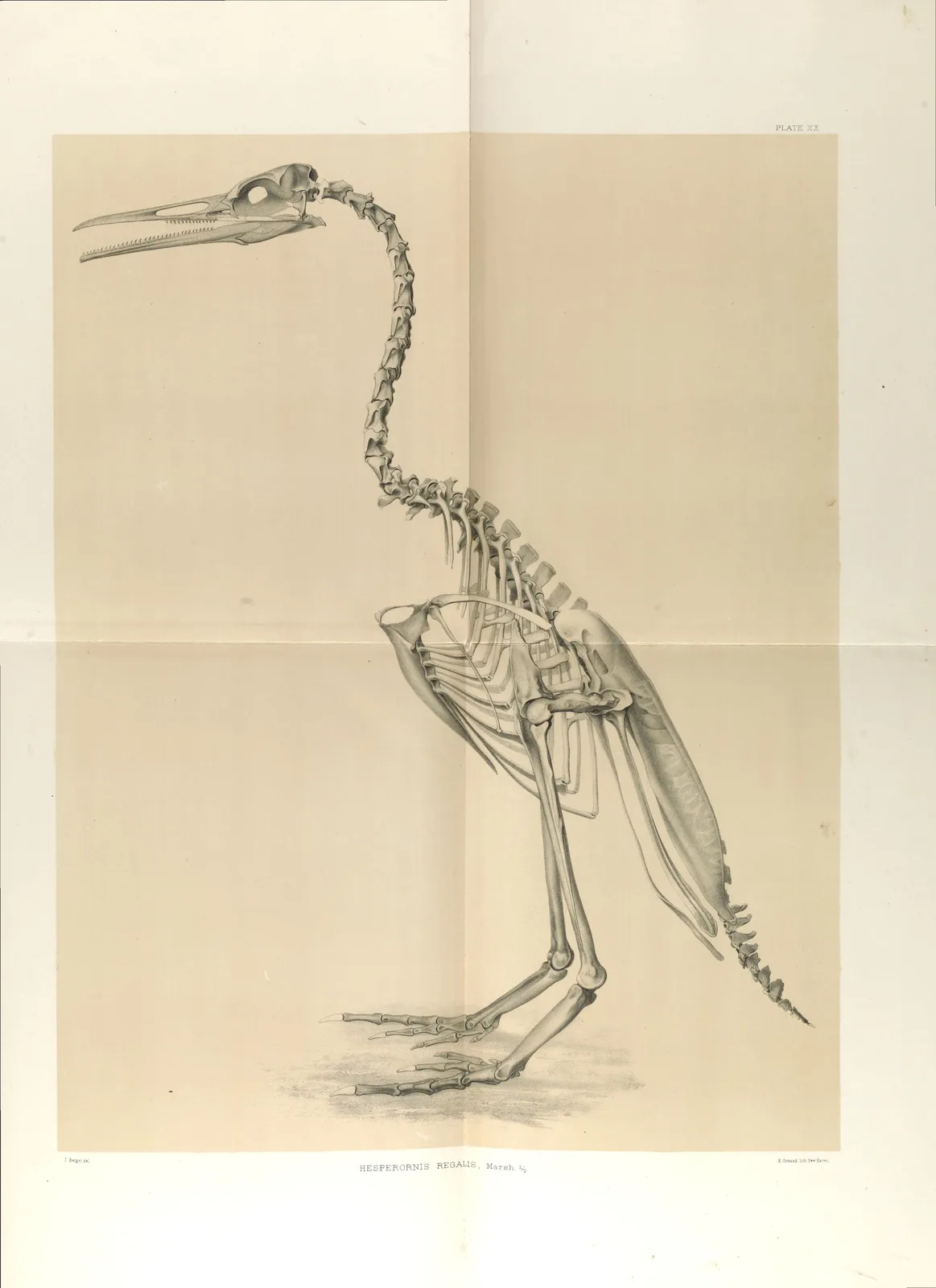
Plate XX of Othniel Charles Marsh's 1880 monograph on extinct toothed birds: a skeletal plate of Hesperornis regalis, drawn bone by bone. The jaws carry a row of small teeth.
“Plate XX, Hesperornis regalis, from Odontornithes: a monograph on the extinct toothed birds of North America”, Marsh, Othniel Charles (1880), via Biodiversity Heritage Library; Public Domain Mark.
Full credit
"Plate XX, Hesperornis regalis, from Odontornithes: a monograph on the extinct toothed birds of North America" by Marsh, Othniel Charles (1880), via Biodiversity Heritage Library — https://commons.wikimedia.org/wiki/File:Odontornithes-_a_monograph_on_the_extinct_toothed_birds_of_North_America_(Plate_XX)_BHL40333948.jpg — Public domain (US: published 1880, before 1931; EU: author O. C. Marsh d. 1899; plate credits F. Berger (drawing) and E. Crisand (lithography), death years not checked, but both were working on the plate in 1880, 76 years before 1956, so a death after 1955 is not credible)
Look at a drawing of an ostrich's hip bones beside those of Megalosaurus, and the hips start to look familiar. Thomas Henry Huxley made that comparison in a lecture printed in 1868, where he found that a Megalosaurus bone long called a collarbone was “extremely similar to the ischia of such a bird as an ostrich”. The ischium is one of three bones on each side of the hip. Marsh's plate above sends a second mixed signal: a bird skeleton with teeth.
Where do birds sit on the tree?
Tree Redrawn from published trees, each node with its source; no branch lengths or dates.
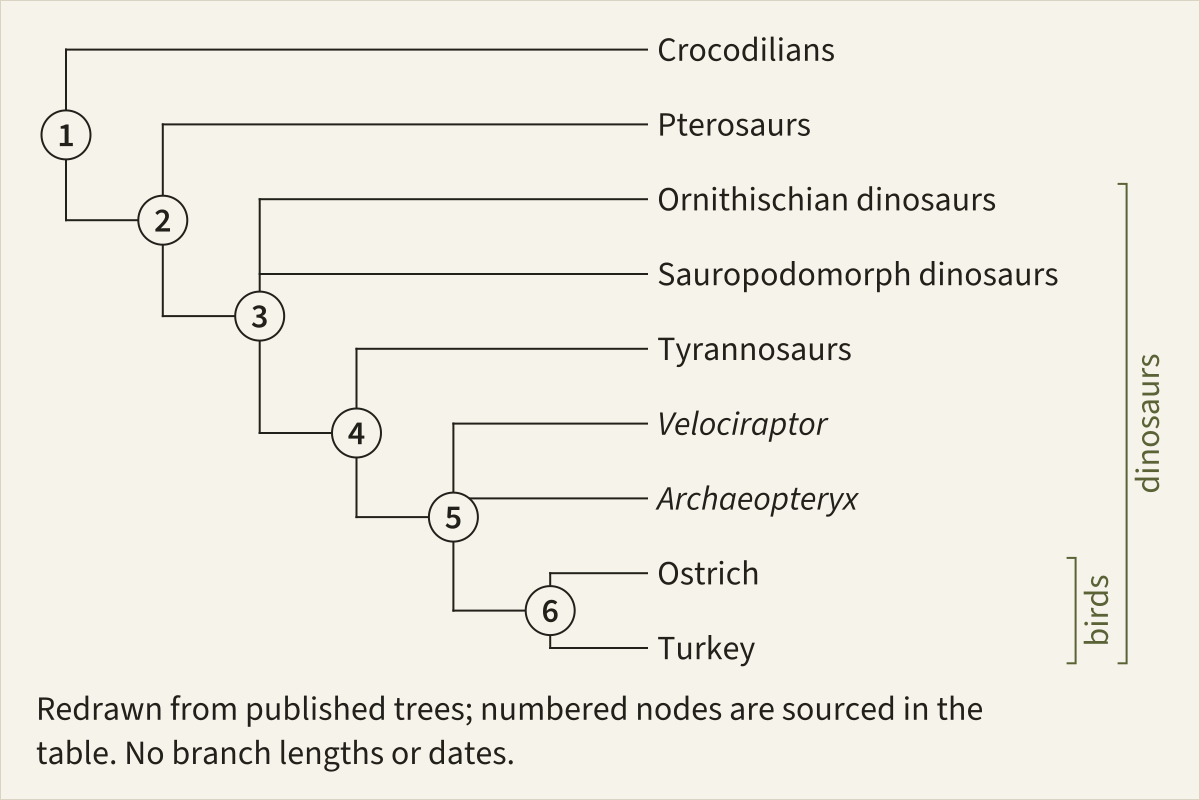
Each numbered circle is a branch point, the common ancestor of every group on the branches that split from it. Follow the ostrich back from the tip: it passes nodes 6, 5, 4 and 3, so it sits inside the dinosaur bracket. Nodes 3 and 5 are drawn with three branches because studies disagree on the order of those splits.
Basis Each numbered node is sourced in the table below.
"Where birds sit among dinosaurs" by Feathers, Skeletons & Nests, https://feathersskeletonsandnests.com/lineages/are-birds-dinosaurs/ , licensed under CC BY 4.0, https://creativecommons.org/licenses/by/4.0/
Data: Butler R. J., Barrett P. M. and Gower D. J. (2012) Reassessment of the evidence for postcranial skeletal pneumaticity in Triassic archosaurs, and the early evolution of the avian respiratory system. PLoS ONE 7(3): e34094, https://doi.org/10.1371/journal.pone.0034094, CC BY (version not stated); Parry L. A., Baron M. G. and Vinther J. (2017) Multiple optimality criteria support Ornithoscelida. Royal Society Open Science 4: 170833, https://doi.org/10.1098/rsos.170833, CC BY 4.0; Hartman S. et al. (2019) A new paravian dinosaur from the Late Jurassic of North America supports a late acquisition of avian flight. PeerJ 7: e7247, https://doi.org/10.7717/peerj.7247, CC BY 4.0
Reading a family tree only by its tips is a habit Feathers, Skeletons & Nests calls node blindness: missing that every branch point on a rooted tree stands for a common ancestor. A reader with node blindness sees the turkey drawn below Velociraptor and decides that one came from the other. The tree says otherwise: node 5 is a population ancestral to both, and it no longer exists. The order of the tips from top to bottom means nothing either, so the turkey is not “higher” than the crocodile.
Read the nodes instead, and the answer comes out of the tree. Node 3 is the common ancestor of all dinosaurs. The ostrich and turkey descend from it. A 2017 study by Parry, Baron and Vinther found the dinosaur group well supported, with three big branches inside it: ornithischians, sauropodomorphs and theropods.
Hartman and colleagues (2019) analysed theropods and placed modern birds inside Paraves. They describe paravians as “winged coelurosaurs more closely related to birds than to Oviraptor”, a branch that also holds the dromaeosaurids such as Velociraptor.
| Node | Group | Members on the tree | Source | Note |
|---|---|---|---|---|
| 1 | Archosauria | crocodilians and all groups below | Butler, Barrett & Gower 2012, PLoS ONE 7: e34094 | crown group of crocodilians and birds |
| 2 | Ornithodira | pterosaurs and dinosaurs | Butler, Barrett & Gower 2012 | pterosaurs “probably” belong here |
| 3 | Dinosauria | ornithischians, sauropodomorphs, theropods | Parry, Baron & Vinther 2017, R. Soc. Open Sci. 4: 170833 | first split debated; drawn unresolved |
| 4 | Theropoda | tyrannosaurs, Velociraptor, Archaeopteryx, ostrich, turkey | Hartman et al. 2019, PeerJ 7: e7247 | theropod-only analysis |
| 5 | Paraves | Velociraptor, Archaeopteryx, ostrich, turkey | Hartman et al. 2019 | Archaeopteryx placement varies; drawn unresolved |
| 6 | Aves (modern birds) | ostrich, turkey | Hartman et al. 2019 | two of the five modern birds sampled |
Download the node sources (CSV) (what this file records) Data: Butler R. J., Barrett P. M. and Gower D. J. (2012) PLoS ONE 7(3): e34094, https://doi.org/10.1371/journal.pone.0034094, CC BY (version not stated); Parry L. A., Baron M. G. and Vinther J. (2017) Royal Society Open Science 4: 170833, https://doi.org/10.1098/rsos.170833, CC BY 4.0; Hartman S. et al. (2019) PeerJ 7: e7247, https://doi.org/10.7717/peerj.7247, CC BY 4.0
Two splits are left open on purpose. The dataset of Baron and colleagues joins ornithischians with theropods in a group called Ornithoscelida, while a rescored version of the same data favoured the older pairing of sauropodomorphs with theropods under parsimony, as Parry and colleagues (2017) summarise. The second open split is Archaeopteryx, which different studies have placed among dromaeosaurids, among troodontids, in its own family or among early birds (Hartman et al. 2019). The details are in Archaeopteryx.
Neither debate moves birds out of the dinosaurs. Wagner and Gauthier (1999) considered the idea that birds are not theropods at all, as one way to explain the fingers of the bird hand, and they rejected it. In their section on the relationships of birds, they write that “The hypothesis that birds are but one clade of theropod dinosaurs has survived repeated, extensive, and vigorous challenge”. Their argument about which fingers a bird keeps is told in bird wing bones.
What did Huxley see in the hips?
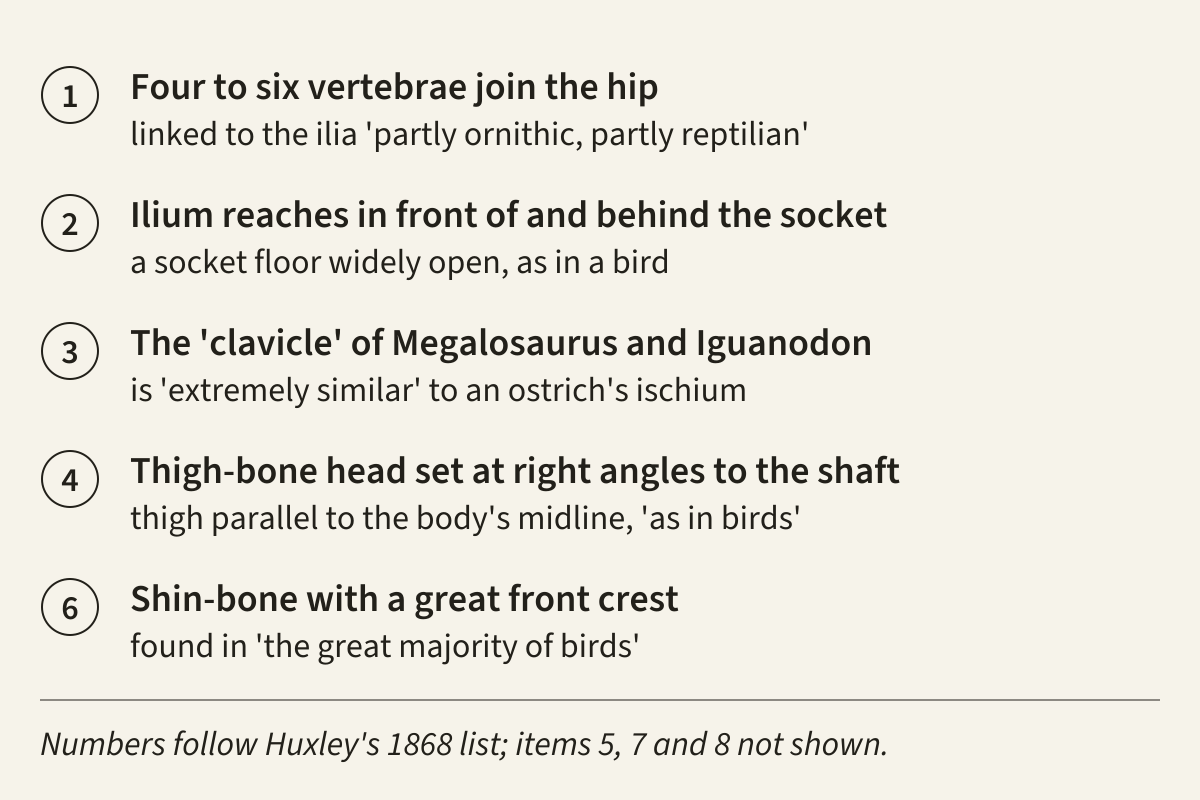
Five of the eight characters Huxley listed for dinosaur hips and legs in 1868, numbered as in his list. Each row pairs the dinosaur feature with the bird comparison he made; the quoted words are his.
Basis Huxley 1868, Annals and Magazine of Natural History, pages 72 and 73; items 5, 7 and 8 not drawn.
"Hip and leg characters Huxley listed for dinosaurs in 1868" by Feathers, Skeletons & Nests, https://feathersskeletonsandnests.com/lineages/are-birds-dinosaurs/ , licensed under CC BY 4.0, https://creativecommons.org/licenses/by/4.0/
Huxley's route to the hips began with a mislabelled bone. In October 1867 he visited the Megalosaurus collection in the Oxford museum, where a complete shoulder girdle showed him that the bone long called the coracoid could not belong to the shoulder. It had to be the ilium, the large upper hip bone, and it was “eminently ornithic in its chief peculiarities”, he wrote in his 1870 paper. Ornithic means bird-like.
His 1868 lecture listed eight hip and leg characters for dinosaurs. The ilium reached forward and back of the hip socket, as in a bird, and the head of the thigh-bone was set at right angles to its shaft. The shin-bone carried a large crest that “the great majority of birds” also have.
From these characters Huxley drew his conclusion on page 73: “there can be no doubt that the hind quarters of the Dinosauria wonderfully approached those of birds in their general structure, and therefore that these extinct reptiles were more closely allied to birds than any which now live.”
| No. | Character in Huxley's 1868 list | Bird comparison he gave |
|---|---|---|
| 1 | four to six vertebrae join the hip | joint “partly ornithic, partly reptilian” |
| 2 | ilium reaches in front of and behind the socket | resembles “the bird's ilium” |
| 3 | so-called clavicle of Megalosaurus and Iguanodon | “extremely similar” to an ostrich's ischium |
| 4 | thigh-bone head at right angles to the shaft | thigh parallel to the body's midline, “as in birds” |
| 6 | great front crest on the shin-bone | found in “the great majority of birds” |
Huxley also ruled one candidate out. Pterosaurs, he said on page 71, were “a sort of reptilian Bats rather than links between reptiles and birds”. He described Compsognathus, a small animal he placed “among, or close to, the Dinosauria”, as more bird-like than any ordinary dinosaur.
On page 74 he wrote that there was nothing “very wild or illegitimate in the hypothesis that the phylum of the class Aves has its root in the Dinosaurian reptiles”. In his longer paper of 1870 he went further on the pelvis: “Thus the ischia of a Dinosaurian are more bird-like than those of any existing reptile, but retain the reptilian union in a symphysis.”
Which bird features appeared before birds?
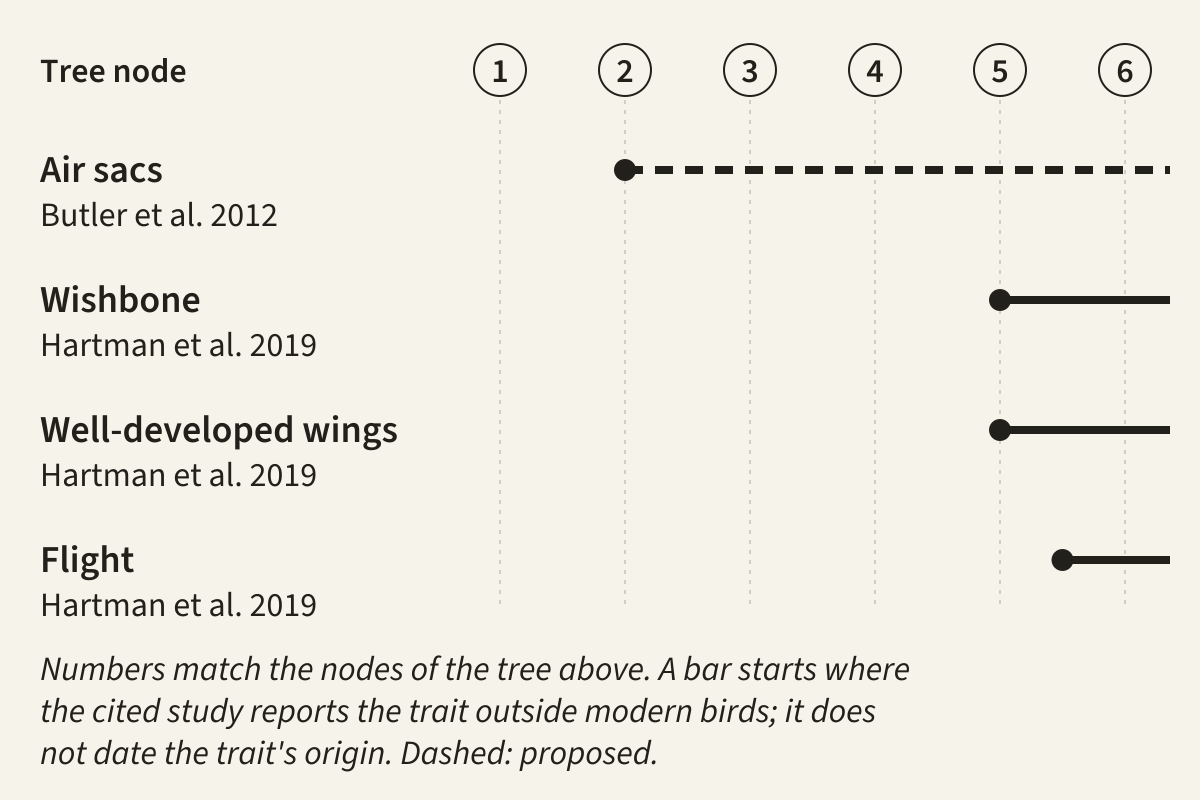
Four bird traits set against the numbered nodes of the tree. A bar starts at the group where the cited study reports the trait outside modern birds; it does not date the trait's origin. The dashed bar is a proposal, not an observation.
Basis Air sacs after Butler et al. 2012; wishbone, wings and flight after Hartman et al. 2019; schematic, not to scale.
"Bird traits reported outside modern birds, placed against the tree nodes" by Feathers, Skeletons & Nests, https://feathersskeletonsandnests.com/lineages/are-birds-dinosaurs/ , licensed under CC BY 4.0, https://creativecommons.org/licenses/by/4.0/
Data: Butler R. J., Barrett P. M. and Gower D. J. (2012) PLoS ONE 7(3): e34094, https://doi.org/10.1371/journal.pone.0034094, CC BY (version not stated); Hartman S. et al. (2019) PeerJ 7: e7247, https://doi.org/10.7717/peerj.7247, CC BY 4.0
Several parts of a bird's body turn up in dinosaurs that were not birds. Butler, Barrett and Gower (2012) studied bones hollowed by air sacs, the balloon-like extensions of the lungs that reach into a bird's skeleton, and they report clear signs of these air-filled bones in pterosaurs, sauropod dinosaurs and theropods that were not birds. They propose that air sacs were already present in the common ancestor of node 2, the bird-line archosaurs.
The hollowed bones themselves are another matter: on a conservative reading, the authors add, air spaces probably invaded bone at least three separate times. Crocodilians, they note, have no true air sacs and none of these air-filled bones behind the skull.
A wishbone is the fused pair of collarbones in front of a bird's chest. Hartman and colleagues (2019) describe “a large and robust furcula”, the technical name, in Hesperornithoides, a small paravian from the Late Jurassic of Wyoming that could not fly, and they compare its shape with the wishbone of Velociraptor.
The same study argues that “well-developed wings evolved in terrestrial contexts millions of years prior to the origin of crown avian flight”. Flight itself came late in their reading: they conclude that it “evolved within Avialae, most likely in the Late Jurassic or Early Cretaceous”.
| Trait | Reported outside modern birds in | Source |
|---|---|---|
| Air sacs | proposed for node 2, from air-filled bones in pterosaurs, sauropod dinosaurs and non-bird theropods | Butler et al. 2012 |
| Wishbone | Hesperornithoides, Velociraptor (paravians) | Hartman et al. 2019 |
| Well-developed wings | paravians that lived on the ground | Hartman et al. 2019 |
| Flight | within the bird line (Avialae), most likely Late Jurassic or Early Cretaceous | Hartman et al. 2019 |
Is a chicken a dinosaur?
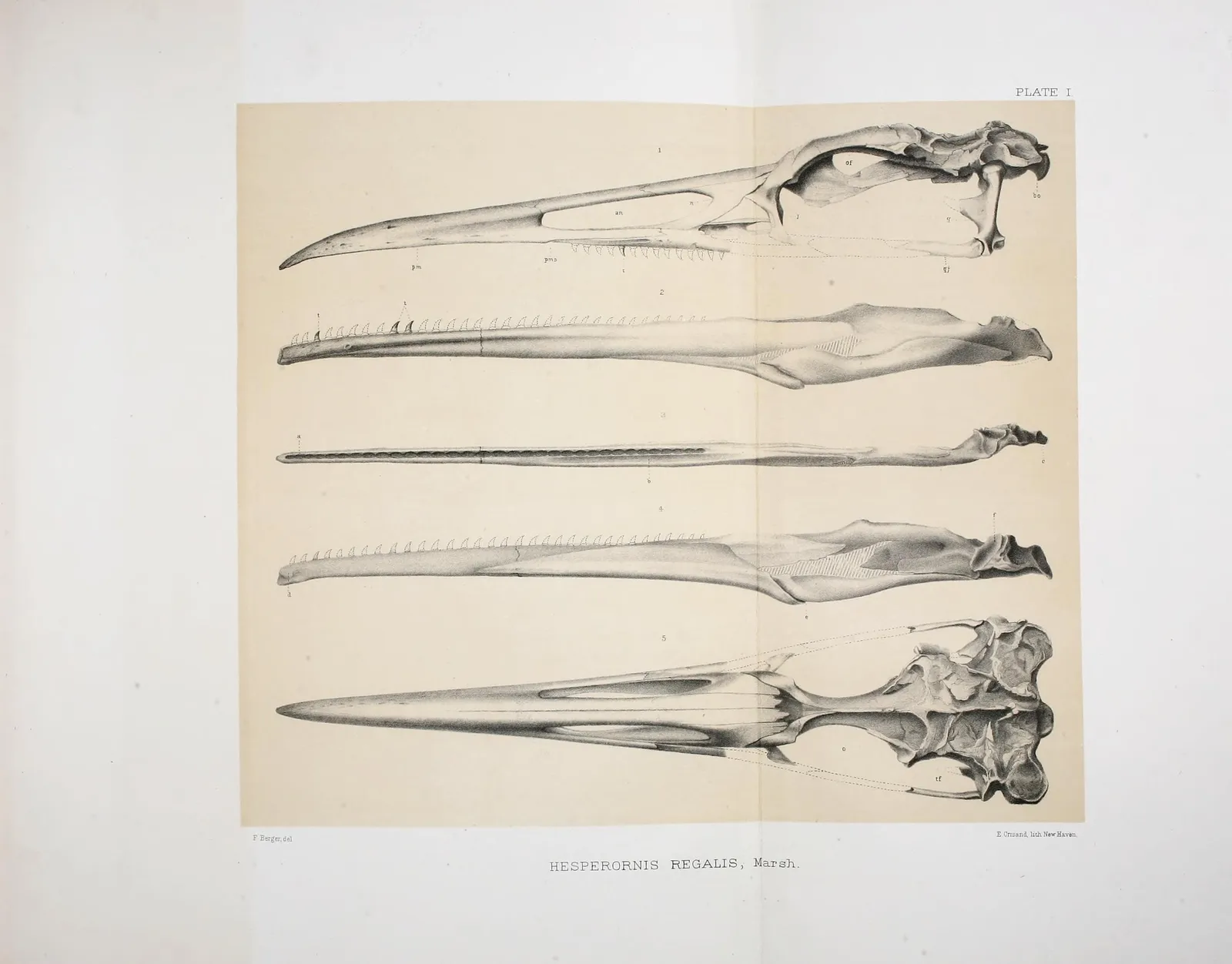
Plate I of Marsh's 1880 monograph: the skull and lower jaws of Hesperornis regalis in five views. Look along the lower jaws for the rows of small pointed teeth.
“Plate I, Hesperornis regalis skull, from Odontornithes: a monograph on the extinct toothed birds of North America”, Marsh, Othniel Charles (1880), via Biodiversity Heritage Library; Public Domain Mark.
Full credit
"Plate I, Hesperornis regalis skull, from Odontornithes: a monograph on the extinct toothed birds of North America" by Marsh, Othniel Charles (1880), via Biodiversity Heritage Library — https://commons.wikimedia.org/wiki/File:Odontornithes-_a_monograph_on_the_extinct_toothed_birds_of_North_America_(Plate_I)_BHL40333854.jpg — Public domain (US: published 1880, before 1931; EU: author O. C. Marsh d. 1899; plate credits F. Berger (drawing) and E. Crisand (lithography), death years not checked, but both were working on the plate in 1880, 76 years before 1956, so a death after 1955 is not credible)
On the family tree the answer is yes, because a chicken is a modern bird in the same group as the ostrich and turkey at node 6, and so it shares their dinosaur ancestor at node 3. In the tree's sense a chicken is a dinosaur in the way a whale is a mammal: by descent, not by looks.
Marsh's Hesperornis shows why the line around “modern birds” sits where it does. Hartman and colleagues (2019) placed the toothed hesperornithines, and the toothed Ichthyornis, outside the modern-bird group, though moving either one closer to modern birds costs only four extra steps in their analysis. A bird can be a dinosaur and still sit outside the modern birds.
That also answers the question of the closest living relative of dinosaurs. Butler and colleagues (2012) call crocodilians “the closest living relatives of birds and the only other extant group of archosaurs”. With birds counted as dinosaurs, crocodilians are the nearest living group outside the dinosaur branch, and they join it at node 1 on the tree.
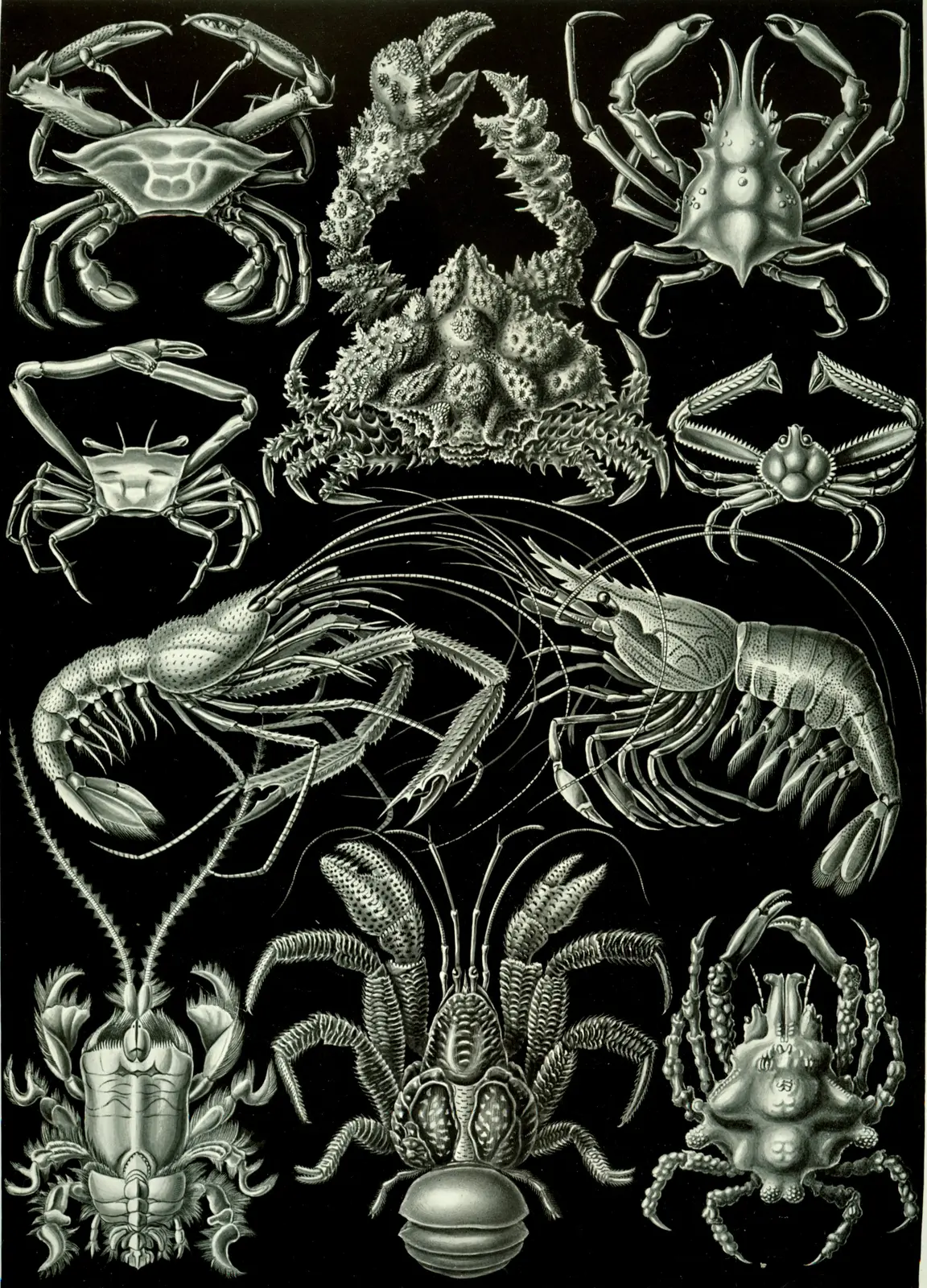
Shared shapes alone do not settle such questions, and crabs show the reverse case, a shape that evolved more than once, in carcinization. For another branch you sit inside, see humans and the apes; for a small theropod whose tail colour has been inferred from fossils, see Sinosauropteryx.
Same bones, elsewhere:
- Archaeopteryx: where Archaeopteryx fits, and why its name began with a single feather.
- Bird wing bones: the three fingers in a bird's hand, and which three they are.
Sources
- Scott Hartman, Mickey Mortimer, William R. Wahl, Dean R. Lomax, Jessica Lippincott and David M. Lovelace, "A new paravian dinosaur from the Late Jurassic of North America supports a late acquisition of avian flight", PeerJ 7 (2019): e7247. doi.org/10.7717/peerj.7247Read: full textText licence: CC BY 4.0 (terms)
- Luke A. Parry, Matthew G. Baron and Jakob Vinther, "Multiple optimality criteria support Ornithoscelida", Royal Society Open Science 4, no. 10 (2017): 170833. doi.org/10.1098/rsos.170833Read: full textText licence: CC BY 4.0 (terms)
- Richard J. Butler, Paul M. Barrett and David J. Gower, "Reassessment of the evidence for postcranial skeletal pneumaticity in Triassic archosaurs, and the early evolution of the avian respiratory system", PLoS ONE 7, no. 3 (2012): e34094. doi.org/10.1371/journal.pone.0034094Read: full textText licence: CC BY (version not stated in the article) (terms)
- Thomas Henry Huxley, "On the animals which are most nearly intermediate between birds and reptiles", Annals and Magazine of Natural History, 4th series, 2 (1868): 66 ff. archive.org/details/annalsmagazineof421868londRead: pages 71–74 checked against the page images
- Thomas Henry Huxley, "Further evidence of the affinity between the Dinosaurian reptiles and birds", Quarterly Journal of the Geological Society 26 (1870): 12–31. doi.org/10.1144/GSL.JGS.1870.026.01-02.08Read: full text
- Günter P. Wagner and Jacques A. Gauthier, "1,2,3 = 2,3,4: A solution to the problem of the homology of the digits in the avian hand", Proceedings of the National Academy of Sciences 96, no. 9 (1999): 5111–5116. doi.org/10.1073/pnas.96.9.5111Read: full text
Cite this page
Feathers, Skeletons & Nests. “Are Birds Dinosaurs? On the Family Tree, Birds Sit Inside.” first published 17 November 2026. https://feathersskeletonsandnests.com/lineages/are-birds-dinosaurs/ (accessed on the date you read it).
How facts are sourcedAll correctionsReport an error on this page (contact@feathersskeletonsandnests.com)
More from the Lineages drawer
Carcinization: King Crabs Evolved From Hermit Crab Kin
- Kind
- Comparison and reading
- Added
Picture credit
"Decapoda, plate 86, from Kunstformen der Natur" by Ernst Haeckel, Kunstformen der Natur (1904), plate 86 — https://commons.wikimedia.org/wiki/File:Haeckel_Decapoda.jpg — Public domain (US: published 1904, before 1931; EU: artist Ernst Haeckel d. 1919, lithographer Adolf Giltsch d. 1911)
Did Humans Evolve From Monkeys? Not From Any Living Species
- Kind
- Comparison and reading
- Added
Picture credit
"Skeletons of the gibbon, orang, chimpanzee, gorilla and man (frontispiece), from Evidence as to Man's Place in Nature" by Wellcome Library, London. Wellcome Images — https://commons.wikimedia.org/wiki/File:Frontispiece_to_Huxley_%27Evidence_as_to_man%27s_place...%27_Wellcome_L0063032.jpg — CC BY 4.0 (https://creativecommons.org/licenses/by/4.0/)