Carcinization: King Crabs Evolved From Hermit Crab Kin
Short answer
Carcinization is the evolution of a crab-like body in crustaceans outside the true crabs. Within Anomura, the group of hermit crabs, king crabs, squat lobsters and porcelain crabs, it happened independently three times, a 2013 study by Heather Bracken-Grissom and colleagues found. King crabs are one origin; the study places them inside the hermit crabs, not among the true crabs.
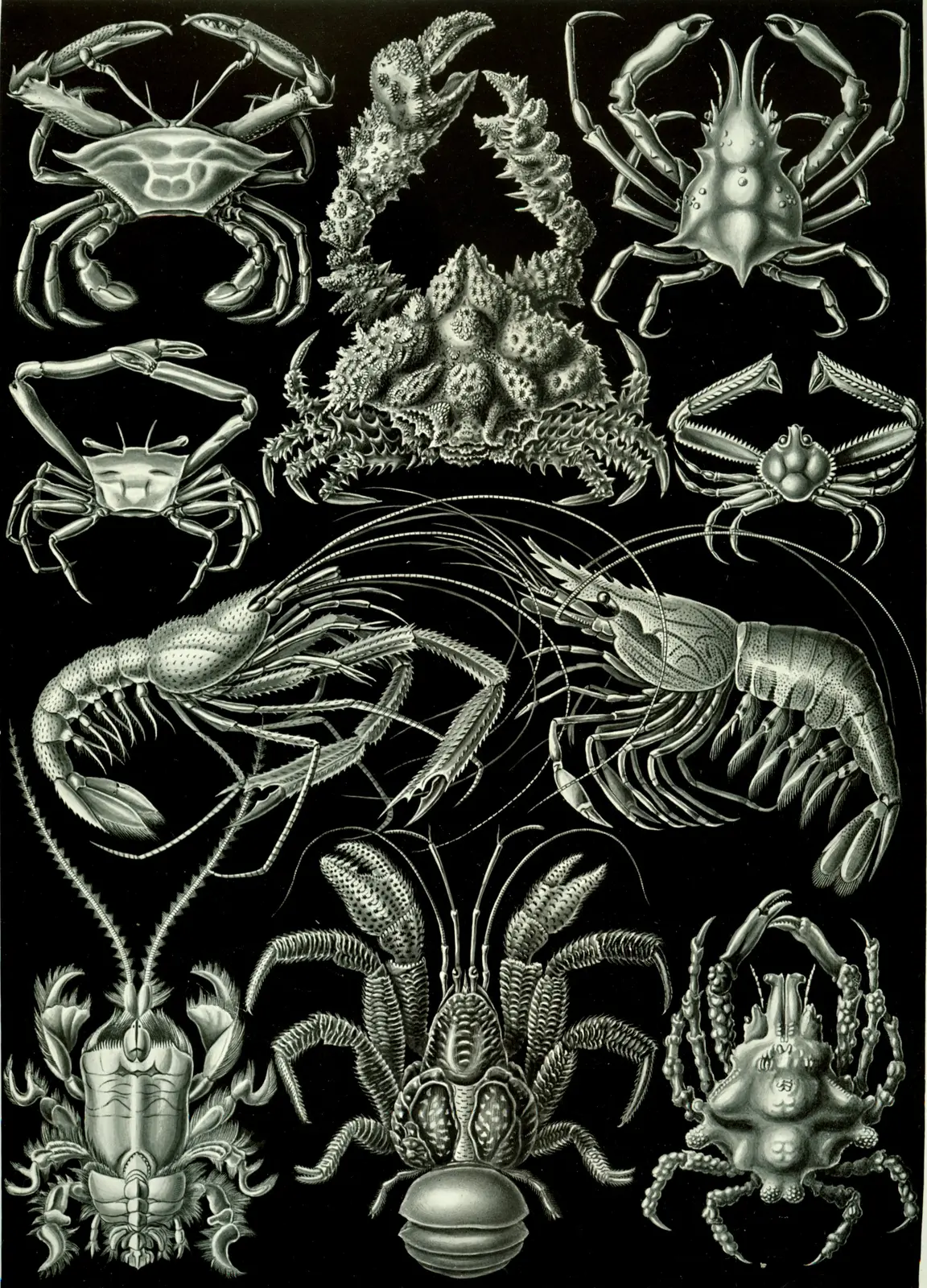
Plate 86 of Ernst Haeckel’s Kunstformen der Natur (1904), a sheet of decapod crustaceans. The file record lists true crabs, shrimps and the coconut crab (Birgus latro), the large animal at the bottom centre with its rounded abdomen at the back.
"Decapoda, plate 86, from Kunstformen der Natur" by Ernst Haeckel, Kunstformen der Natur (1904), plate 86 — https://commons.wikimedia.org/wiki/File:Haeckel_Decapoda.jpg — Public domain (US: published 1904, before 1931; EU: artist Ernst Haeckel d. 1919, lithographer Adolf Giltsch d. 1911)
Turn to a photograph of a king crab’s underside and the tail lies folded flat beneath the body. From above, the animal passes for any crab. The family tree disagrees. King crabs belong to Anomura, not to the true crabs, and their closest relatives are hermit crabs, relatively small animals that depend on a shell for protection.
What is carcinization?
Carcinization is the name for gaining a crab-like body form. Borradaile first proposed the term in 1916, for the crab-like look of one hermit crab and the tendency of anomurans to reach that shape, as Bracken-Grissom and colleagues recount in their 2013 paper in BMC Evolutionary Biology.
That paper sorts the living members of Anomura into four body forms. There are crab-like forms; squat lobsters; hermit crabs whose pleon, or abdomen, is symmetrical, found in one family; and hermit crabs with an asymmetrical abdomen, found in four families. Anomura holds about 2,500 described species.
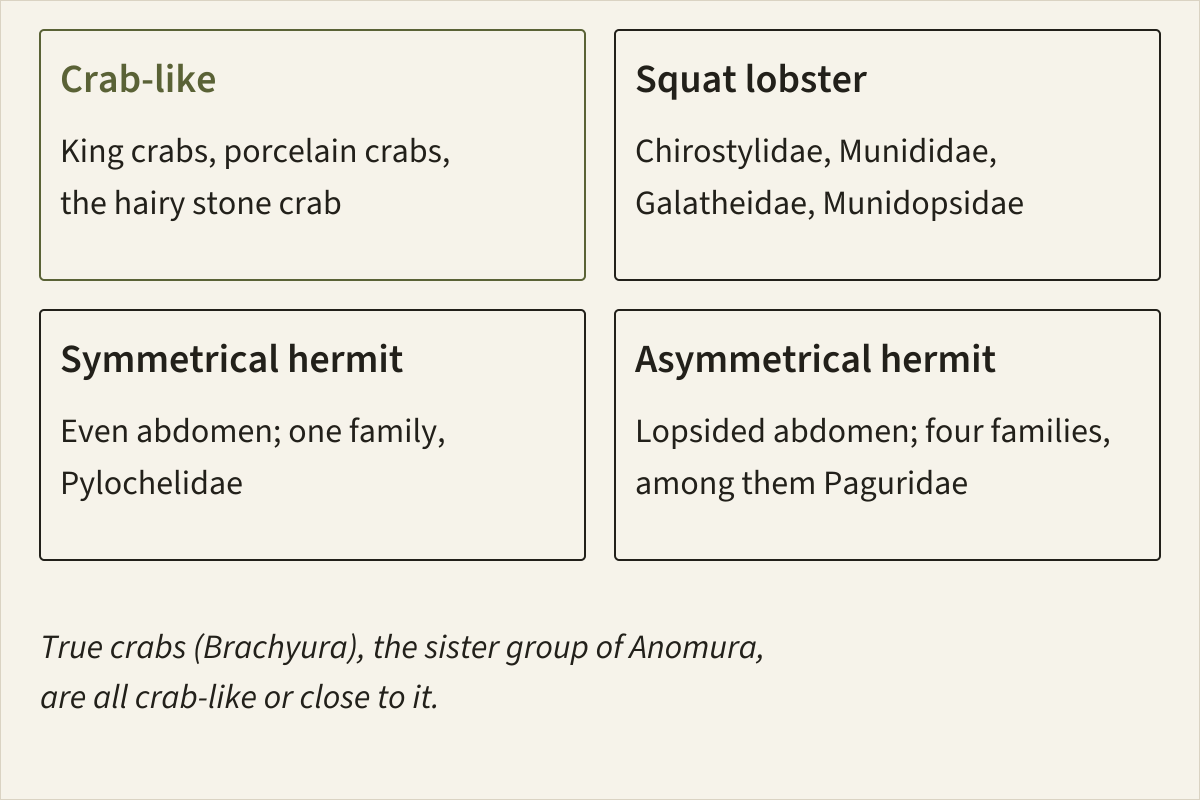
The four body forms in Anomura, with examples of the families that have each one. The crab-like card is outlined in olive; the note at the bottom covers the true crabs.
Basis Body forms and families from Bracken-Grissom et al. 2013 (CC BY 2.0); schematic, not to scale.
"Four body forms in Anomura" by Feathers, Skeletons & Nests, https://feathersskeletonsandnests.com/lineages/carcinization/ , licensed under CC BY 4.0, https://creativecommons.org/licenses/by/4.0/
Data: Bracken-Grissom H. D. et al. (2013) A comprehensive and integrative reconstruction of evolutionary history for Anomura (Crustacea: Decapoda). BMC Evolutionary Biology 13: 128, https://doi.org/10.1186/1471-2148-13-128, CC BY 2.0
| Body form | Examples in Anomura |
|---|---|
| Crab-like | King crabs, porcelain crabs, the hairy stone crab |
| Squat lobster | The families Chirostylidae, Munididae, Galatheidae and Munidopsidae |
| Symmetrical hermit | One family, Pylochelidae |
| Asymmetrical hermit | Four families, among them Paguridae and Coenobitidae |
The same paper calls the body forms of Anomura a case of “apparently rampant” convergent or parallel evolution, meaning separate lineages reached the same shape on their own. That makes the crab shape an example of convergent evolution. The true crabs, Brachyura, are a different group: the sister group of Anomura, with more than 6,550 species that all have a crab-like body or a slight variation on it.
There is an internet joke that everything turns into a crab, a joke the tree does not bear out. In the 2013 study the crab form arose in three lineages, while the squat lobsters and hermit crabs kept body forms of their own.
How many times did a crab shape evolve?
An ancestral-state reconstruction by Bracken-Grissom and colleagues in 2013 found that the crab shape arose three separate times within Anomura. In their words, carcinization “occurred independently three times during the evolution of Anomura, once in the Lithodoidea through an asymmetrical hermit intermediate, and twice in Lomisidae and Porcellanidae through squat lobster intermediates.” Lithodoidea are the king crabs, Lomisidae is the family of the hairy stone crab, and Porcellanidae are the porcelain crabs.
The analysis adds a twist. The study recovered a crab-like body as the starting state for all anomurans, with squat-lobster and hermit-crab forms present early on. In the 2013 analysis the three origins came later, each from an ancestor that was not crab-shaped.
Tree Open Tree of Life synthetic tree v16.1, retrieved 2026-11-16; no branch lengths or dates.
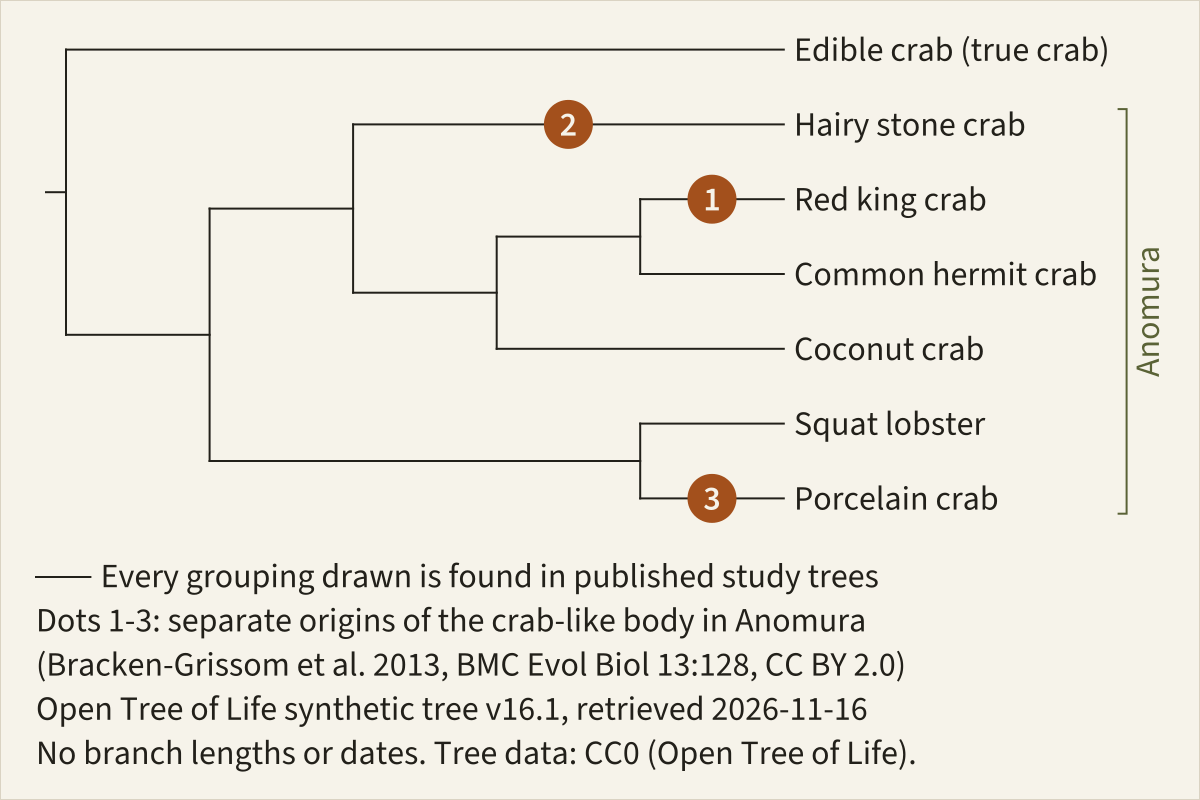
Seven living species on one tree. Each branch point stands for the common ancestor of the species on the branches that split from it. The rust dots 1 to 3 mark the three origins of a crab-like body within Anomura inferred in the 2013 study: king crabs, the hairy stone crab and porcelain crabs.
Basis Origins marked after Bracken-Grissom et al. 2013.
"Crab-like bodies in Anomura, with a true crab for comparison" by Feathers, Skeletons & Nests, https://feathersskeletonsandnests.com/lineages/carcinization/ , licensed under CC BY 4.0, https://creativecommons.org/licenses/by/4.0/
Data: Open Tree of Life synthetic tree v16.1 (opentree16.1), CC0 where not limited by pre-existing terms of use; Bracken-Grissom H. D. et al. (2013) A comprehensive and integrative reconstruction of evolutionary history for Anomura (Crustacea: Decapoda). BMC Evolutionary Biology 13: 128, https://doi.org/10.1186/1471-2148-13-128, CC BY 2.0
Follow the red king crab back from its tip. Its first branch point joins it to the common hermit crab, not to the edible crab at the top, which is a true crab. The coconut crab sits on the hermit-crab side too.
Bracken-Grissom and colleagues describe the coconut crab as a semi-terrestrial hermit crab that has given up shells as an adult and grown a calcified body. It is not one of the three origins the 2013 study counts. The same tree is set out in words below.
| Species on the tree | Common name | Where it sits | Origin dot |
|---|---|---|---|
| Cancer pagurus | Edible crab | True crabs (Brachyura), outside Anomura | None |
| Lomis hirta | Hairy stone crab | Anomura; next to the coconut, hermit and king crab group | 2 |
| Paralithodes camtschaticus | Red king crab | Anomura; paired with the common hermit crab | 1 |
| Pagurus bernhardus | Common hermit crab | Anomura; paired with the red king crab | None |
| Birgus latro | Coconut crab | Anomura; next to the king crab and hermit crab pair | None |
| Munida gregaria | Squat lobster | Anomura; paired with the porcelain crab | None |
| Petrolisthes armatus | Porcelain crab | Anomura; paired with the squat lobster | 3 |
Is a king crab a true crab?
A king crab is not a true crab. King crabs belong to the superfamily Lithodoidea within Anomura, and the 2013 study found Lithodoidea nested within the hermit crab family Paguridae. The authors note that every recent molecular and combined study they cite also places king crabs among the hermit crabs. The reverse idea, that hermit crabs came from king crabs, fitted their data significantly worse when they tested it (P < 0.05).
The idea that king crabs evolved from a hermit-crab-like ancestor is the hermit-to-king hypothesis, and the paper sums up the state of play as “all recent evidence pointing to a ‘hermit to king’ hypothesis.” Fossils agree with the order, since hermit crabs appear in the Jurassic and king crabs only in the Miocene. In this study the king crab line became crab-shaped about 29 to 18 million years ago, from an ancestor with an asymmetrical, hermit-crab-like abdomen.
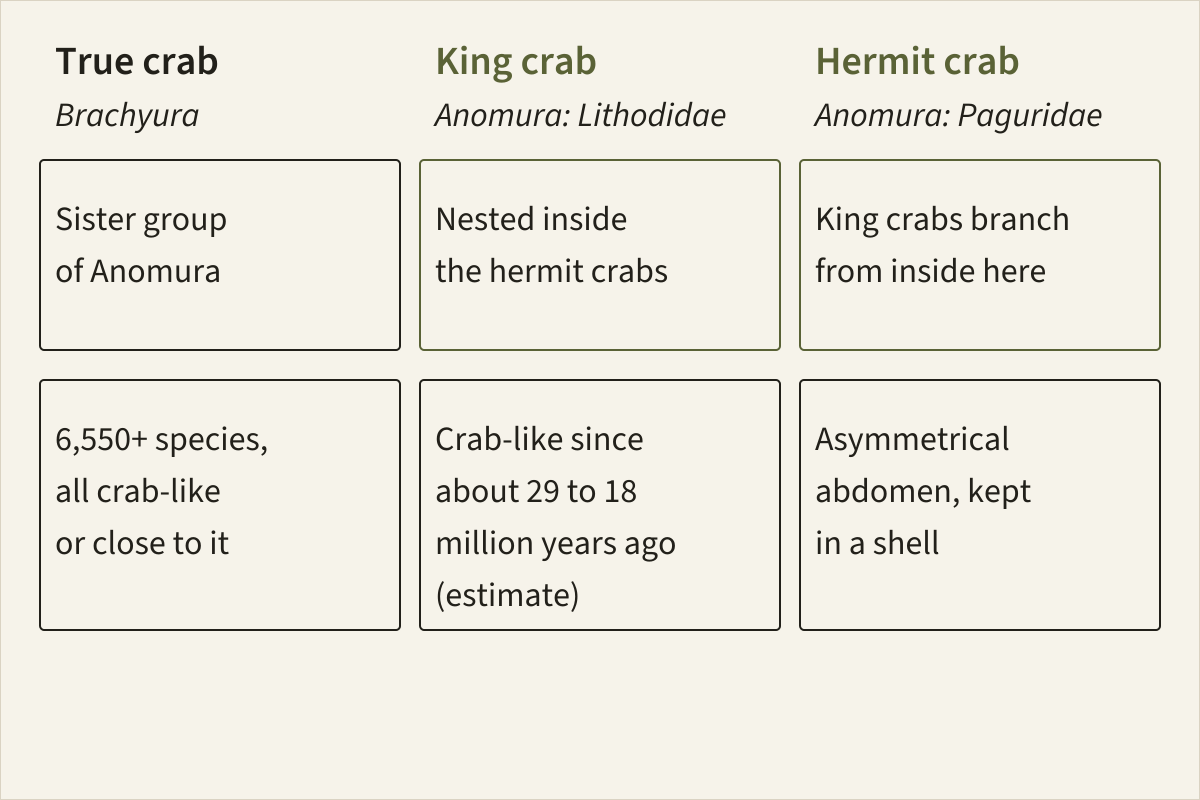
A true crab, a king crab and a hermit crab side by side. The top row gives where each sits; the bottom row gives a fact about its body or its group.
Basis Groups, relationships and dates from Bracken-Grissom et al. 2013 (CC BY 2.0); schematic, not to scale.
"A true crab, a king crab and a hermit crab compared" by Feathers, Skeletons & Nests, https://feathersskeletonsandnests.com/lineages/carcinization/ , licensed under CC BY 4.0, https://creativecommons.org/licenses/by/4.0/
Data: Bracken-Grissom H. D. et al. (2013) A comprehensive and integrative reconstruction of evolutionary history for Anomura (Crustacea: Decapoda). BMC Evolutionary Biology 13: 128, https://doi.org/10.1186/1471-2148-13-128, CC BY 2.0
| True crab | King crab | Hermit crab | |
|---|---|---|---|
| Group | Brachyura | Anomura: Lithodidae | Anomura: Paguridae |
| Relationship | Sister group of Anomura | Nested inside the hermit crabs | King crabs branch from inside this family |
| Body | 6,550+ species, all crab-like or close to it | Crab-like since about 29 to 18 million years ago (estimate) | Asymmetrical abdomen, protected by a shell |
The hairy stone crab and the porcelain crabs share the crab shape too, yet on the tree they sit on other branches, away from the king crab. The opposite pattern turns up in birds and dinosaurs, where birds look unlike their relatives on the tree yet sit inside them. Asking whether humans evolved from monkeys runs into the same trap of reading kinship from looks.
What does a king crab look like underneath?
On its underside, a king crab shows a broad, plated flap folded tight under the rear of the body. In the photograph below, of a red king crab, Paralithodes camtschaticus, the plates on one side of that flap do not match the plates on the other.
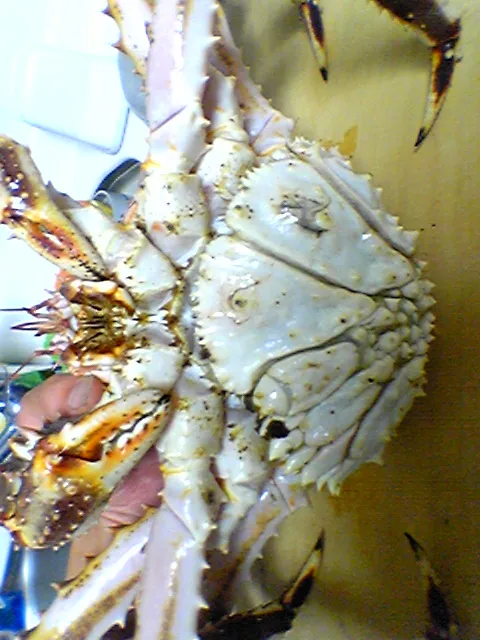
Underside of a live red king crab, Paralithodes camtschaticus. The plated flap folded under the rear of the body is the abdomen; the plates on one side of it are not the same as those on the other.
"KingCrab-reverse (underside of a live red king crab)" by メリケン・ステーツ — https://commons.wikimedia.org/wiki/File:KingCrab-reverse.JPG — CC BY-SA 3.0 (https://creativecommons.org/licenses/by-sa/3.0/)
That flap is the pleon, the abdomen, the same body region that a hermit crab protects inside a shell. Same part, different shape: that makes it a homologue, the idea behind homologous structures. Some researchers have argued that the lopsided abdomen of female king crabs is evidence of an asymmetrical hermit crab ancestry, as Bracken-Grissom and colleagues summarise the debate.
How the king crab abdomen changed is less settled. Studies of young king crabs, as summarised in the same paper, found that in several species the adult plates arose as the plates lost some of their mineral and split apart, not by fusing together. The authors call the steps within the king crab line “at best poorly understood.”
Why does a crab shape keep evolving?
Why the crab shape arose three separate times is still an open question; Bracken-Grissom and colleagues pose it themselves. They discuss two ideas from earlier work. The first is that a crab-like body is a key innovation, a trait that helps a lineage split into many new species, perhaps because the body gives greater mobility and agility.
Their own analysis, which they present as initial insights, did not support that first idea. It found no correlation between branching times in the tree and the history of the crab-shaped lineages, which, the authors write, suggests that the crab form “did not play a major role” in shaping the living diversity of Anomura, though they add that further work is needed to confirm the pattern. The hairy stone crab makes the point: its family is about 122 million years old and has one living species, found only in Australia.
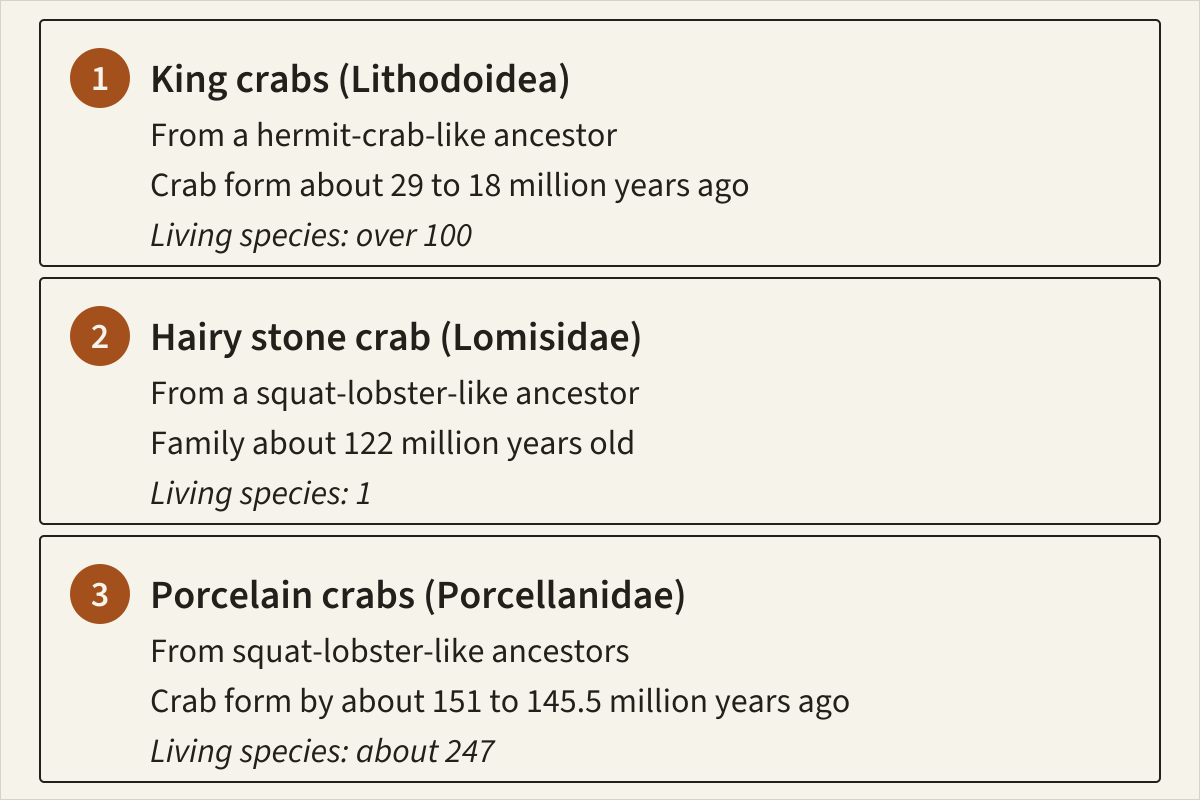
The three origins of the crab form within Anomura, numbered as on the tree. Each card gives the kind of ancestor, the timing estimate and the number of living species.
Basis Ancestors, timing estimates and species counts from Bracken-Grissom et al. 2013 (CC BY 2.0); schematic, not to scale.
"Three origins of the crab form in Anomura" by Feathers, Skeletons & Nests, https://feathersskeletonsandnests.com/lineages/carcinization/ , licensed under CC BY 4.0, https://creativecommons.org/licenses/by/4.0/
Data: Bracken-Grissom H. D. et al. (2013) A comprehensive and integrative reconstruction of evolutionary history for Anomura (Crustacea: Decapoda). BMC Evolutionary Biology 13: 128, https://doi.org/10.1186/1471-2148-13-128, CC BY 2.0
The second idea is that a body no longer tied to a shell may have an advantage in finding food. The coconut crab is the example the paper offers. The paper leaves the question open. The same kind of question, reading a reshaped body from its parts, runs through whale evolution.
| Origin | Lineage | Ancestor | Timing (estimate) | Living species |
|---|---|---|---|---|
| 1 | King crabs (Lithodoidea) | Asymmetrical hermit-crab-like | About 29 to 18 million years ago | Over 100 |
| 2 | Hairy stone crab (Lomisidae) | Squat-lobster-like | Family about 122 million years old; crab form not dated | 1 |
| 3 | Porcelain crabs (Porcellanidae) | Squat-lobster-like | Crab form by about 151 to 145.5 million years ago | About 247 |
Download the origins table (CSV) (what this file records) Data: Bracken-Grissom H. D. et al. (2013) A comprehensive and integrative reconstruction of evolutionary history for Anomura (Crustacea: Decapoda). BMC Evolutionary Biology 13: 128, https://doi.org/10.1186/1471-2148-13-128, CC BY 2.0
Same bones, elsewhere:
- Homologous structures: the same part in any shape, read in the bones of a forelimb.
- Are birds dinosaurs?: the opposite case, where birds look unlike dinosaurs but sit inside them.
Sources
- Heather D. Bracken-Grissom, Maren E. Cannon, Patricia Cabezas, Rodney M. Feldmann, Carrie E. Schweitzer, Shane T. Ahyong, Darryl L. Felder, Rafael Lemaitre and Keith A. Crandall, "A comprehensive and integrative reconstruction of evolutionary history for Anomura (Crustacea: Decapoda)", BMC Evolutionary Biology 13 (2013): 128. doi.org/10.1186/1471-2148-13-128Read: full textText licence: CC BY 2.0 (terms)
- Open Tree of Life, synthetic tree opentree16.1 with Open Tree Taxonomy 3.7draft3. tree.opentreeoflife.orgRead: full text of the subtree for eight living primate species (27-0012) and of the subtree for seven anomuran and brachyuran species (27-0008), with the study-tree records for each branch point (topology retrieved 2026-11-16, node records 2026-11-17)Text licence: CC0 where not limited by pre-existing terms of use (terms)
Cite this page
Feathers, Skeletons & Nests. “Carcinization: King Crabs Evolved From Hermit Crab Kin.” first published 17 November 2026. https://feathersskeletonsandnests.com/lineages/carcinization/ (accessed on the date you read it).
How facts are sourcedAll correctionsReport an error on this page (contact@feathersskeletonsandnests.com)
More from the Lineages drawer
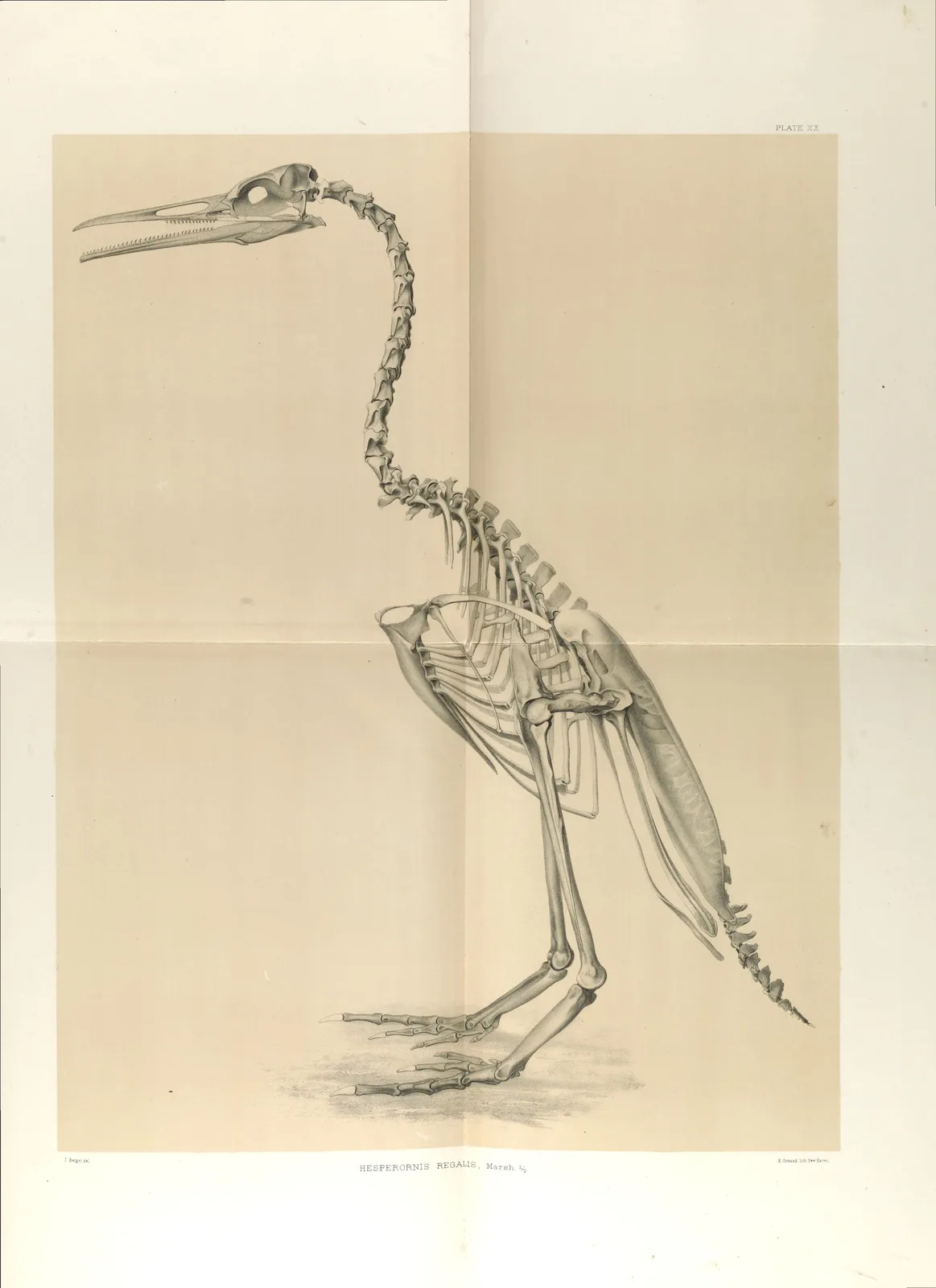
Are Birds Dinosaurs? On the Family Tree, Birds Sit Inside
- Kind
- Comparison and reading
- Added
Picture credit
"Plate XX, Hesperornis regalis, from Odontornithes: a monograph on the extinct toothed birds of North America" by Marsh, Othniel Charles (1880), via Biodiversity Heritage Library — https://commons.wikimedia.org/wiki/File:Odontornithes-_a_monograph_on_the_extinct_toothed_birds_of_North_America_(Plate_XX)_BHL40333948.jpg — Public domain (US: published 1880, before 1931; EU: author O. C. Marsh d. 1899; plate credits F. Berger (drawing) and E. Crisand (lithography), death years not checked, but both were working on the plate in 1880, 76 years before 1956, so a death after 1955 is not credible)
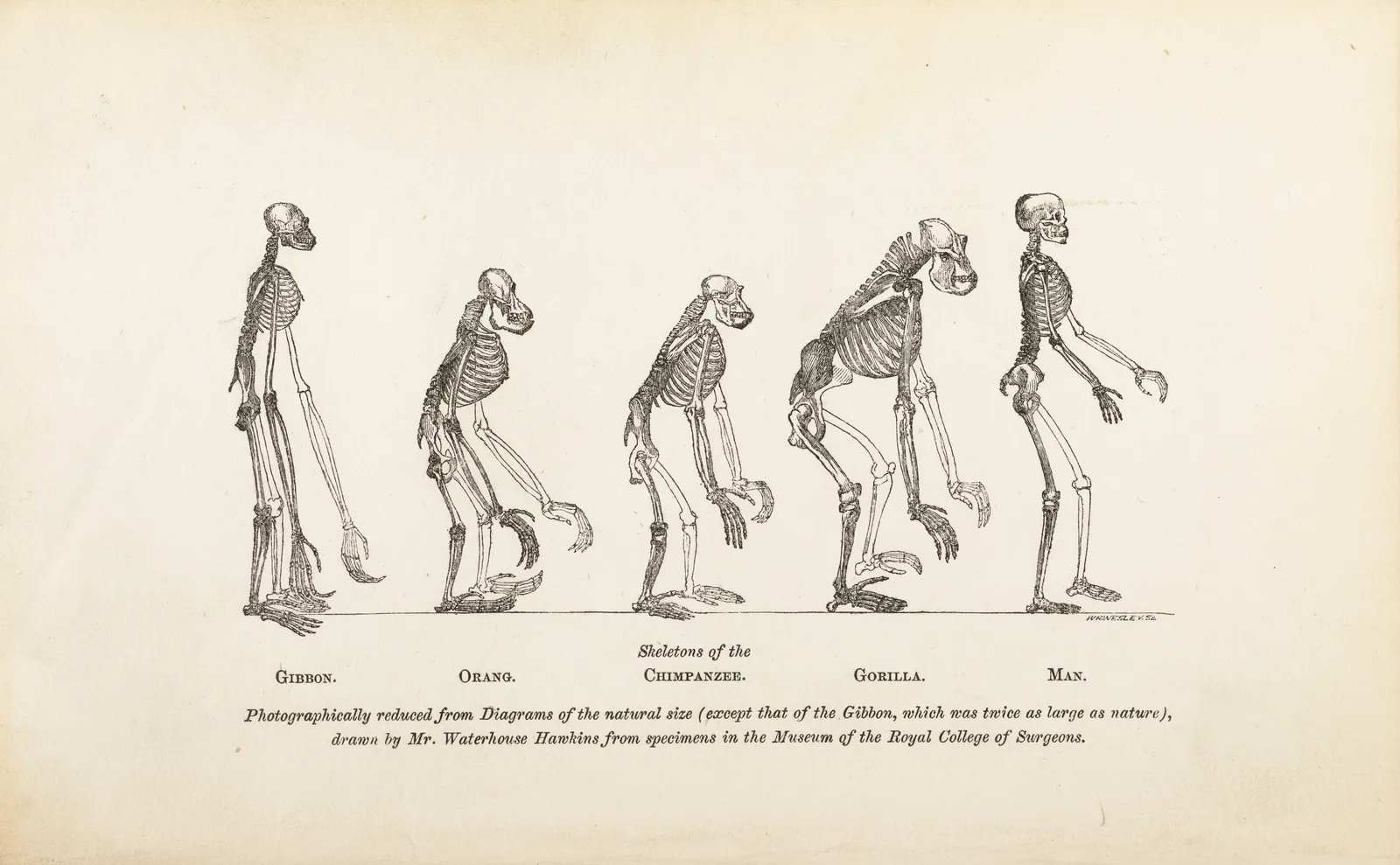
Did Humans Evolve From Monkeys? Not From Any Living Species
- Kind
- Comparison and reading
- Added
Picture credit
"Skeletons of the gibbon, orang, chimpanzee, gorilla and man (frontispiece), from Evidence as to Man's Place in Nature" by Wellcome Library, London. Wellcome Images — https://commons.wikimedia.org/wiki/File:Frontispiece_to_Huxley_%27Evidence_as_to_man%27s_place...%27_Wellcome_L0063032.jpg — CC BY 4.0 (https://creativecommons.org/licenses/by/4.0/)