Beaver Dam: Is Running Water’s Sound the Cue to Build?
Short answer
Beavers build dams to keep their lodge or burrow entrances under water, according to Angela Gurnell's 1997 review for Scottish Natural Heritage. Running water's sound has been suggested as an important building trigger in North American and European beavers. A 1992 study the review cites, of European beavers in Poland, judged it of secondary importance to a safer site and access to food.
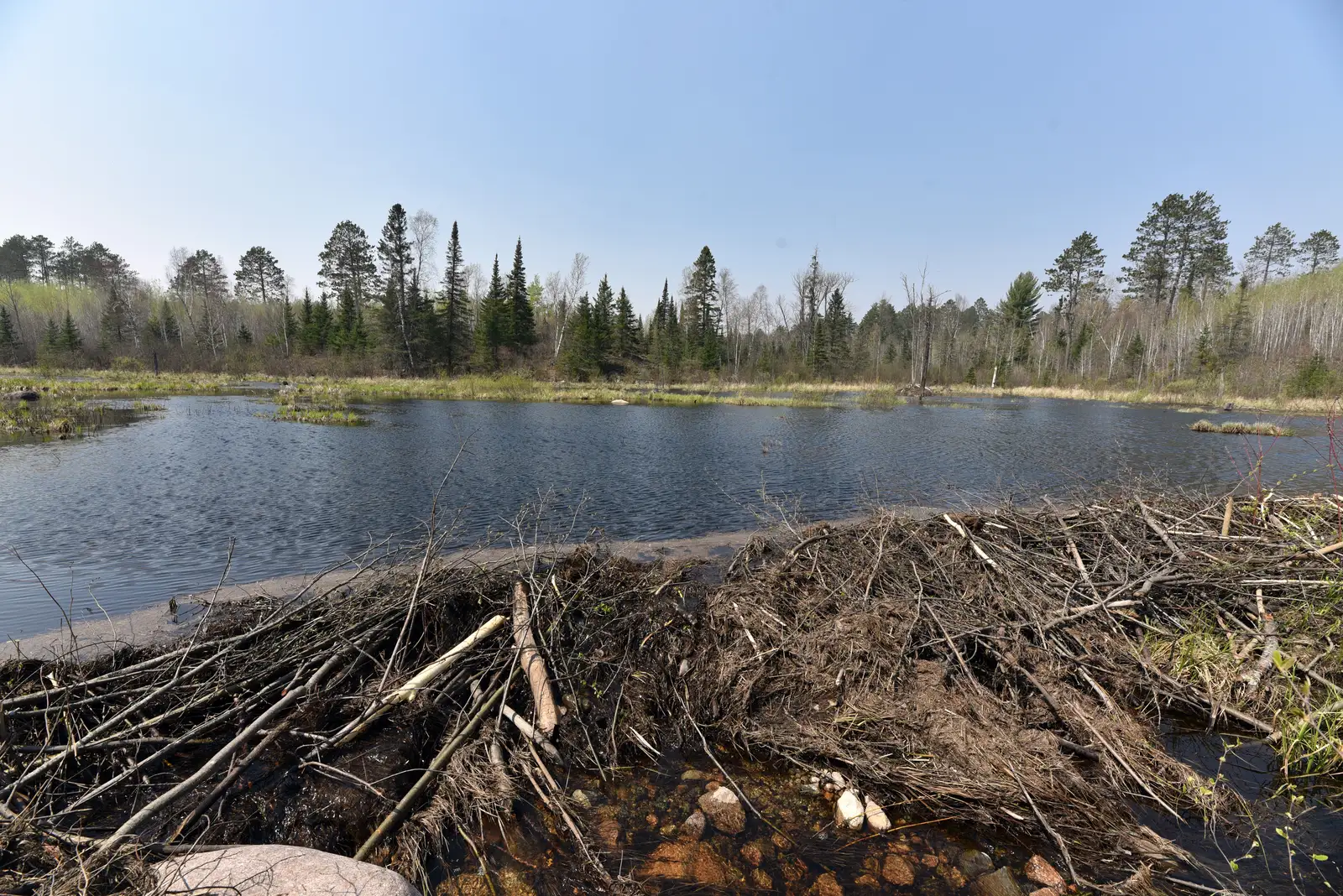
A beaver dam holding back a large wetland in St. Louis County, Minnesota, photographed in May 2024. The pond behind the dam stands above the shallow, stony water in front of it.
"Beaver dam, St. Louis County, Minnesota" by Courtney Celley/USFWS — https://commons.wikimedia.org/wiki/File:Beaver_dam_(53718655489).jpg — Public domain (US: U.S. Government work (17 U.S.C. §105); USFWS photo by Courtney Celley; EU: no statutory public-domain basis, agency PDM marking); modified: resized: 3,000 x 2,003 px copy of the 6,016 x 4,016 original, no crop, no colour change; camera metadata not copied
The sound of running water has been suggested as the cue that sets a beaver building. Gurnell's review covers published work on both species. The studies it cites point to other cues as well: water level, low autumn flows, safety and food.
Why do beavers build dams?
A beaver's shelter, whether a lodge or a burrow in the bank, needs entrances that open under water, Gurnell writes, citing a 1983 paper by P. B. Richard. Dams go up where they are needed for this, with building timed to the changes in water level that the shelter requires. One colony can build several dams to keep its pond at the right height.
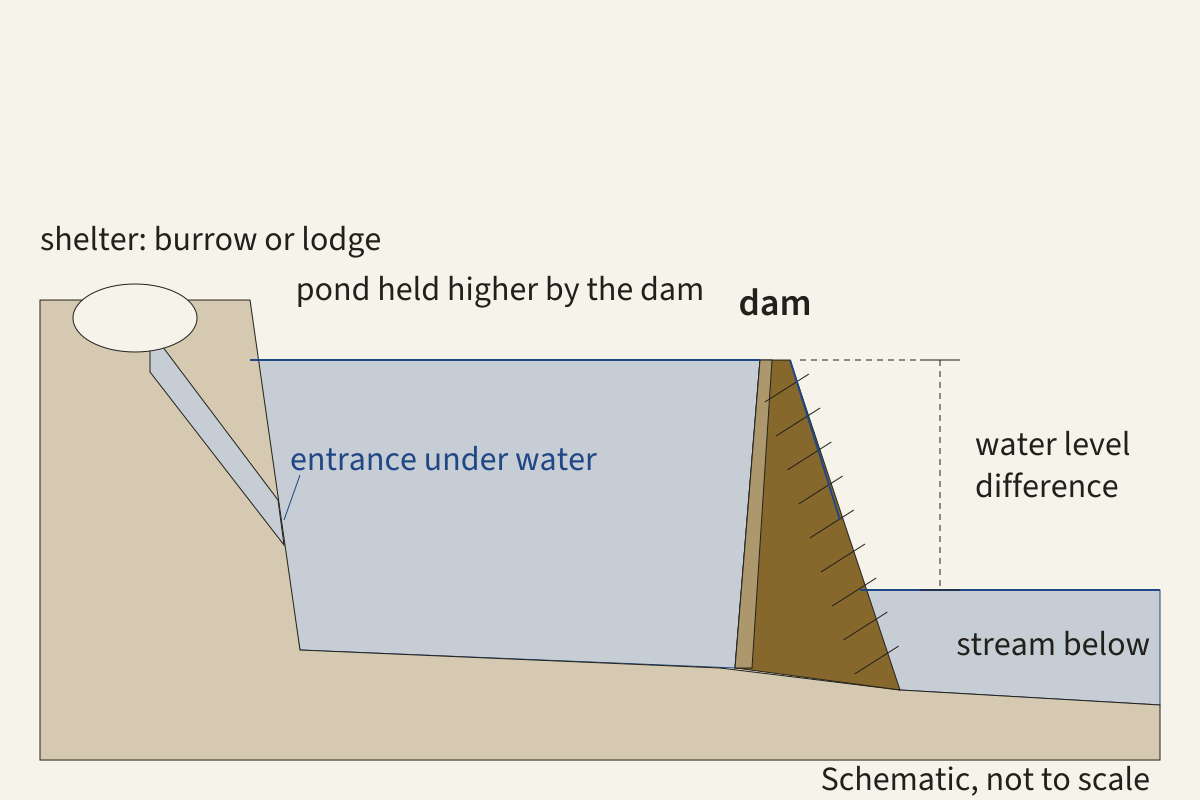
A dammed stream in section. The dam holds the pond above the level of the stream below, which keeps the burrow's entrance under water while its chamber stays dry above the water line.
Basis Shelter, entrance and dam relationship as summarised by Gurnell (1997); schematic, not to scale.
"Why a dam matters to a beaver's shelter" by Feathers, Skeletons & Nests, https://feathersskeletonsandnests.com/animal-builders/beaver-dam/ , licensed under CC BY 4.0, https://creativecommons.org/licenses/by/4.0/
Data: Gurnell A. M. (1997) Analysis of the effects of beaver dam-building activities on local hydrology. Scottish Natural Heritage Review No 85. Contains public sector information licensed under the Open Government Licence v3.0. Retrieved 2026-11-17
Many colonies build no dam at all. In Poland, Zurowski and Kasperczyk (1986) found dams at only 50 of 257 beaver sites in the Suwałki Lakeland, and Zurowski (1992) found them at 17 of 62 colony sites in the Masurian and Brodnica Lakelands, as cited by Gurnell. All of Zurowski's dams were on small rivers or drainage ditches and appeared to be built mainly to reach new areas of food. A dam in use, with a shelter behind it, is best watched from a distance and left undisturbed.
Is the sound of running water the cue to start building?
The sound of running water has been suggested to be an important stimulus for dam building in the North American beaver, Castor canadensis (Hodgdon and Lancia 1983), and in the European beaver, Castor fiber (Richard 1983), as cited in Gurnell 1997. Zurowski set out in 1992 to weigh the stimuli thought to trigger building. He concluded, in Gurnell's words, that sound “was of secondary importance to the stimulus of improving safety and access to food at particular sites”.
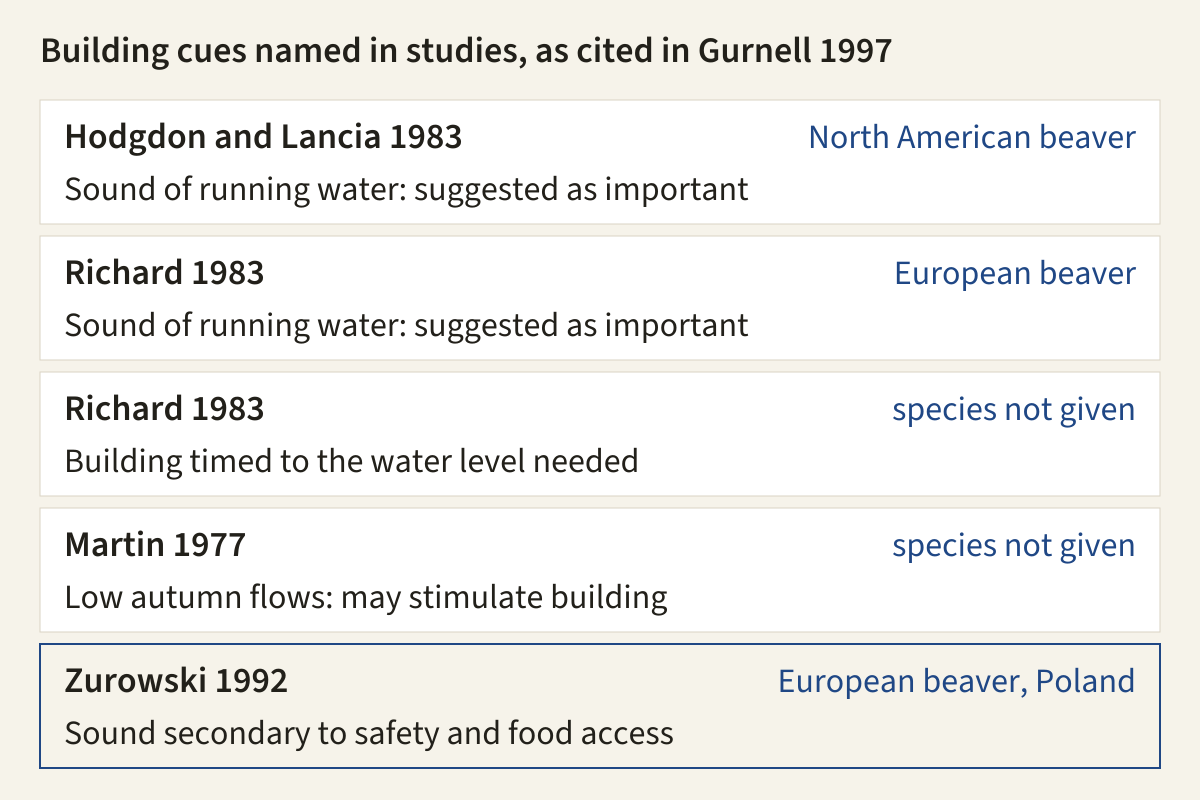
Five findings on what sets off dam building, as cited in Gurnell's review. Only the last weighs the sound of water against other cues, and it ranks sound lower.
Basis Studies and findings as cited in Gurnell (1997), Scottish Natural Heritage Review No 85; originals not read.
"Building cues named in beaver studies" by Feathers, Skeletons & Nests, https://feathersskeletonsandnests.com/animal-builders/beaver-dam/ , licensed under CC BY 4.0, https://creativecommons.org/licenses/by/4.0/
Data: Gurnell A. M. (1997) Analysis of the effects of beaver dam-building activities on local hydrology. Scottish Natural Heritage Review No 85. Contains public sector information licensed under the Open Government Licence v3.0. Retrieved 2026-11-17
| Study (as cited in Gurnell 1997) | Species | Cue | Reported finding |
|---|---|---|---|
| Hodgdon and Lancia 1983 | North American beaver | sound of running water | suggested to be an important stimulus |
| Richard 1983 | European beaver | sound of running water | suggested to be an important stimulus |
| Richard 1983 | not given in the review's sentence | water level at the shelter entrances | building timed to the water level needed |
| Martin 1977 | not given in the review's sentence | low flows in autumn | considered as a possible stimulus |
| Zurowski 1992 | European beaver, Poland | safety and access to food | sound judged of secondary importance |
Download the building cues table (CSV) (what this file records) Data: Gurnell A. M. (1997) Analysis of the effects of beaver dam-building activities on local hydrology. Scottish Natural Heritage Review No 85, https://www.nature.scot/sites/default/files/2025-06/naturescot-review-85.pdf. Contains public sector information licensed under the Open Government Licence v3.0. Retrieved 2026-11-17
No row claims that sound alone is enough. The review does not describe any test in which recorded water sounds were played to beavers, so this page does not report one.
Is a beaver dam the same as a lodge?
No. A dam is a wall across moving water, while a lodge or burrow is where the beavers shelter, as Gurnell sets them apart. European beavers usually dig burrows where the banks are high enough. Where banks are lower they add wood on top to make a bank lodge, and lodges made entirely of wood were very rare in the Rhône basin (Erome 1984, as cited). Zurowski still found many lodges in the Polish lakelands, most of them conical, with more than one per colony on average.
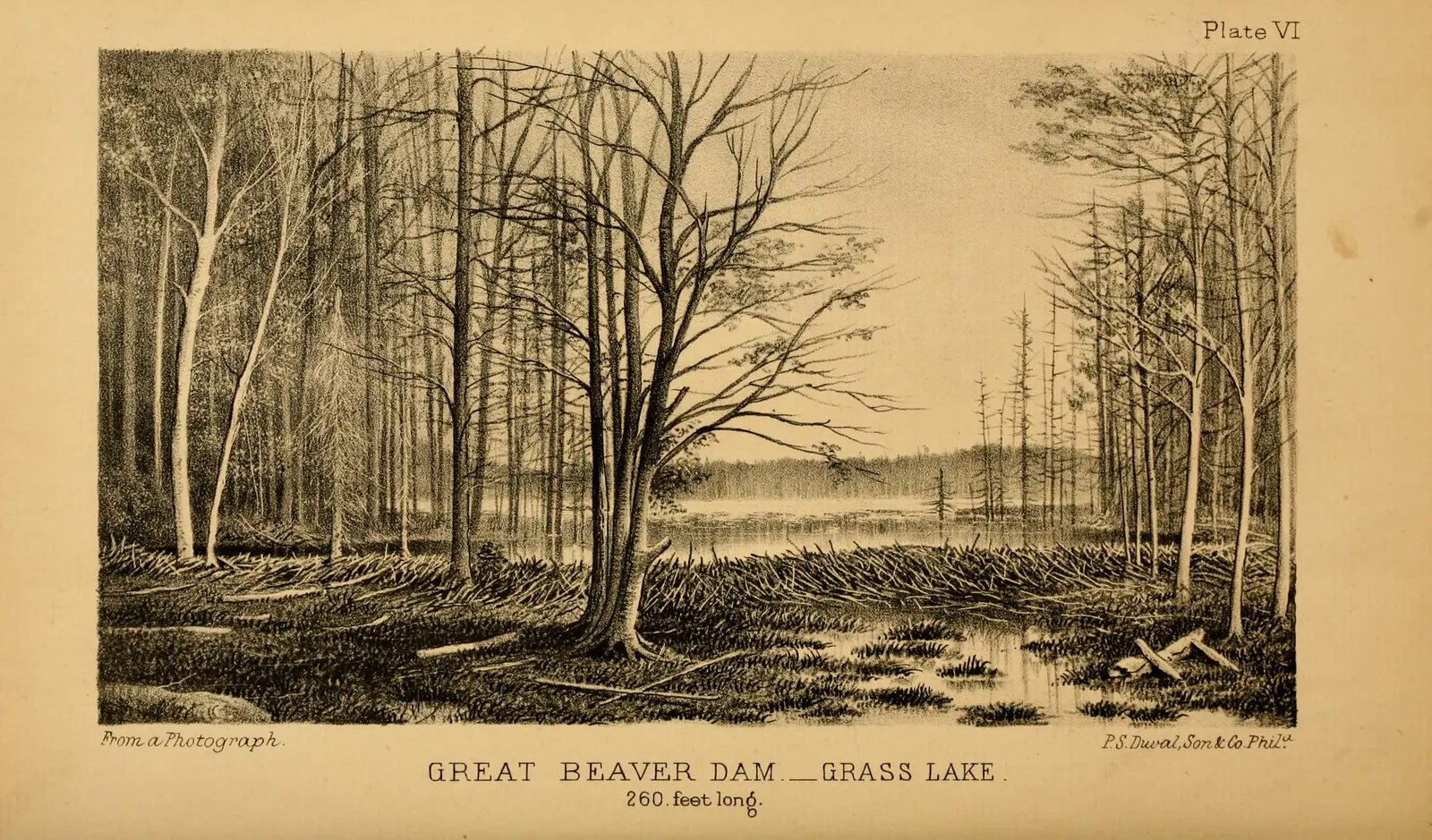
Plate VI of Lewis Henry Morgan's 1868 book on the American beaver: the Great Beaver Dam at Grass Lake, lithographed from a photograph and labelled 260 feet long.
"Plate VI, Great Beaver Dam, Grass Lake, from The American Beaver and His Works" by Morgan, Lewis Henry (1868), via Biodiversity Heritage Library — https://commons.wikimedia.org/wiki/File:The_American_beaver_and_his_works_(Plate_VI)_BHL10622867.jpg — Public domain (US: published 1868; EU: author d. 1881; lithographers P. S. Duval, Son & Co., Philadelphia (death years not checked, but anyone working on the plate in 1868 died long before 1956))
Lewis Henry Morgan gave the size of this North American beaver dam in his 1868 book. Measured with a tape line, it ran 260 feet 10 inches along the crest, about 79.5 metres, and 6 feet 2 inches high at its great curve, about 1.88 metres. The pond stood 5 feet, about 1.5 metres, above the water below the dam. The dam made the pond, and the pond is what keeps a shelter's entrances covered.
How do beavers build a dam?
Dams are made of tree trunks, branches, twigs, earth, mud and sometimes stones, and the upstream face is sealed with mud, according to Gurnell's review. Morgan described the same split at Grass Lake: a lower face of interlaced sticks with their lower ends against the ground, and an upper face of earth and mud mixed with sticks and brush.
Richard sorted European beaver dams on the upper River Tave in France into three kinds of frame: one leaning on a fallen tree, one built on upright stakes driven into the bed, and one braced by props laid along the stream (Richard 1955, as cited).
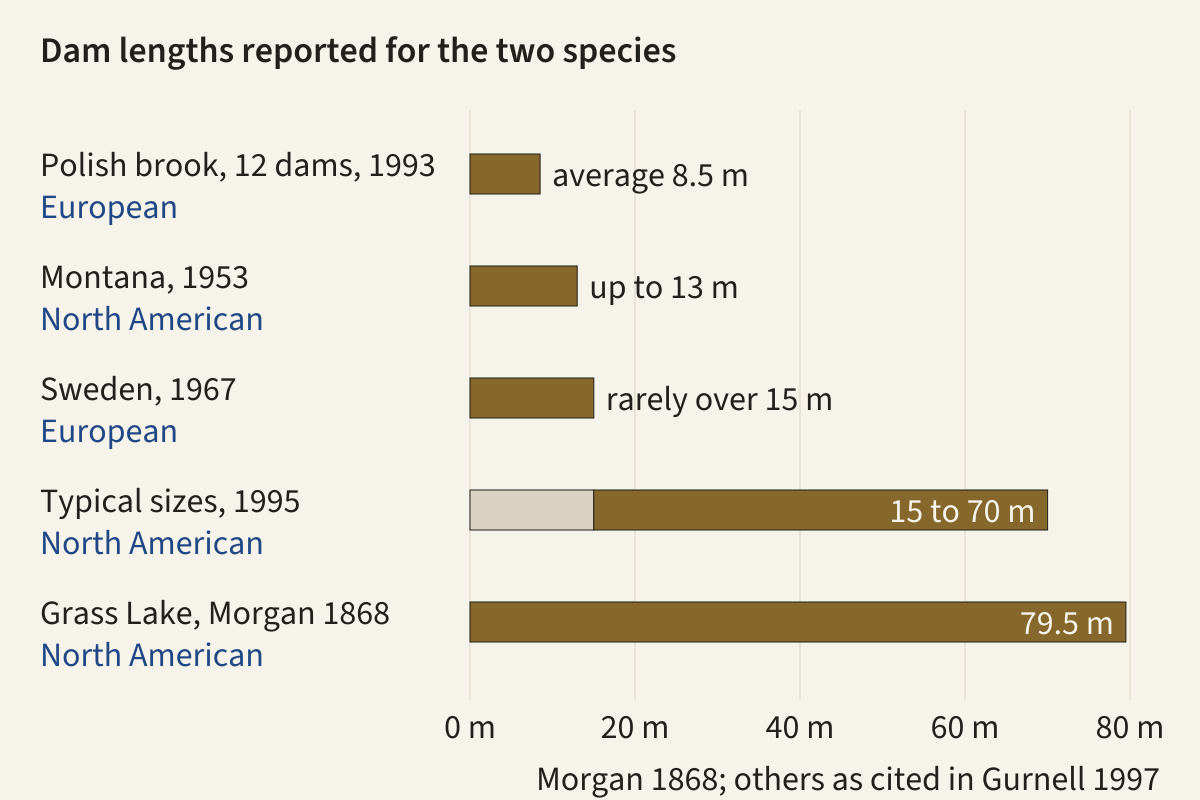
Dam lengths reported for the two species, drawn to one scale. The two European beaver bars are an average and a length rarely exceeded, not the longest dams, while Morgan's Grass Lake dam runs past the top of the typical North American range given in 1995.
Basis Lengths as cited in Gurnell (1997) and as given by Morgan (1868); 260 feet 10 inches converted to metres; bars to scale.
"Beaver dam lengths compared" by Feathers, Skeletons & Nests, https://feathersskeletonsandnests.com/animal-builders/beaver-dam/ , licensed under CC BY 4.0, https://creativecommons.org/licenses/by/4.0/
Data: Gurnell A. M. (1997) Analysis of the effects of beaver dam-building activities on local hydrology. Scottish Natural Heritage Review No 85. Contains public sector information licensed under the Open Government Licence v3.0. Retrieved 2026-11-17; Morgan L. H. (1868) The American Beaver and His Works, p. 86, public domain
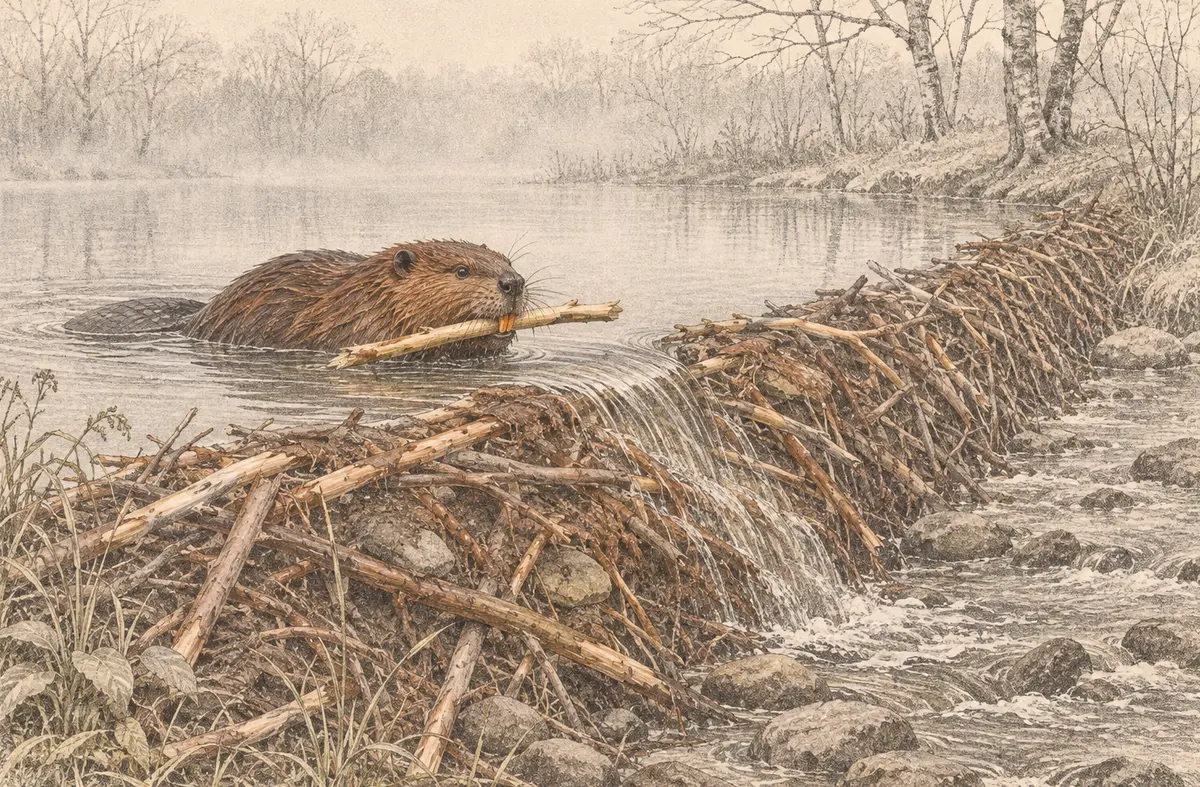
A beaver, illustrated carrying a stick across the pond behind its dam, where the pond stands level with the top of the dam and a thin layer of water slides down the sticks to the lower stream.
Illustration: Feathers, Skeletons & Nests. Generated schematic image — not a photograph, specimen, or historical record. Reuse: no open licence is granted; Feathers, Skeletons & Nests reserves only such rights as it holds under applicable law.
The two species differ in how much they build. European beavers are thought to build dams less often than North American beavers and usually smaller ones, Gurnell writes. Dams in Sweden rarely exceed 15 metres in length and are typically 1 metre high (Curry-Lindahl 1967, as cited). For North American beavers, Dugmore suggested in 1914 that the large majority of dams were under 1.5 metres high, although some early accounts describe dams several hundred metres long.
Dams also change with age. Studying dams in northern Ontario, Woo and Waddington sorted them by how water crosses them (over the top, through a gap, through the structure or under it) and found that this tracks a dam's age and state of repair (as cited in Gurnell 1997). Other builders on this site solve different problems: a bowerbird builds for display, and a sociable weaver nest is a roof that many birds share.
Same bones, elsewhere:
- Termite mound: a builder that moves air instead of water.
- Petrified wood: wood that turned to stone instead of staying wood.
Sources
- Angela M. Gurnell, Analysis of the Effects of Beaver Dam-Building Activities on Local Hydrology, Scottish Natural Heritage Review No 85 (Perth: Scottish Natural Heritage, 1997). www.nature.scot/sites/default/files/2025-06/natur…Read: full text of sections 1 and 2 (pp. 3–26)Text licence: Open Government Licence v3.0 (terms)
- Lewis H. Morgan, The American Beaver and His Works (1868). archive.org/details/americanbeaverhi68morgRead: pages 86–88, checked against the page images
Cite this page
Feathers, Skeletons & Nests. “Beaver Dam: Is Running Water’s Sound the Cue to Build?.” first published 17 November 2026. https://feathersskeletonsandnests.com/animal-builders/beaver-dam/ (accessed on the date you read it).
How facts are sourcedAll correctionsReport an error on this page (contact@feathersskeletonsandnests.com)
More from the Animal Builders drawer
Termite Mound: In One Study, Day and Night Flip the Airflow
- Kind
- In-depth explainer
- Added
Picture credit
"Namibia Kalahari Desert Termite Mound" by Alexander Klink — https://commons.wikimedia.org/wiki/File:Namibia_Kalahari_Desert_Termite_Mound.jpg — CC BY 4.0 (https://creativecommons.org/licenses/by/4.0/)
Great Bowerbird: Its Court Stones Are Sorted by Size
- Kind
- Specimen entry
- Added
Picture credit
"Great bowerbird bower, Horseshoe Bay, Bowen" by John Robert McPherson — https://commons.wikimedia.org/wiki/File:Great_bowerbird_bower,_Horseshoe_Bay,_Bowen_101_0183.jpg — CC0 1.0 (https://creativecommons.org/publicdomain/zero/1.0/)
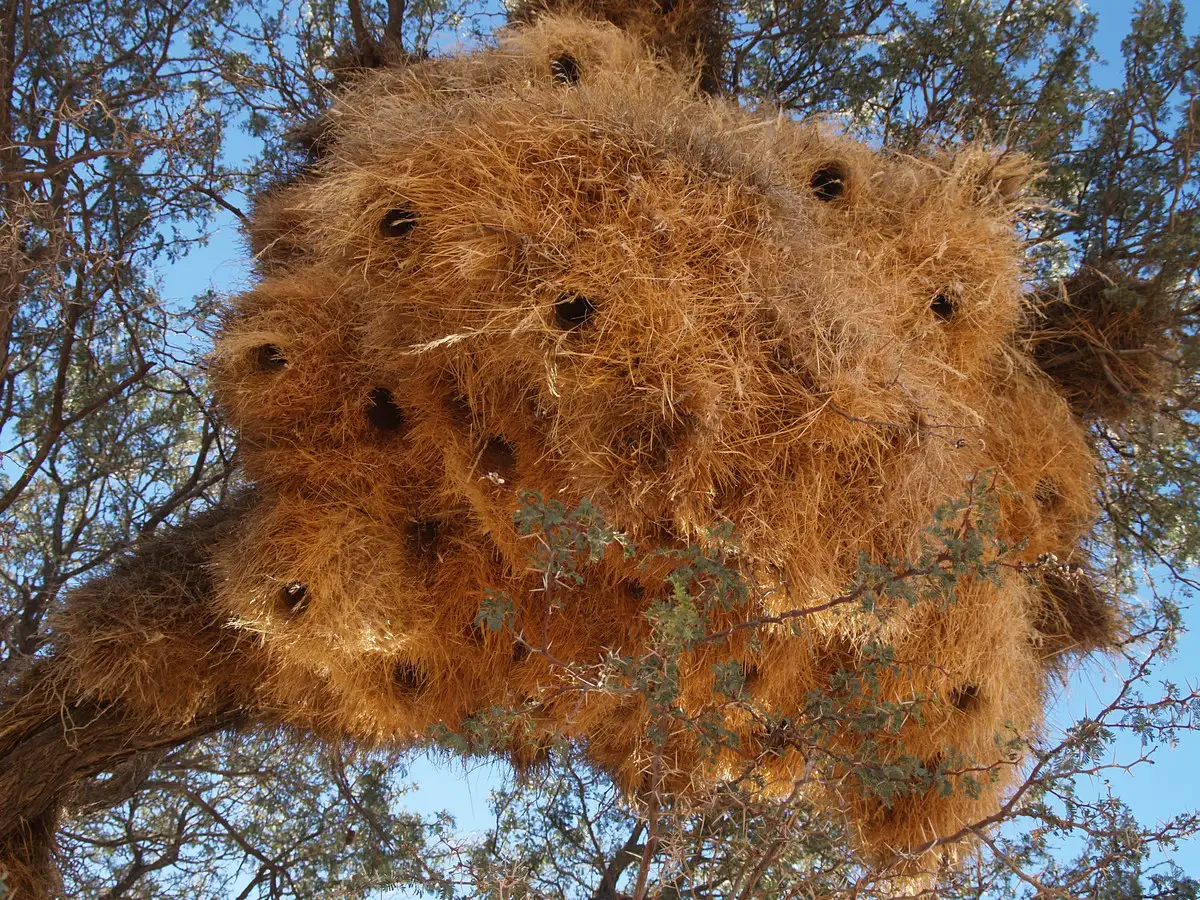
Sociable Weaver Nest Study: Chambers Warmer Than Night Air
- Kind
- Specimen entry
- Added
Picture credit
"Social weaver colony" by Rui Ornelas — https://commons.wikimedia.org/wiki/File:Social_weaver_colony.jpg — CC BY 2.0 (https://creativecommons.org/licenses/by/2.0/); modified: resized: 1,200 x 900 px copy of the 3,264 x 2,448 original, no crop, no colour change; camera metadata not copied