Great Bowerbird: Its Court Stones Are Sorted by Size
Short answer
A male great bowerbird sorts the pale stones, bones and shells of his display court by size: smallest near the entrance of his stick avenue, largest farthest away. When researchers reversed that order, the males had put it back within 3 days, John Endler and colleagues reported in 2010. The bower is a courtship stage, not a nest.
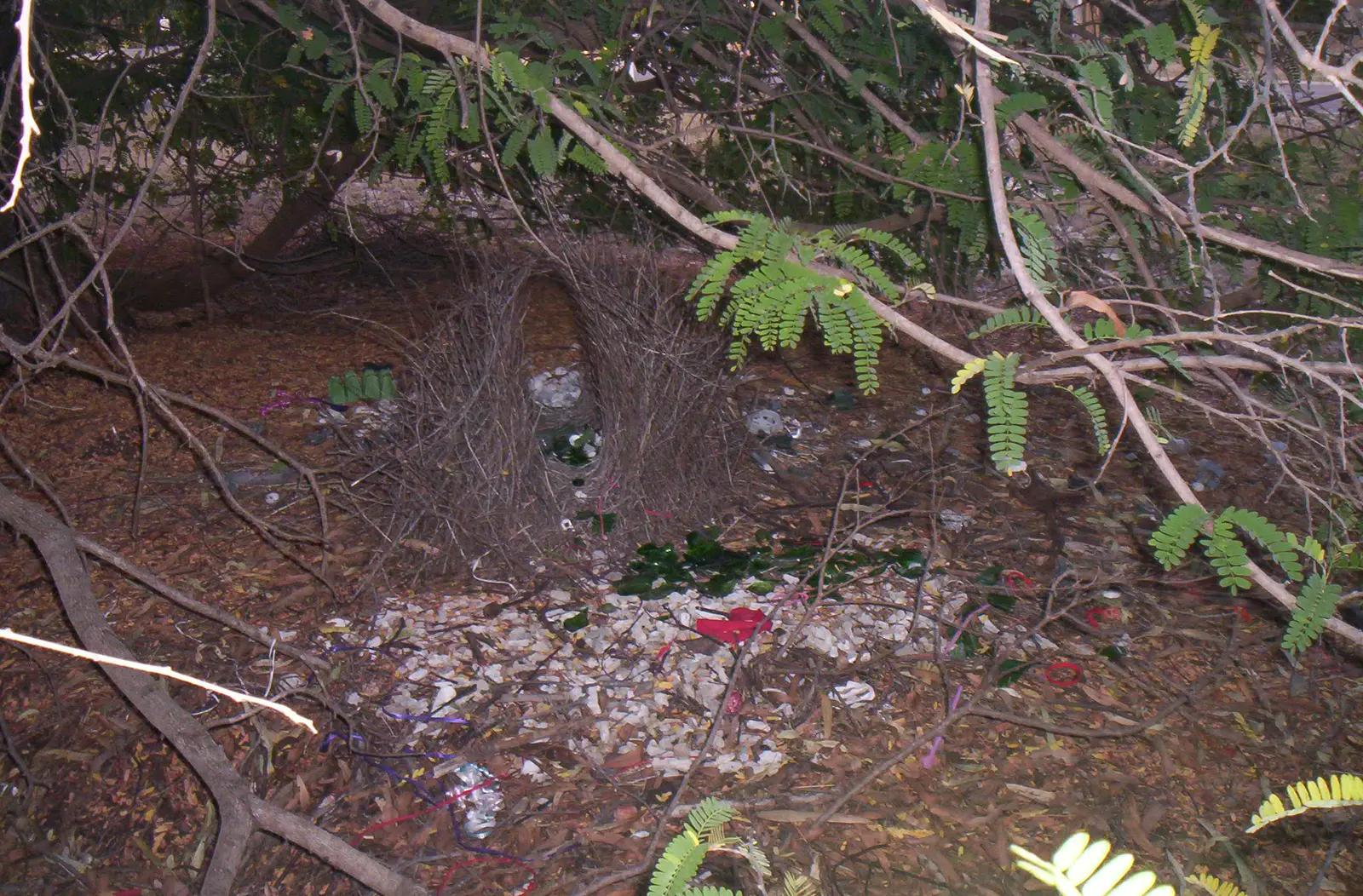
A great bowerbird's bower at Horseshoe Bay, Bowen, as named in the photo's file record: two walls of thatched sticks, a pale court of stones in front, and bits of green glass and red and purple ribbon among them. The file record lists the bird as Chlamydera nuchalis; the studies on this page use the name Ptilonorhynchus nuchalis.
"Great bowerbird bower, Horseshoe Bay, Bowen" by John Robert McPherson — https://commons.wikimedia.org/wiki/File:Great_bowerbird_bower,_Horseshoe_Bay,_Bowen_101_0183.jpg — CC0 1.0 (https://creativecommons.org/publicdomain/zero/1.0/)
Seen from inside a great bowerbird's avenue, the pale stones nearest the entrance are the smallest. The farther a stone lies from the entrance, the larger it is, and the bones and bleached shells around it follow the same rule. A female standing in the avenue sees the court from that spot. A bower in use is a male's display site, so one seen in the wild is best watched from a distance and left undisturbed, with nothing on the court moved.
How is a great bowerbird's court laid out?
A great bowerbird's bower has three parts: an avenue, two courts and a collection of coloured objects, Laura Kelley and John Endler wrote in 2012. The avenue is a short corridor between two parallel walls of densely thatched sticks, each given as 0.6 metres, about 2 feet. The avenue has a stick floor and a partial roof. At each end it opens onto a court: a flat patch covered with stones, bones, bleached shells and other grey-to-white objects.
The pale objects are not scattered at random. They get larger with distance from the avenue entrance, and each court holds several hundred of them. The coloured objects are the pieces on show; the pale ones form the plain ground they are shown against, which the researchers compare to the gesso a painter lays down before adding colour.
The order matters because of where the female stands. She watches with her head in the centre of the avenue while the male shows off his coloured objects, and the crest on the nape of his neck, over one court. From that spot, a small stone close by and a larger stone farther off fill a similar angle of her view. The result is forced perspective: the court looks more even than it would if the objects lay at random, Endler and colleagues found.
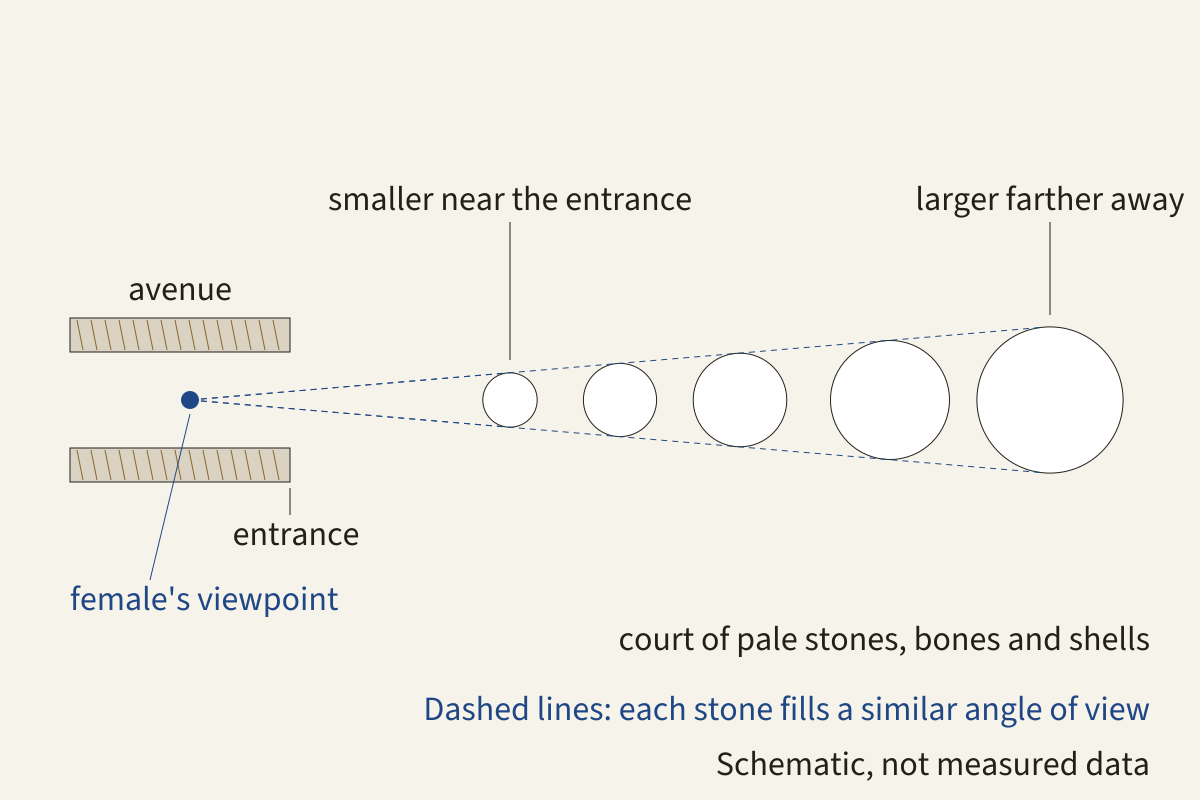
The court drawn from above. Pale objects get larger with distance from the avenue entrance, so that from the female's viewpoint inside the avenue each one fills a similar angle of view, shown by the dashed lines. Sizes are for illustration only.
Basis Layout and size order as described by Endler, Endler and Doerr (2010) and Kelley and Endler (2012); schematic, not measured data.
"How a great bowerbird's court is laid out" by Feathers, Skeletons & Nests, https://feathersskeletonsandnests.com/animal-builders/bowerbird/ , licensed under CC BY 4.0, https://creativecommons.org/licenses/by/4.0/
Do bowerbirds live in their bowers?
No. The bower is a display site, the place where females choose a mate, as Kelley and Endler describe it. They set it apart from structures such as nests, which benefit the female directly; in great bowerbirds, they write, males give their offspring nothing beyond their genes. A bower is built to be looked at, unlike a sociable weaver nest, which is built to live in.
What happens if the gradient is reversed?
Endler, Lorna Endler and Natalie Doerr tested how much the order mattered to the birds. They reversed the size gradient on males' courts, putting large objects near the entrance and small ones far away. Within 3 days the males had recovered their gradients, and after 2 weeks the courts differed little from the original, according to the abstract of their 2010 paper.
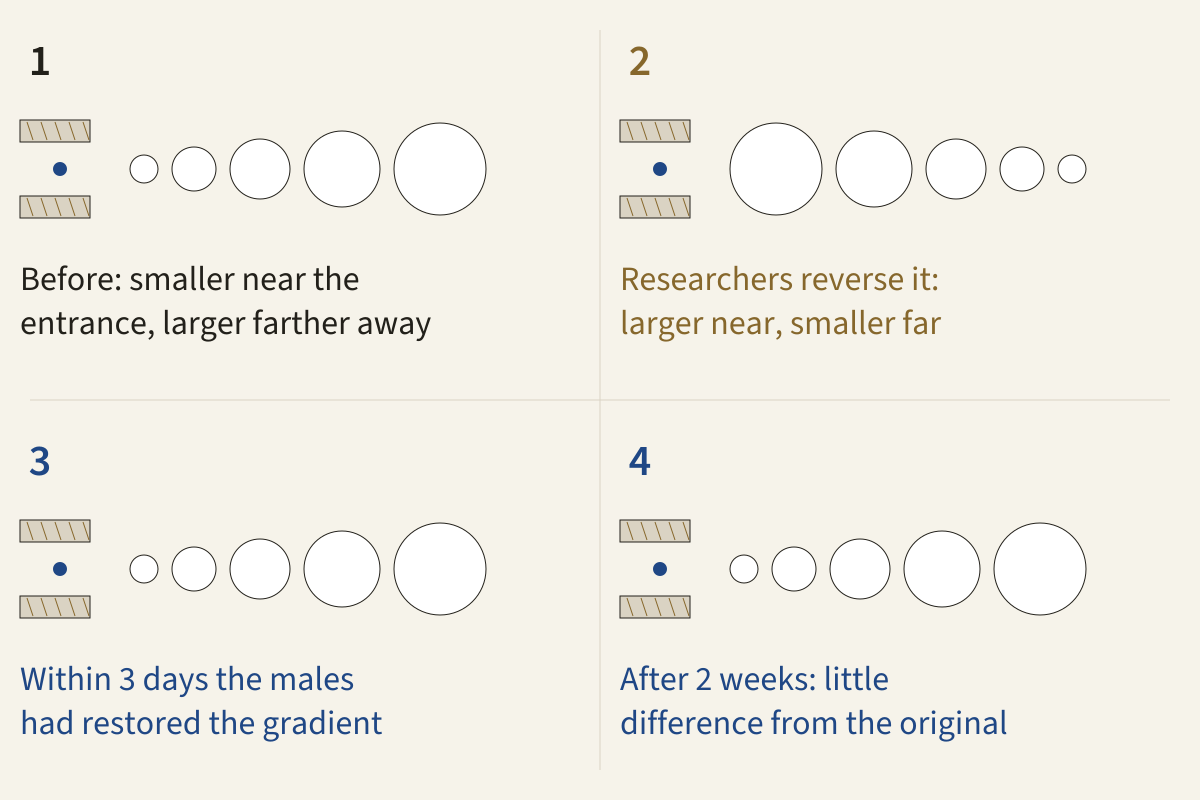
The reversal experiment in four steps: the original order, the order reversed, the gradient restored within 3 days, and a court little different from the original after 2 weeks. Object sizes are schematic.
Basis Steps and timings from the abstract of Endler, Endler and Doerr (2010); schematic, not to scale.
"The gradient reversal experiment, step by step" by Feathers, Skeletons & Nests, https://feathersskeletonsandnests.com/animal-builders/bowerbird/ , licensed under CC BY 4.0, https://creativecommons.org/licenses/by/4.0/
Kelley and Endler then tried the opposite in the 2010 breeding season at Dreghorn, in central Queensland, Australia. On 21 of 25 bowers they made the gradients better than the birds had, using only objects already on each court, and left 4 bowers alone as controls. All the males returned their courts to their original values within 3 days, and 10 and 90 days later the courts were still much the same.
Each male seemed to keep to his own level. Bowers differed in how good their gradients were, and those differences held through one breeding season and, for 17 bowers measured in both 2009 and 2010, from one year to the next. Theft by rival males, at less than one object a day, was far too slow to explain a 3-day change on courts of several hundred objects, the authors note.
| Experiment | What was changed | What the males did |
|---|---|---|
| 2009 season (Endler, Endler and Doerr 2010) | gradient reversed | restored it within 3 days; little difference after 2 weeks |
| 2010 season (Kelley and Endler 2012, PNAS) | gradient improved on 21 of 25 bowers | went back to their original values within 3 days; similar at 10 and 90 days |
Does the gradient help a male?
It may. In a 2012 study in Science, Kelley and Endler reported a significant link between a male's mating success and the gradient as the female sees it from the avenue; that view explained more of the variation in mating success than the strength of the gradient itself. Later that year Gerald Borgia and colleagues published a comment on the study in Science, and Kelley and Endler published a reply.
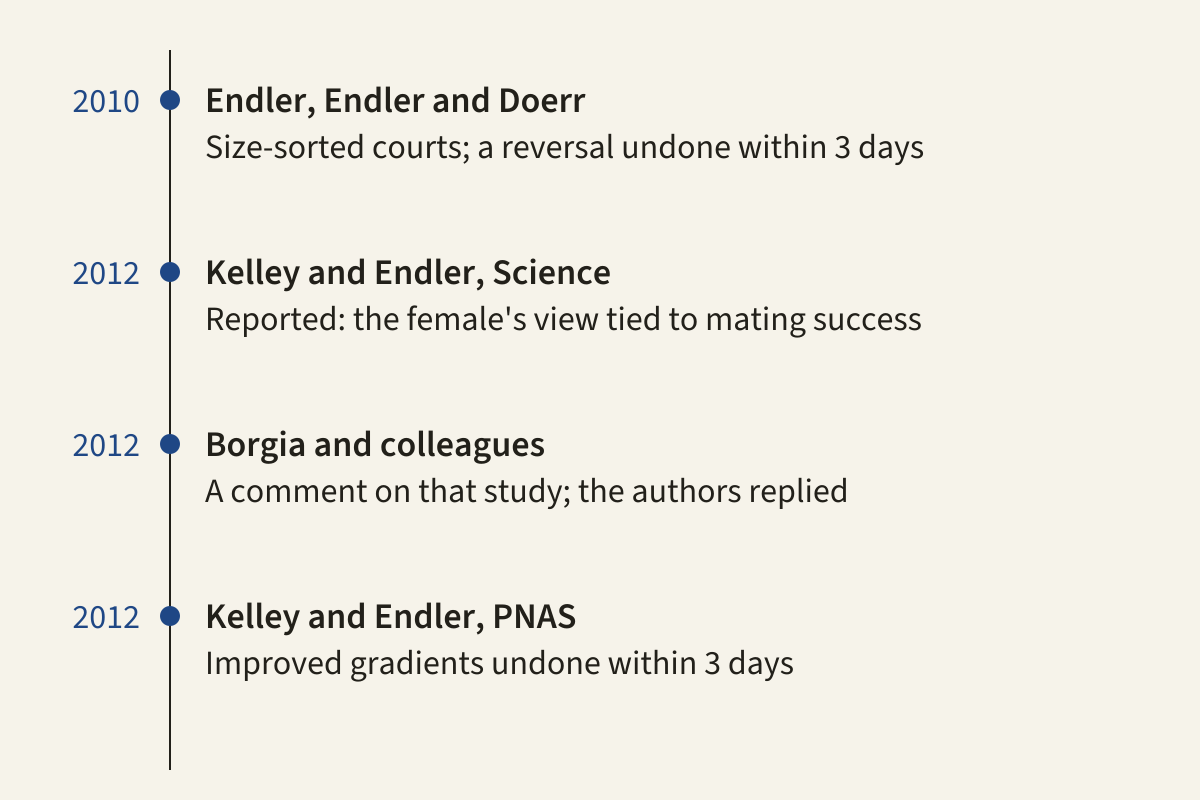
Four publications on great bowerbird courts in order: the reversal study, the Science study that reported a link to mating success, a comment on it by Borgia and colleagues, and the PNAS study in which improved gradients were undone.
Basis Abstracts of Endler, Endler and Doerr (2010) and Kelley and Endler (2012, Science), the full text of Kelley and Endler (2012, PNAS) and the bibliographic record of Borgia, Coyle and Keagy (2012).
"Three great bowerbird studies and one comment" by Feathers, Skeletons & Nests, https://feathersskeletonsandnests.com/animal-builders/bowerbird/ , licensed under CC BY 4.0, https://creativecommons.org/licenses/by/4.0/
| Study | Read for this page | What it reported |
|---|---|---|
| Endler, Endler and Doerr (2010) | abstract | courts sorted by size; reversed gradients recovered within 3 days |
| Kelley and Endler (2012, Science) | abstract | mating success related to the female's view of the gradient (reported) |
| Borgia, Coyle and Keagy (2012) | bibliographic record only | a comment on the 2012 Science study, with a reply from the authors |
| Kelley and Endler (2012, PNAS) | full text | improved gradients returned to each male's original level within 3 days |
Why the order would matter to a female is still open. Endler and colleagues suggested in 2010 that differences in forced perspective between males could be used in mate choice, perhaps as a sign of cognitive ability. Kelley and Endler later added that the even ground may make the coloured objects easier to see. If the differences between males turn out to be inherited, they noted, sexual selection could act on them even if the gradient says nothing about a male's abilities.
The court is best read as an evolved display behaviour rather than a work of art: males differ, keep to their own level and repair it fast. Other builders here solve other problems. A beaver dam reshapes a whole stream, and a termite mound has a shape that changes how air moves.
Same bones, elsewhere:
- Sociable weaver nest: a nest built to live in, not to show off.
- Bird wing bones: the wing bones under the display.
Sources
- John A. Endler, Lorna C. Endler and Natalie R. Doerr, "Great bowerbirds create theaters with forced perspective when seen by their audience", Current Biology 20, no. 18 (2010): 1679–1684. doi.org/10.1016/j.cub.2010.08.033Read: abstract only
- Laura A. Kelley and John A. Endler, "Illusions promote mating success in great bowerbirds", Science 335, no. 6066 (2012): 335–338. doi.org/10.1126/science.1212443Read: abstract only
- Laura A. Kelley and John A. Endler, "Male great bowerbirds create forced perspective illusions with consistently different individual quality", Proceedings of the National Academy of Sciences 109, no. 51 (2012): 20980–20985. pmc.ncbi.nlm.nih.gov/articles/PMC3529017/Read: full text
- Gerald Borgia, Brian J. Coyle and Jason Keagy, "Comment on 'Illusions promote mating success in great bowerbirds'", Science 337, no. 6092 (2012): 292; author reply 292. doi.org/10.1126/science.1220775Read: bibliography only
Cite this page
Feathers, Skeletons & Nests. “Great Bowerbird: Its Court Stones Are Sorted by Size.” first published 17 November 2026. https://feathersskeletonsandnests.com/animal-builders/bowerbird/ (accessed on the date you read it).
How facts are sourcedAll correctionsReport an error on this page (contact@feathersskeletonsandnests.com)
More from the Animal Builders drawer
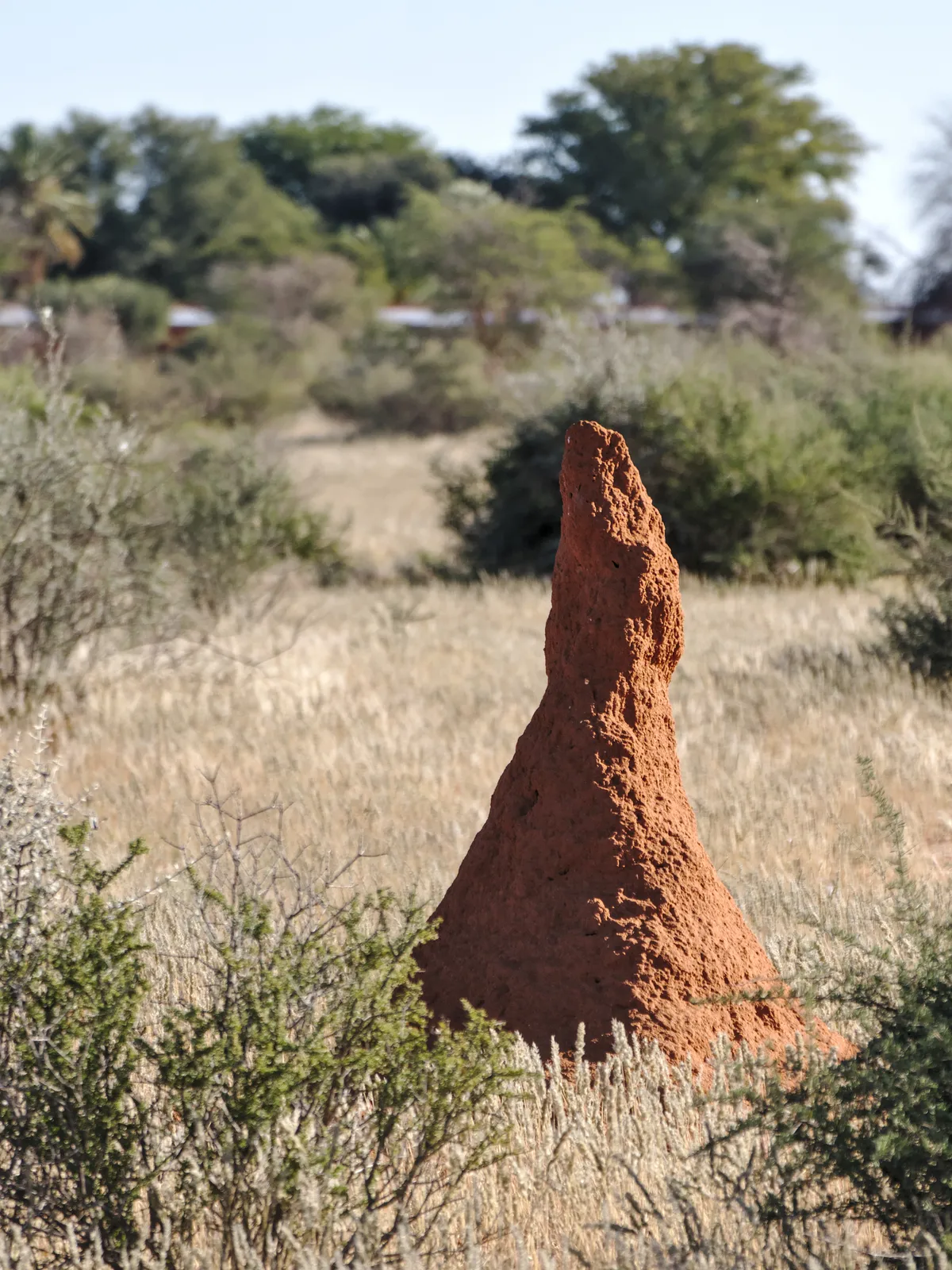
Termite Mound: In One Study, Day and Night Flip the Airflow
- Kind
- In-depth explainer
- Added
Picture credit
"Namibia Kalahari Desert Termite Mound" by Alexander Klink — https://commons.wikimedia.org/wiki/File:Namibia_Kalahari_Desert_Termite_Mound.jpg — CC BY 4.0 (https://creativecommons.org/licenses/by/4.0/)
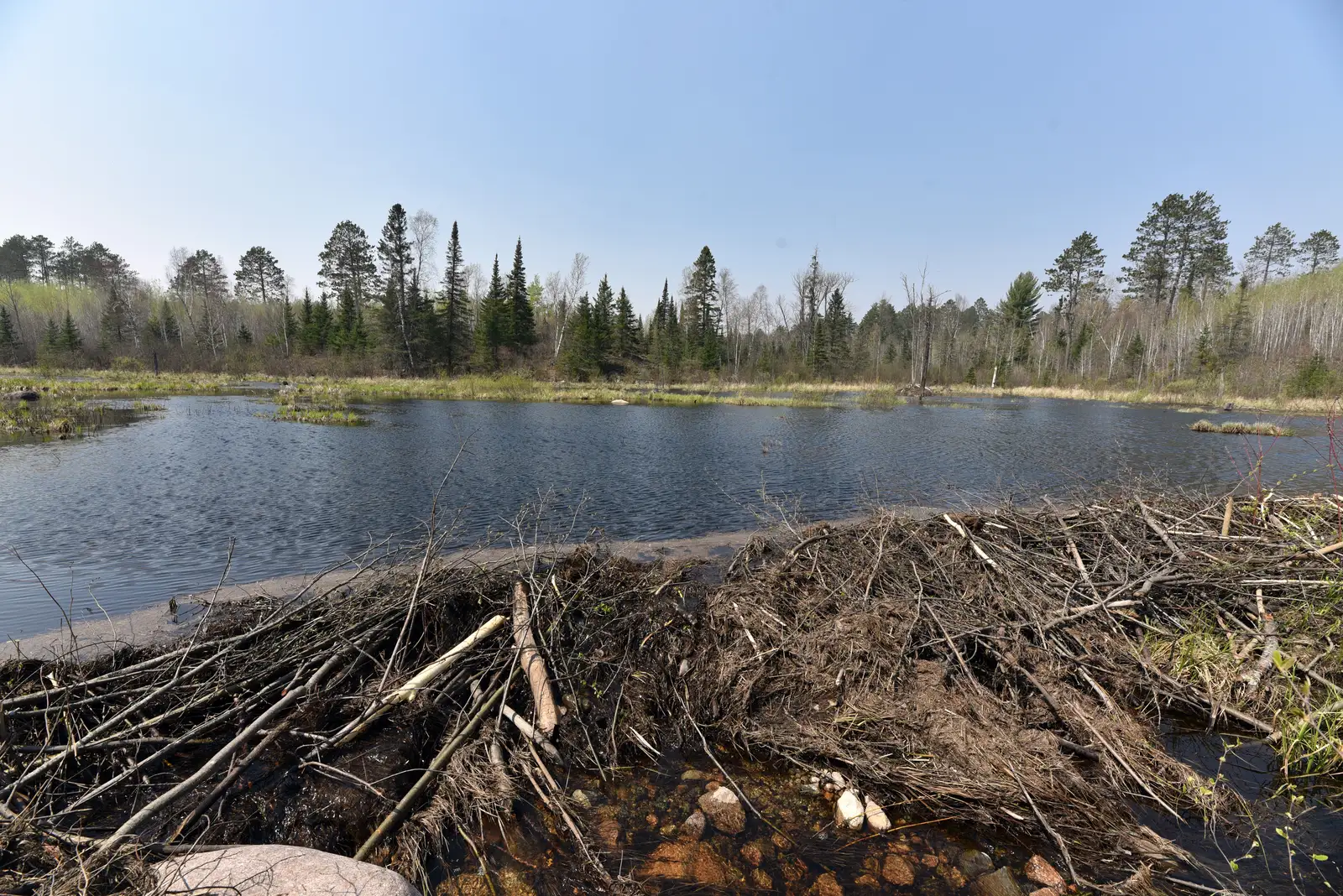
Beaver Dam: Is Running Water’s Sound the Cue to Build?
- Kind
- Specimen entry
- Added
Picture credit
"Beaver dam, St. Louis County, Minnesota" by Courtney Celley/USFWS — https://commons.wikimedia.org/wiki/File:Beaver_dam_(53718655489).jpg — Public domain (US: U.S. Government work (17 U.S.C. §105); USFWS photo by Courtney Celley; EU: no statutory public-domain basis, agency PDM marking); modified: resized: 3,000 x 2,003 px copy of the 6,016 x 4,016 original, no crop, no colour change; camera metadata not copied
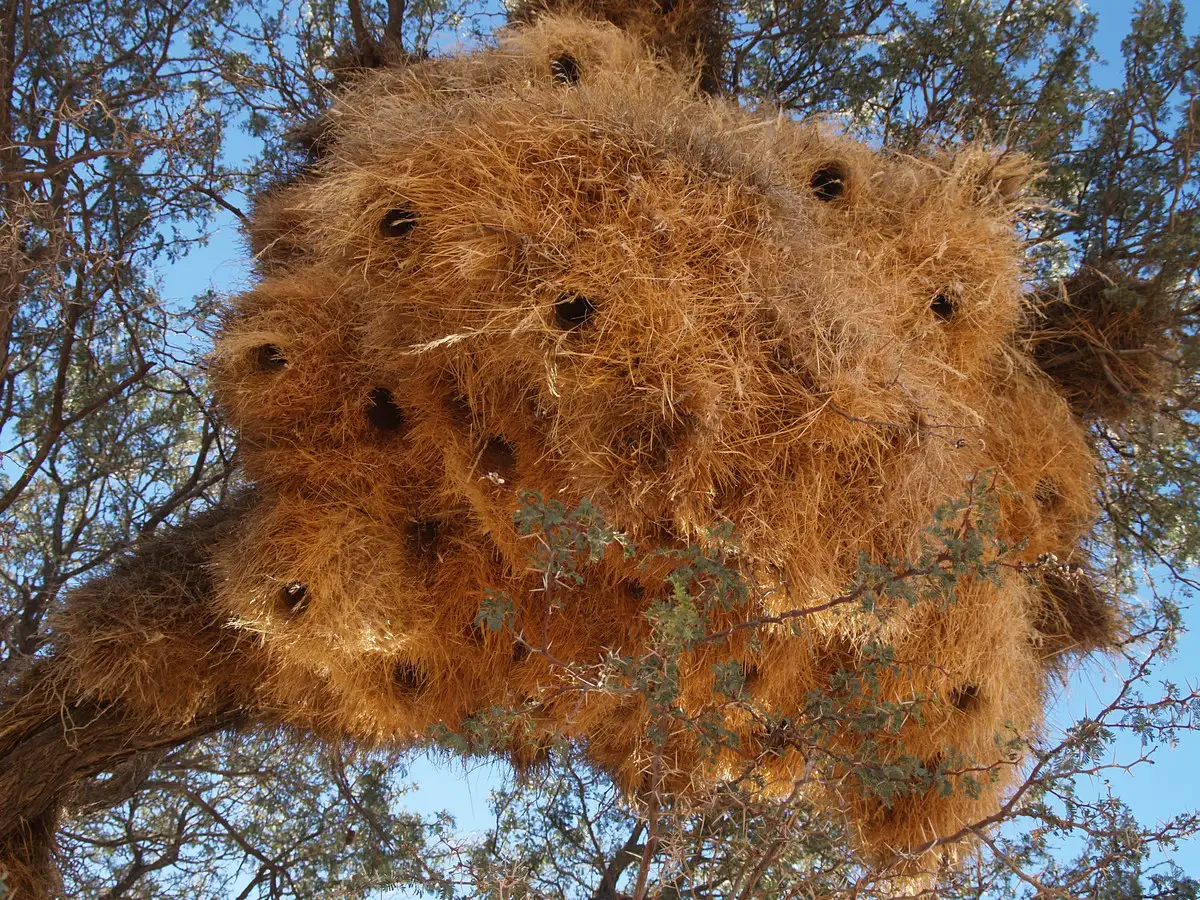
Sociable Weaver Nest Study: Chambers Warmer Than Night Air
- Kind
- Specimen entry
- Added
Picture credit
"Social weaver colony" by Rui Ornelas — https://commons.wikimedia.org/wiki/File:Social_weaver_colony.jpg — CC BY 2.0 (https://creativecommons.org/licenses/by/2.0/); modified: resized: 1,200 x 900 px copy of the 3,264 x 2,448 original, no crop, no colour change; camera metadata not copied