Sociable Weaver Nest Study: Chambers Warmer Than Night Air
Short answer
Measurements published in 2020 found that sociable weaver nest chambers stay warmer than the outside air on cold nights and cooler than it on hot days. On the coldest night of that study, at −3.1 °C, models predicted the chambers to be about 4 °C warmer than the air, and about 6 °C warmer near the middle of the nest.
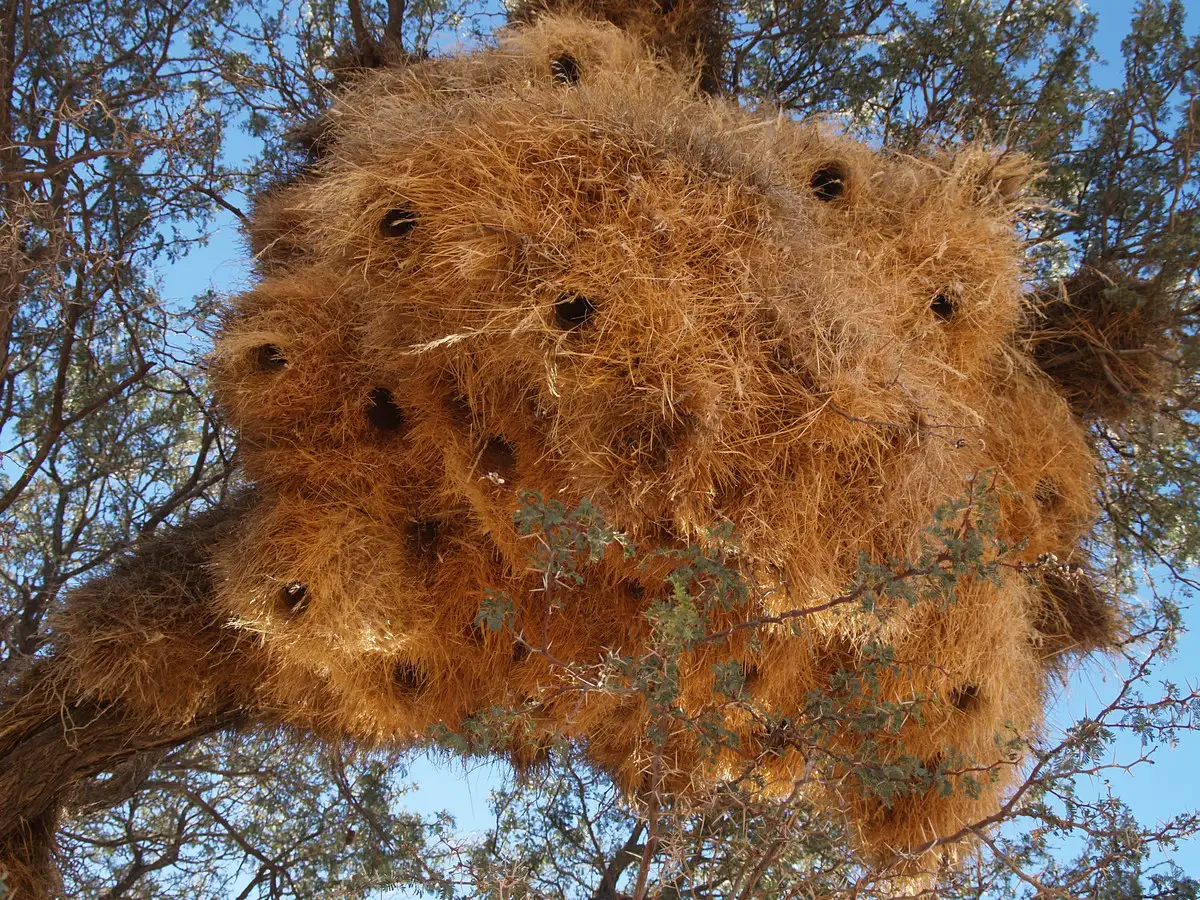
A sociable weaver colony photographed from below, through the branches of the tree that holds it. The dark openings are chamber entrances, which open on the underside of the nest.
"Social weaver colony" by Rui Ornelas — https://commons.wikimedia.org/wiki/File:Social_weaver_colony.jpg — CC BY 2.0 (https://creativecommons.org/licenses/by/2.0/); modified: resized: 1,200 x 900 px copy of the 3,264 x 2,448 original, no crop, no colour change; camera metadata not copied
On a frosty night, the chambers of a sociable weaver nest stay warmer than the open air. The nest is one shared mass of grass, built and kept in repair by small birds called sociable weavers, Philetairus socius, about 27 g each. The chambers are nests in the breeding season and roosts the rest of the year, so a 2020 study measured them in every season.
How many birds share one nest?
A single sociable weaver colony can hold between 2 and 250 chambers and hundreds of birds, according to a 1973 study by Maclean as cited by Anthony Lowney and colleagues in 2020. The birds build with Stipagrostis grasses. Because the birds keep repairing it, a colony can last for decades and house many generations.
Colonies vary a lot in size. At the 2020 study site, colonies averaged 50 chambers, with a range of 2 to 244, and hung an average of 2.45 metres (about 8 feet) above the ground. The 48 colonies used for the temperature study held 10 to 102 chambers each.
In cold weather the sharing goes further. When the weavers are not breeding and the air is cold, up to 8 birds may roost in one chamber. This raises the temperature inside even more, Lowney and colleagues write, citing a 2016 study.
Other birds move in too. The African pygmy falcon, Polihierax semitorquatus, about 60 g, breeds and roosts only inside weaver colonies in southern Africa. It also preys on the weavers and their chicks.
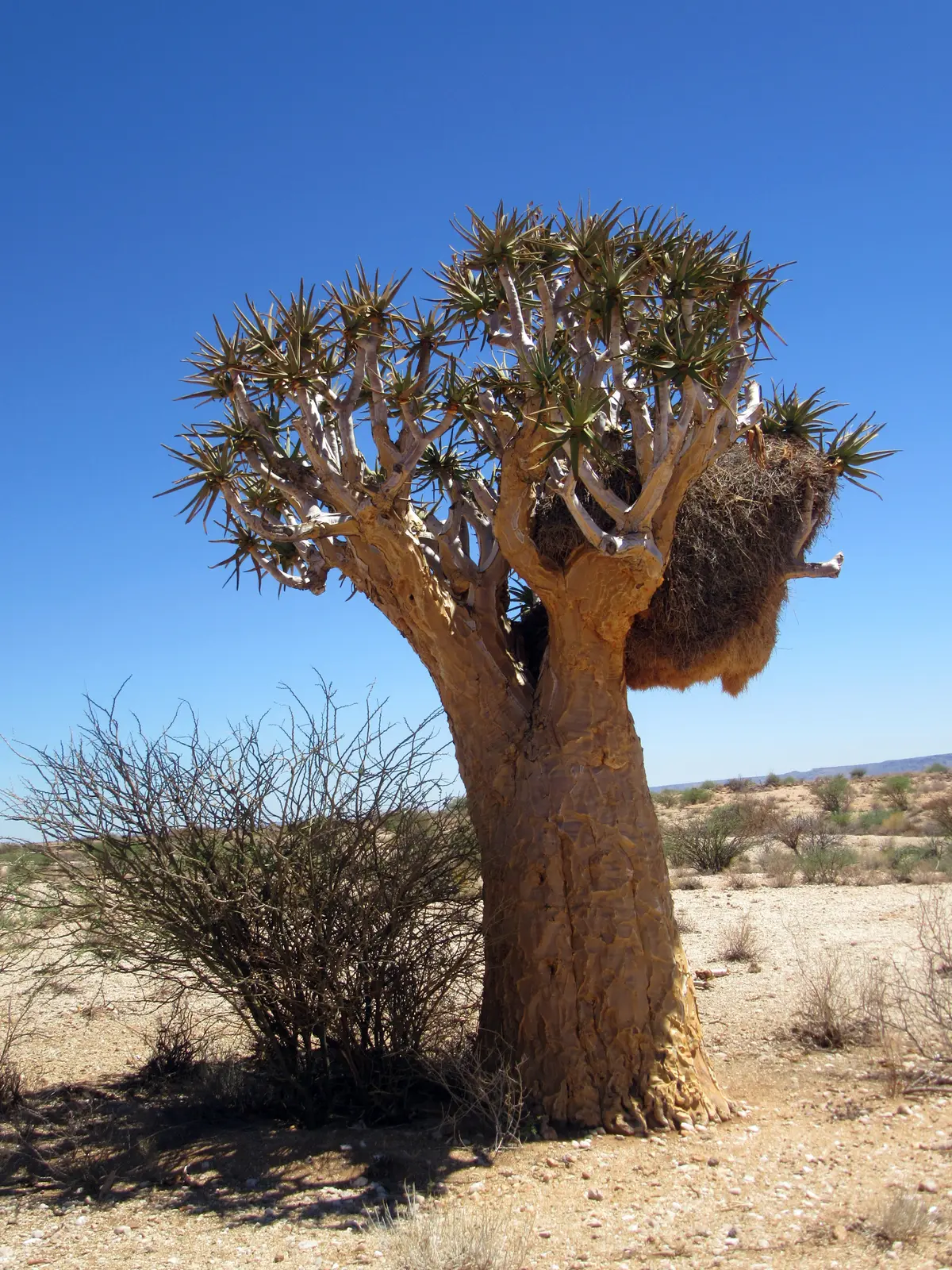
A sociable weaver nest lodged among the branches of a quiver tree in Augrabies Falls National Park, South Africa, as recorded on the photo's file page.
"Quiver tree with Social Weavers nest Augrabies Falls National Park South Africa" by amanderson2 — https://commons.wikimedia.org/wiki/File:Quiver_tree_with_Social_Weavers_nest_Augrabies_Falls_National_Park_South_Africa.jpg — CC BY 2.0 (https://creativecommons.org/licenses/by/2.0/)
How warm are the chambers on a cold night?
Across the year, the daily low inside the chambers was on average higher than the daily low outside. In the 2020 study, the measured gap averaged 2.3 °C in chambers at the edge of a colony, 3.2 °C in intermediate chambers and 3.1 °C in central ones.
At the coldest moment, the predicted gap was larger. The air fell to −3.1 °C (26.4 °F), the lowest reading of the study. For that air temperature, the study's statistical models predicted edge chambers to be 4.4 °C warmer than the air, and intermediate and central chambers 6.2 °C warmer. The chambers could still freeze: the lowest reading inside any chamber during the study was −2.1 °C, in an edge chamber.
A second model compared colonies by size. It predicted the largest colonies to be 3.8 °C warmer than the air and the smallest 4.0 °C warmer. These are model predictions fitted to a year of readings, not single thermometer readings. Each one carries an uncertainty of about ±0.4 to ±0.7 °C.
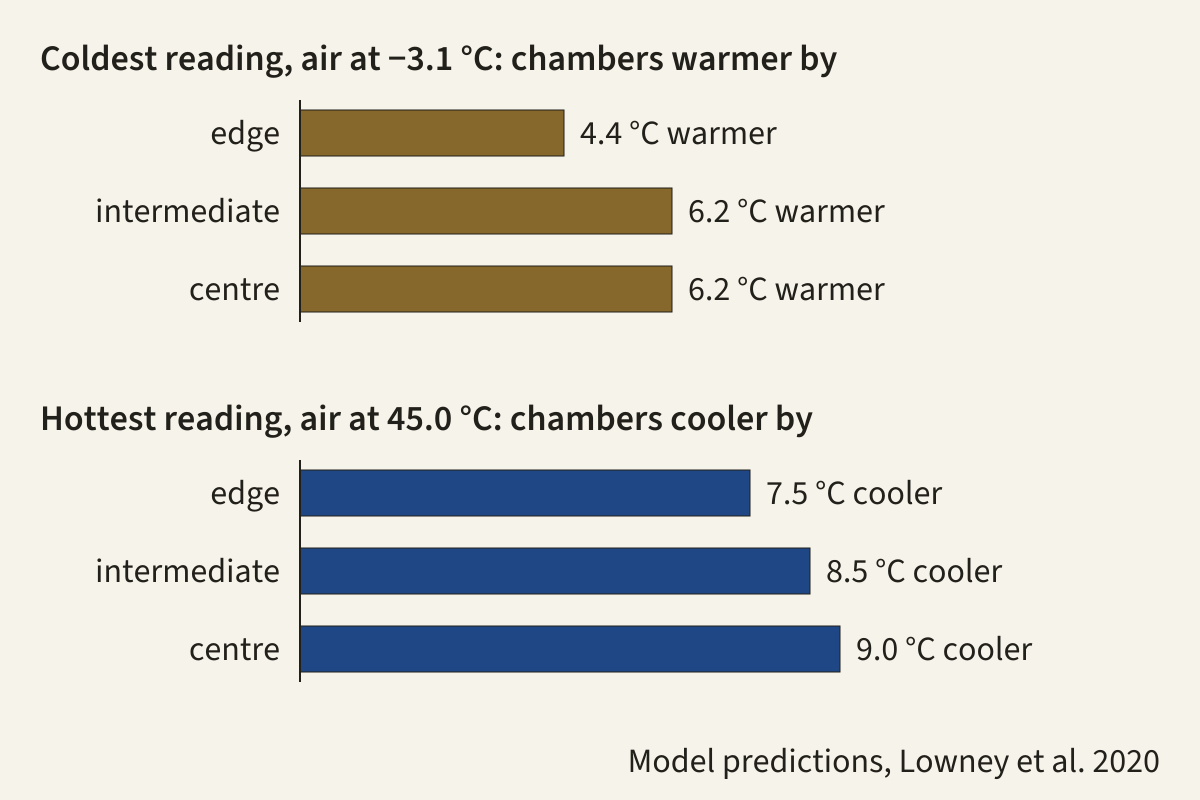
Predicted differences between the chambers and the outside air at the two extremes of the study year: amber bars for the coldest reading, blue bars for the hottest.
Basis Model predictions from Lowney et al. 2020 (CC BY 4.0); bar lengths drawn to scale from those values.
"Predicted chamber temperatures at the coldest and hottest readings" by Feathers, Skeletons & Nests, https://feathersskeletonsandnests.com/animal-builders/sociable-weaver-nest/ , licensed under CC BY 4.0, https://creativecommons.org/licenses/by/4.0/
Data: Lowney, Bolopo, Krochuk and Thomson, Frontiers in Ecology and Evolution 8 (2020): 570006, CC BY 4.0
| Condition | Chambers | Difference from the outside air | Kind of figure |
|---|---|---|---|
| Daily low, year-round | edge | 2.3 °C warmer | measured average |
| Daily low, year-round | intermediate | 3.2 °C warmer | measured average |
| Daily low, year-round | centre | 3.1 °C warmer | measured average |
| Daily high, year-round | edge | 2.8 °C cooler | measured average |
| Daily high, year-round | intermediate | 3.3 °C cooler | measured average |
| Daily high, year-round | centre | 3.7 °C cooler | measured average |
| Air at −3.1 °C (coldest reading) | edge | 4.4 °C warmer | model prediction |
| Air at −3.1 °C (coldest reading) | intermediate | 6.2 °C warmer | model prediction |
| Air at −3.1 °C (coldest reading) | centre | 6.2 °C warmer | model prediction |
| Air at −3.1 °C (coldest reading) | largest colonies | 3.8 °C warmer | model prediction |
| Air at −3.1 °C (coldest reading) | smallest colonies | 4.0 °C warmer | model prediction |
| Air at −3.1 °C (coldest reading) | deepest chambers | 6.9 °C warmer | model prediction |
| Air at −3.1 °C (coldest reading) | shallowest chambers | 4.0 °C warmer | model prediction |
| Air at 45.0 °C (hottest reading) | edge | 7.5 °C cooler | model prediction |
| Air at 45.0 °C (hottest reading) | intermediate | 8.5 °C cooler | model prediction |
| Air at 45.0 °C (hottest reading) | centre | 9.0 °C cooler | model prediction |
| Air at 45.0 °C (hottest reading) | deepest chambers | 10.0 °C cooler | model prediction |
| Air at 45.0 °C (hottest reading) | shallowest chambers | 6.5 °C cooler | model prediction |
| Night low of 30 °C (warmest night) | edge | 0.8 °C warmer | model prediction |
| Night low of 30 °C (warmest night) | intermediate | 1.3 °C warmer | model prediction |
| Night low of 30 °C (warmest night) | centre | 1.2 °C warmer | model prediction |
| Night low of 30 °C (warmest night) | largest colonies | 2.4 °C warmer | model prediction |
| Night low of 30 °C (warmest night) | smallest colonies | 0.3 °C warmer | model prediction |
Download the chamber temperature table (CSV) (what this file records) Data: Lowney, Bolopo, Krochuk and Thomson, Frontiers in Ecology and Evolution 8 (2020): 570006, CC BY 4.0
How were the temperatures measured?
Lowney and colleagues worked at Tswalu Kalahari, a reserve in the Northern Cape Province of South Africa. There, summer days can pass 40 °C and winter nights can drop below freezing. Between December 2015 and January 2017, they picked 48 colonies at random. They left temperature loggers in each colony for about 14 days, usually split between opposite seasons.
Each colony got four loggers. Three went inside chambers: one at the edge, one in the centre and one midway between. The fourth hung in the shade under a branch to record the outside air. All four took a reading every 5 minutes.
If eggs or chicks were seen in a chosen chamber, the logger went into the next chamber instead. Wire mesh over each logged chamber let air through but kept birds out.
Does the nest stay cool on hot days?
At the hottest part of the day, the same chambers were on average cooler than the air. The study found that this gap did not change with the season. On average, the daily high was 2.8 °C lower than outside in edge chambers, 3.3 °C lower in intermediate chambers and 3.7 °C lower in central ones.
The hottest reading of the study was 45.0 °C (113 °F). At that heat, the models predicted edge chambers to be 7.5 °C cooler than the air, intermediate chambers 8.5 °C cooler and central chambers 9.0 °C cooler. Citing earlier work, the 2020 paper notes that bird embryos die quickly if eggs reach 44 °C.
Do bigger nests keep warmer?
Not in the cold, according to the 2020 study. In their Discussion, the authors write that their results suggest that “as colony size increases, the insulation capability of the structure against low temperatures deteriorate”. At −3.1 °C, chambers in the largest colonies studied were predicted to be 3.8 °C warmer than the air, against 4.0 °C in the smallest.
That gap is only 0.2 °C, and each value carries an uncertainty of ±0.7 °C. The clearer difference comes on warm nights, when the order flips. With a night-time low of 30 °C, the largest colonies were predicted to be 2.4 °C warmer than the air and the smallest only 0.3 °C warmer.
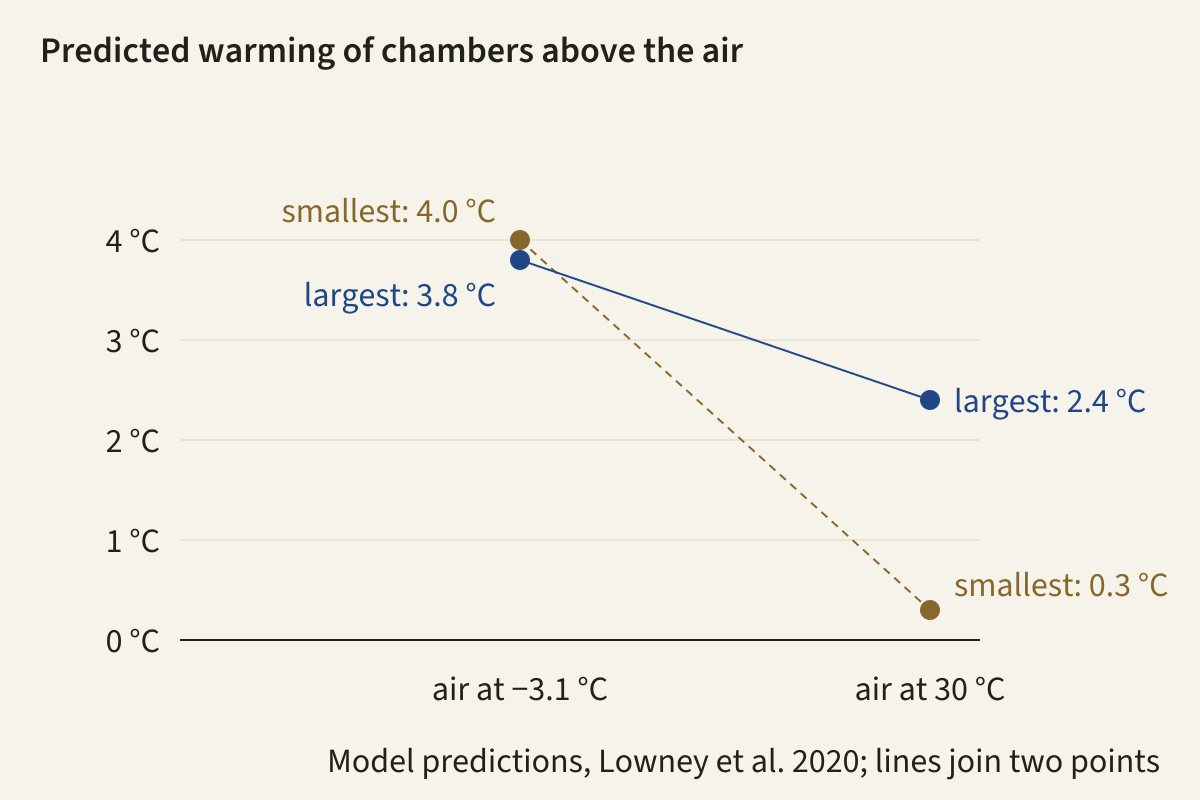
How much warmer than the outside air the chambers of the largest and smallest colonies were predicted to be, on the coldest night and on the warmest night of the study.
Basis Model predictions at the two ends of the recorded range from Lowney et al. 2020 (CC BY 4.0); straight lines only join the two points.
"Larger and smaller colonies on the coldest and warmest nights" by Feathers, Skeletons & Nests, https://feathersskeletonsandnests.com/animal-builders/sociable-weaver-nest/ , licensed under CC BY 4.0, https://creativecommons.org/licenses/by/4.0/
Data: Lowney, Bolopo, Krochuk and Thomson, Frontiers in Ecology and Evolution 8 (2020): 570006, CC BY 4.0
The 2020 paper reports larger colonies running warmer whenever the night-time low stayed above 18 °C. The authors write that they are unsure why larger colonies did worse in the cold. One idea they offer is that birds may leave outer chambers in cold weather to huddle in central ones. That could leave a large colony with more empty chambers at its edge, which might lose heat faster.
The authors conclude that the result suggests something other than insulation drives the selection for larger colonies. One example they give is safety in numbers. Roosting among hundreds of other birds may lower each bird’s risk from predators.
What is it like at a nest entrance?
Every chamber in a sociable weaver nest is entered from below, through its own entrance tunnel on the underside of the colony. Chambers sit at different depths in the nest, so the tunnels differ in length. A live colony is home to many birds, so one seen in the wild is best watched from a distance, without approaching the tree or pole that holds it or disturbing its chambers.
Chambers with longer tunnels were better insulated. In the 2020 models, the deepest chambers had tunnels 30 cm (about a foot) long. At −3.1 °C, they were predicted to be 6.9 °C warmer than the air, against 4.0 °C for the shallowest. At 45.0 °C, the deepest were predicted to be 10.0 °C cooler and the shallowest 6.5 °C cooler.
Pygmy falcons leave a thick white layer of droppings around the entrances of the chambers they use, for reasons that remain unknown. Lowney and colleagues found no significant temperature difference between falcon chambers and the weaver chambers next to them. Their samples were small, though: 7 colonies in summer and 5 in winter. Falcons tended to use chambers away from the centre, with shorter tunnels, perhaps because the larger birds find long tunnels harder to enter.
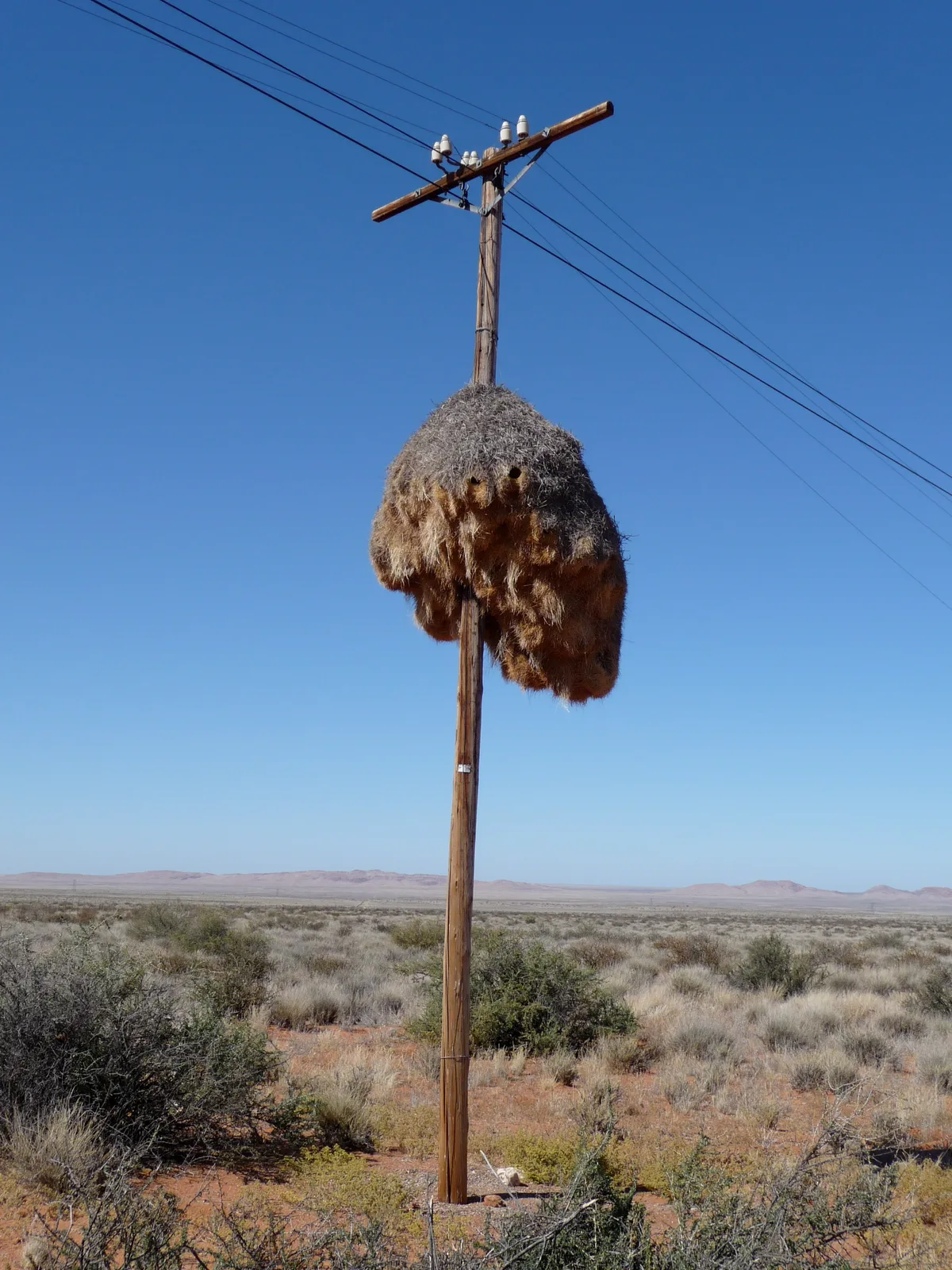
A sociable weaver nest built around a telephone pole in South Africa, photographed from the side rather than from below, where the chamber entrances open.
"Nest of the Sociable Weaver" by Octagon — https://commons.wikimedia.org/wiki/File:Nest_of_the_Sociable_Weaver.jpg — CC BY 3.0 (https://creativecommons.org/licenses/by/3.0/)
Lowney and colleagues read the colonies as a nest structure that appears to have evolved to shelter its users from heat and cold. Not every animal structure is a shelter. A bowerbird’s bower is built for courtship display, not for living in. A beaver dam is built with sticks in running water.
Same bones, elsewhere:
- Termite mound: another built structure whose inside air was measured through day and night.
- Bird wing bones: the wing bones of the birds that do the building.
Sources
- Anthony M. Lowney, Diana Bolopo, Billi A. Krochuk and Robert L. Thomson, "The Large Communal Nests of Sociable Weavers Provide Year-Round Insulated Refuge for Weavers and Pygmy Falcons", Frontiers in Ecology and Evolution 8 (2020): 570006. doi.org/10.3389/fevo.2020.570006Read: full textText licence: CC BY 4.0 (terms)
Cite this page
Feathers, Skeletons & Nests. “Sociable Weaver Nest Study: Chambers Warmer Than Night Air.” first published 17 November 2026. https://feathersskeletonsandnests.com/animal-builders/sociable-weaver-nest/ (accessed on the date you read it).
How facts are sourcedAll correctionsReport an error on this page (contact@feathersskeletonsandnests.com)
More from the Animal Builders drawer
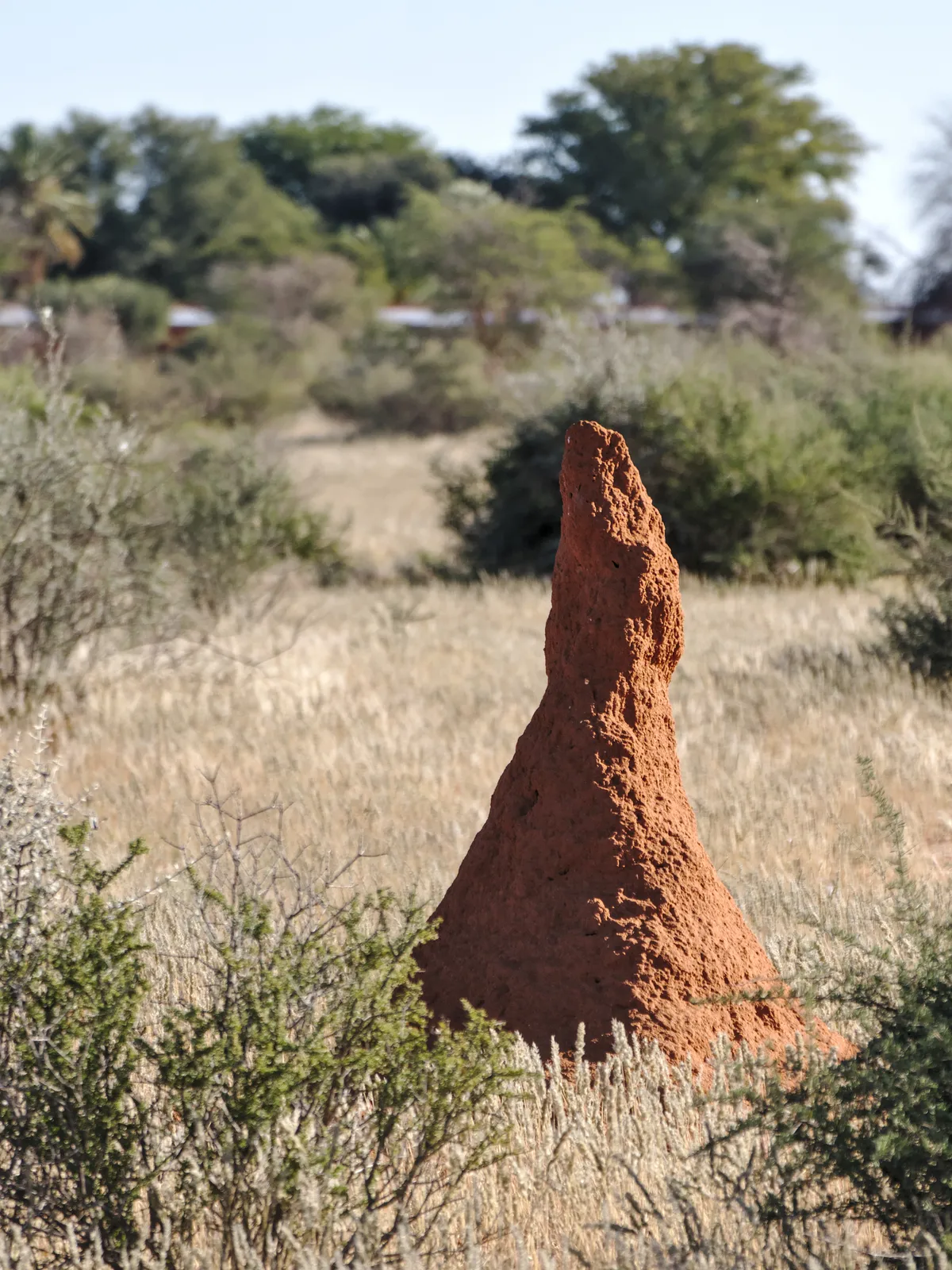
Termite Mound: In One Study, Day and Night Flip the Airflow
- Kind
- In-depth explainer
- Added
Picture credit
"Namibia Kalahari Desert Termite Mound" by Alexander Klink — https://commons.wikimedia.org/wiki/File:Namibia_Kalahari_Desert_Termite_Mound.jpg — CC BY 4.0 (https://creativecommons.org/licenses/by/4.0/)
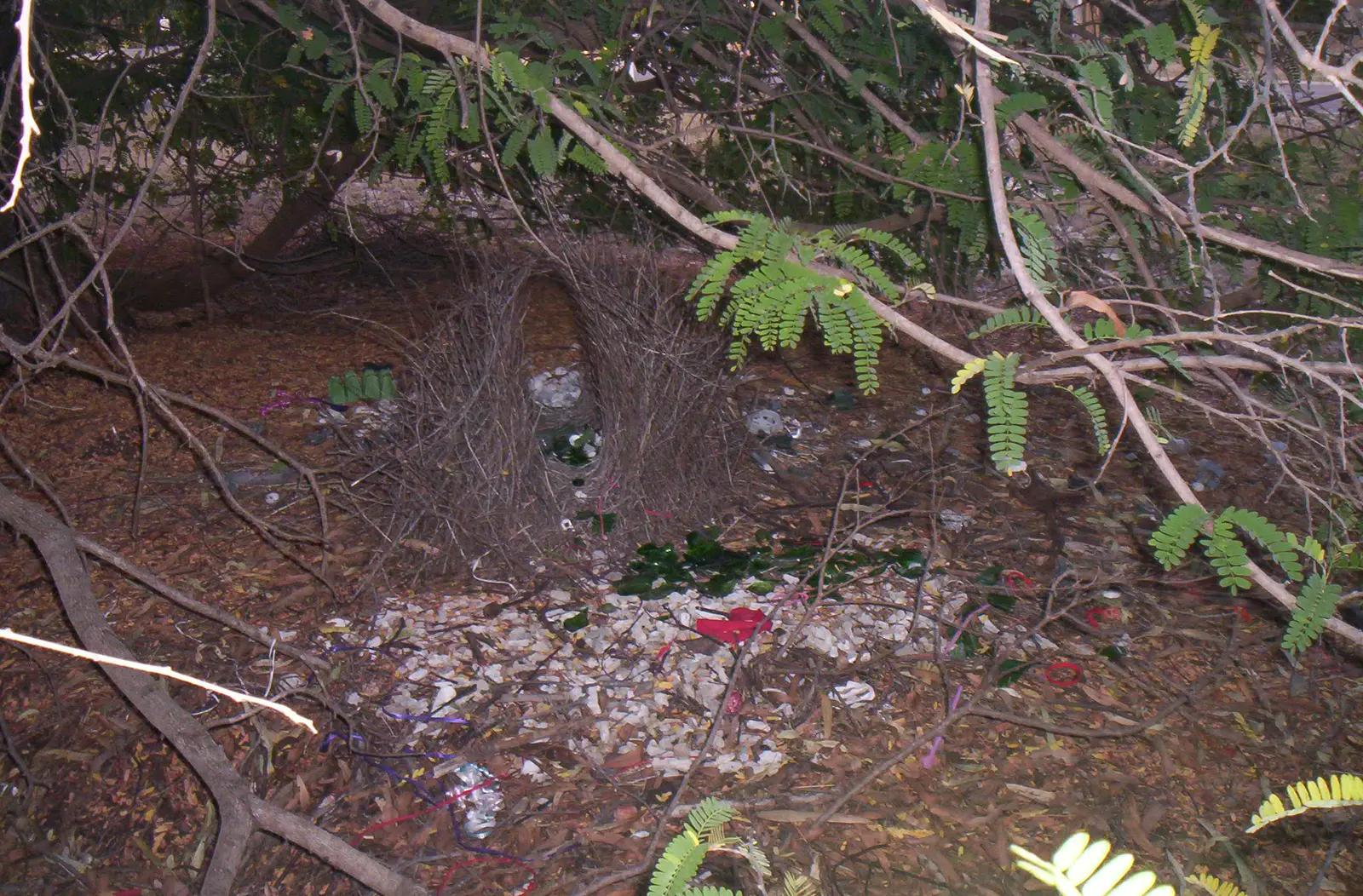
Great Bowerbird: Its Court Stones Are Sorted by Size
- Kind
- Specimen entry
- Added
Picture credit
"Great bowerbird bower, Horseshoe Bay, Bowen" by John Robert McPherson — https://commons.wikimedia.org/wiki/File:Great_bowerbird_bower,_Horseshoe_Bay,_Bowen_101_0183.jpg — CC0 1.0 (https://creativecommons.org/publicdomain/zero/1.0/)
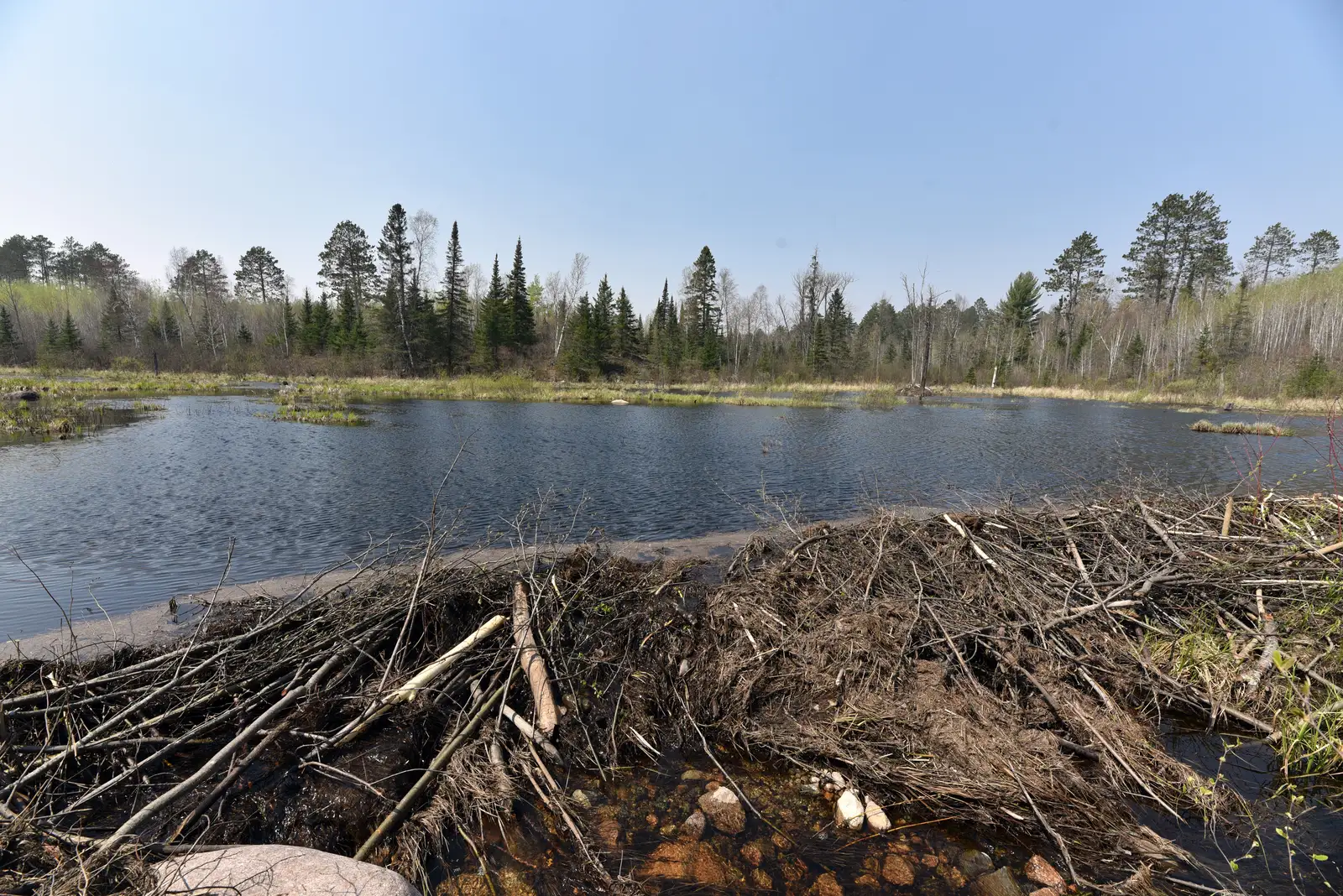
Beaver Dam: Is Running Water’s Sound the Cue to Build?
- Kind
- Specimen entry
- Added
Picture credit
"Beaver dam, St. Louis County, Minnesota" by Courtney Celley/USFWS — https://commons.wikimedia.org/wiki/File:Beaver_dam_(53718655489).jpg — Public domain (US: U.S. Government work (17 U.S.C. §105); USFWS photo by Courtney Celley; EU: no statutory public-domain basis, agency PDM marking); modified: resized: 3,000 x 2,003 px copy of the 6,016 x 4,016 original, no crop, no colour change; camera metadata not copied